

🎯 Three-Shot Burst
Silicon Valley Defense Group (SVDG) released its annual NatSec100, an annual pulse check on the overall health of the emerging defence technology ecosystem in the US.
The top 100 received $4.3B in US federal obligations in FY25 (+22% YoY); $16B lifetime (+36%). 38 new entrants made this year’s list.
Tectonic reports that SVDG teamed up with J.P. Morgan this year, with a big focus not only on helping Silicon Valley connect with defence, but also on helping institutional capital better understand how to deploy later-stage capital into these defence tech companies.
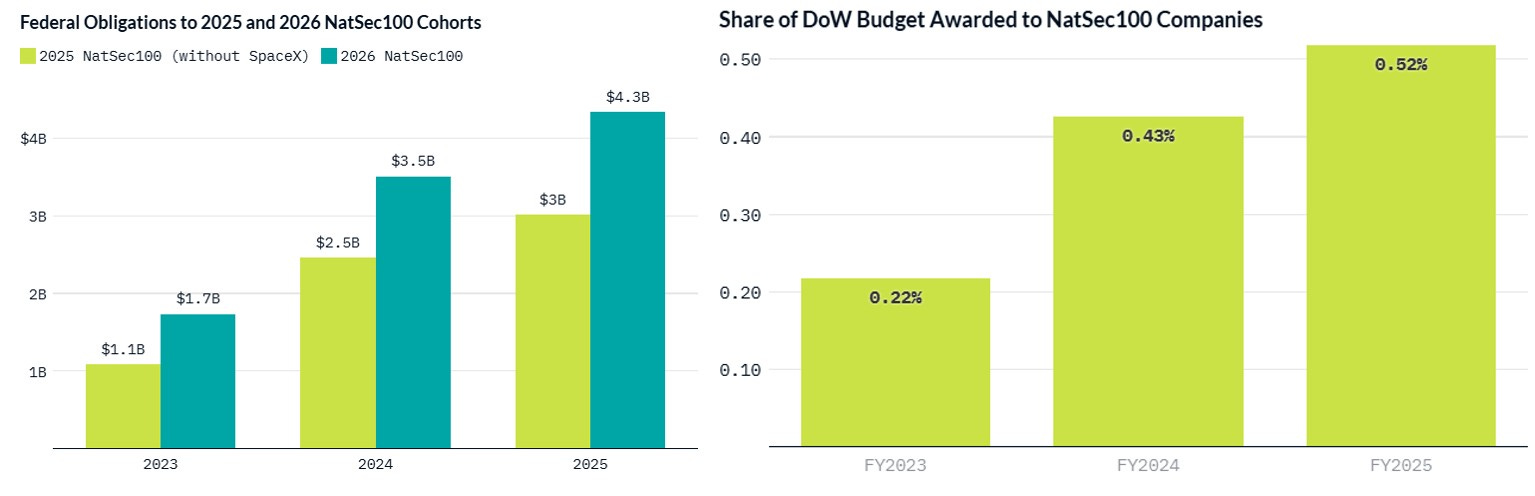
Pete Modigliani at Defense Tech and Acquisition writes that this year’s report captured six shifts in the defence tech landscape:
Washington Rewired the Rules. Executive orders, the Acquisition Transformation Strategy, DRPMs, OSC, EDU, Reconciliation, and the Innovation Adoption Kit.
The Battlefield Imperative. Lessons from Ukraine and Iran resulted in increase in AI and autonomy experimentation to central DoW modernization priority and reshaped capital flows, procurement priorities, and operational doctrine.
Production as the Bottleneck. Drones, counter-drone systems, munitions, advanced manufacturing, and shipbuilding are all facing the same constraint: production capacity has not kept pace with demand signals or private investment.
The Capital Stack is Being Rebuilt. OSC, EDU, equity stakes, DPA-backed financing, leasing arrangements, and large IDIQs represent a new theory of how public and private capital should work together in national security.
The Primes Are Adapting. Corporate venture capital funds are expanding significantly. Prime CapEx investment is up roughly 35% for 2026. Compensation ceiling tensions, subcontracting relationships, and M&A activity are all shifting.
The Exit Landscape is Maturing. Approximately 20 companies have graduated from the NatSec100 through acquisition or public offering since 2023. These exits represent the clearest evidence yet that defence tech is producing real liquidity events and that the asset class is becoming durable.
Related:
US defence startups at 1.3% of Pentagon obligations (up from 0.6%), still stuck moving from production to programming of record
ADVERTISEMENT

Barrack Hill: Navigating Canada’s defence and procurement landscape with precision.
🤝 Deal Corner
Canadian drones will head to Ukrainian battlefield under production deal
Drones made in Canada could be headed for the battlefield in Ukraine, thanks to a new corporate partnership between Canadian and Ukrainian drone makers.
National Defence says the drones will be made by the Ukrainian company Airlogix and Canadian drone maker Sentinel R&D, which is based out of Hamilton, Ont.
Also last week: Defence tech founders are frustrated with Canada’s approach to “dual-use” [N.B. This Toronto Tech Week event was co-hosted by The Icebreaker]
Eliot Pence: Canada’s defence buying timelines are “irrelevant” for modern warfare
Defence companies call on government, investors for more support
Why Canada’s defence tech needs to rewrite the operating model
At CANSEC, the PM announced a series of new supports, including new ITB rules, and a defence concierge service that will be available to SMEs
Ottawa is also designating domestic defence champions — a Strategic Partnership Framework that lets the government bypass traditional procurement
Ottawa has pledged to boost military spending. Canada’s defence companies want to know what it will buy — and when

Related:
Lastwall raises $16 million to defend critical infrastructure in cyberspace
Canada + Poland lock in drone deal via EU SAFE funds
PitchBook analysts identify PE and VC winners and losers across industrials amid Iran war
Defence tech VC hits record quarter as combat, procurement, and AI signals converge
BCI public comps for the month include defence (thanks Christian Grunt!)
Q&A: Erin O’Toole says Canada needs to play catch-up on defence innovation
Canadian defence supply chain: There are 2,880 organizations holding Controlled Goods Program registration in Canada, and 2,458 of them have no observed prime contract
This Founder Left Washington To Defend Canada’s Arctic
How Aurmada threads the needle of fashion and defence tech


SpaceX wins $4.16 billion US Space Force contract for threat-detection satellites
The Growing Canadian Defence Tech Bubble is Real, and It’s Going to Hurt
Telesat and Canadian Strategic Missions Corporation announce strategic collaboration agreement to ensure Canada’s sovereign energy future
Defence start-ups face a financing wall
The US ports and bases that would actually keep a mass of autonomous systems in the fight are treated as background infrastructure:

Accelerating Canada’s Quantum Capabilities for Defence Will Unlock Broader Economic Opportunities
Special Guest POV by Gordon Harling, President and CEO, CMC Microsystems

The Defence Industrial Strategy (DIS) underscores how critical Canada’s quantum industry is to national defence readiness, sovereign capability, cyber resilience, and allied interoperability.
After decades of early investment and visionary research, Canada has established itself as a global leader in quantum technologies. Quantum follows semiconductors as critical infrastructure across many applications beyond defence including vaccine discovery, materials research, and crop management.
Canada’s quantum strategy, as it relates to defence, is about more than just owning quantum computers; it is about retaining critical IP, manufacturing expertise, and research and development capability in Canada as quantum technology heads toward commercial viability. The government’s focus on bolstering sovereignty includes making Canada less dependent on foreign firms for sensitive technologies like quantum.
Recent defence spending and broader government investments are being used to accelerate innovation ecosystems, scale domestic quantum companies, speed commercialization, and support adoption of quantum technologies by the Canadian Armed Forces – and industry at large.
Canada punches above its weight in quantum technologies, whether it’s computing, sensors, or communications. All have been identified as key dual-use capabilities that can contribute to national defence ambitions and map directly onto current Canadian military requirements, and all three have been identified by Canada’s National Quantum Strategy (NQS) as key priorities.
The FABrIC program, managed by CMC Microsystems, is building domestic capacity in advanced technologies such as compound semiconductors, photonics, integrated sensors, and superconductors which are all critical for the fabrication of domestic quantum computers. FABrIC enables the creation of custom components from Canadian factories in support of many advanced technologies, including quantum. FABrIC also provides high-quality training for the designers of the future who will create trusted electronic components, components for secure communications, and advanced sensors.
Canada’s quantum industry is critical to helping the country defend its networks, field advanced military systems, and preserve technological sovereignty in a world where quantum advantage may shape both conflict and competitiveness.
Article continues here. [French translation available].
⚔️ Combat Readiness
Airbus picks Mistral AI as its sovereign defence AI partner
Airbus signed a full partnership agreement with Mistral AI, the Paris-based large language model company, to deploy AI across its commercial aircraft, helicopter, defence, and space divisions. The deal gives Airbus the ability to run models on-premises.
The Defense Post writes that on-premises AI deployment means running model inference on hardware physically inside a secure facility, air-gapped from external networks. The challenge beyond security is compute: large language models require substantial GPU infrastructure to run at useful latency. Mistral’s models are generally smaller and more efficient than US frontier models, making them better suited for on-prem deployment in resource-constrained environments.

Related:
Christian Leuprecht described current investments as barely getting Canada “out of the starting blocks” on a 100-metre run to sovereign defence. Canada still hasn’t finalized a comprehensive list of military needs, and may not be buying the best kit
Why Swindon is emerging as a centre for Britain’s drone industry
This Sam Altman- And Peter Thiel-Backed Aviation Company Achieves Supersonic Flight
Canadian bacon: Once overlooked, Davie now occupies a critical nexus between three allies that have pledged to shore up their icebreaking capabilities… Canada picks Swedish early-warning aircraft tech over U.S. bidders - was it a good idea… After the GlobalEye program, the Carney government is eyeing Gripen fighter jets… Ontario Unveils Framework for Defence Industrial Strategy
Canadian Victoria Cross — independent military honours review board for Afghan cases established
Thought leadership: It’s time to rethink Canada’s space agency through a national security and innovation lens… Non-Arctic State Policies and Strategies Alignments with Canada… A Third Option for Canadian defence SMEs after the Permanent Joint Board on Defence Pause… Sovereign capabilities are not built on spending alone. They are built on the architecture that enables partnerships… Canada calls for NATO strategy to secure Arctic as northern flank of military alliance
Easier to start, harder to win — the dangerous delusion of modern war
Drone wars: Seven Companies Advance to the US Navy’s MUSV Prototype Phase… Drone on drone intercept [VIDEO]… AUKUS to develop unmanned undersea vehicles, delivery set for 2027… President Trump says that the new ballroom will have a “Drone Port”

Iran roundup: The US won’t replenish its Tomahawk inventory until late 2030 — 1,000+ were fired in the Iran war; fewer than 200 are produced per year… The next hot defence category is cheaper and smarter missiles — a list of startups building them… DoD reverted to spreadsheets and phone calls during Operation Epic Fury to track munitions… During the Iran war, the US relied on Canada’s embassy in Abu Dhabi to distribute passports to ~1,000 Americans after US embassies closed
Arctic shelf: Polar regions are critical to space access: China leased antennas in Kiruna, Sweden (not being renewed) and is building its 6th Antarctic station
From the Ukrainian front: Ukraine is turning the tables, using AI drones to strike vital convoys supplying Russian troops… US Military Is Built for the Wrong Century… Russian EW capabilities… How China is secretly arming Russia’s drone arsenal
🔫 Hot Shots
AI war: A Helsing wargame found that 12,000 HX-2 AI-enabled strike drones could collapse a Russian three-front Baltic invasion (targeting Lithuania) within days — Russia would lose 1/3 of attacking troops in 10 days. The HX-2 runs at 60–80% accuracy in Ukraine. Semi-autonomous swarms: 1 pilot to 10+ drones… Anthropic’s Claude has been integrated into Palantir’s Maven Smart System and was used in US strikes on Iran… McKinsey survey: 600+ AI efforts across DoD. Most leaders are not yet seeing scaled impact… A Quiet Navy Shipbuilding Move Just Put Palantir’s Software Deeper Into the Yard
Grey war: China now controls 50.7% of global shipbuilding output — up from 35.9% nine years ago, backed by ~$132B in state support. The US holds 0.1%. A projected 200,000–250,000 worker shortfall over the next decade. The maintenance backlog is now 26 years deep… UK GCHQ Director Anne Keast-Butler: “China is now a science and tech superpower… the ground beneath our feet is shifting.” The West is “running out of time” to maintain its technological edge… Chinese forces used electronic warfare to drive off Dutch frigate HNLMS De Ruyter near the Paracel Islands during the Pacific Archer mission… MIGS Institute: Beijing’s United Front Work Department is conducting foreign interference across all G7 nations. Canada is explicitly named… Finland - ‘Cellular also impacted by interference’… What is a forward-deployed engineer?
Odds & ends: The Swedish deal, the defence bank and the West’s awakening from its long dream… Germany is pledging 4 Type 212-CD submarines by 2036, with both Germany and Norway each yielding one vessel from existing orders to prioritize Canada… Algoma Steel would supply material for the possible manufacturing of land defence vehicles in Canada… Convergence Design Services (Arnprior) and 13 Canadian partners built an all-Canadian electric military vehicle — autonomous and manned variants — in 4 months for a seven-figure prototype cost… Fulfilling The Promise of Canada: Charting a National Strategy for an Unstable World… AERALIS: Innovation, Hype, or the Reality of Defence Procurement?
Canada is the only G7 country without a geodetic station… Warfighting and War Winning in Space… Blue Origin’s New Glenn failure is a reminder of how unforgiving spaceflight remains
The AI supply crunch is here
There is no country that can fully design and manufacture a chip independently
How the AI age is replaying history’s oldest power game — and why the dollar is still the answer:


If you’ve got battlefield intel, classified tips, or just want to call in an airstrike on our typos, hit “reply” and sound off. Whether it’s a new tech sighting, a rumour from the mess hall, or feedback on our comms, we want your SITREP.
Thank you for this defence roundup and I appreciate the applicable links to related matters.