

🎯 Three-Shot Burst
Special guest post by Matt Clancey, VP Maritime Programs at Dominion Dynamics & CAF veteran
We don’t need to be bad at procurement, and this RFP proves it.
Bottom Line Up Front: Canada (DRDC/BOREALIS working with the RCN) has issued and closed a first-of-its-kind developmental RFP for a net new operational capability. If DND keeps contracting in this way, we’ll see an order of magnitude increase in Canadian technology in the hands of CAF members.
The problem: The RCN does not currently have a mine hunting capability. The Fleet Diving Units are responsible for disposing of sea mines once located, but do not have a vessel, crewed or otherwise, equipped with the sonar to find them (notwithstanding the REMUS vehicles that are limited as a standalone platform). Mine Countermeasures has come to obvious relevance from lessons in the black sea, and especially in the Straight of Hormuz.
The status quo: Normally in the Options Analysis phase of a procurement like this, the RCN would have noted that there were no Canadian companies making 12m class USVs, then scanned what our allies were doing, seen that France, Netherlands, and the UK had all procured platforms that fit the need. They then likely would have pursued a Foreign Military Sale as the fastest and easiest procurement. Alternatively, they may have issued an RFI followed by an RFP that stipulated multiple years of experience building USVs for MCM that functionally locked any Canadian solutions out. But that’s not what they did in this case.
Enter W8472-275993: 258 pages of procurement bliss intended to be “…an iterative and incremental approach to meet Canada’s unique operational requirements.” Here’s why it’s remarkable:
The procurement is developmental, but it isn’t innovation theatre, this is a real capability: Minimum Viable Prototype due in 9 months, full solution in 21, requirement to codevelop with DRDC / RCN and implement feedback during the development process, and initial contract for 1 unit with options for 3 additional.
Scoring hugely favours Canadian content (out of 100 pts): 25 for Canadian Value-Added (cost based), 12 for Canadian Sovereign Capability Considerations, 21 for Team Assessment (most of which requires experience in Canada). Plus, only 10 points are price which makes the math prefer a more expensive more Canadian option than a cheaper foreign equivalent.
Incentivized early delivery (12 / 100 scoring points).
Zero requirement to have built a USV of this type before, but rather in the Team Assessment the bidder must show that their team has the requisite skill to make it happen.
The tender originally ran from 10 September to 1 October, and then was extended to 8 October. A 4-week RFP response period favours leaner, faster moving, AI enabled organizations (i.e. startups and SMEs).
There’s even more to it but those 5 points make the case. Could it still be better? Of course. The RFP is very heavily defined, leaving little room for novel capabilities, the fixed firm price bid is challenging to estimate with such a short turn around, there’s no requirement for the IP to be Canadian, etc. Those weaknesses are real, but they do not outweigh what this procurement gets right.
Industry has been asking DND to give us a chance to show that we can build great things, and in W8472-275993 DND has delivered. Now each party has a role to play: DND needs to keep using this as a template, and industry has to follow through and deliver (on time and without litigation).
ADVERTISEMENT

Barrack Hill: Navigating Canada’s defence and procurement landscape with precision.
🤝 Deal Corner
🍁 North Vector Dynamics raises $29M to build interceptors by the thousand. The Calgary counter-drone missile maker closed a Series A of more than $29 million led by Prague’s Tech Horizons, with ONE9, Garage Capital, CSG, Ripple Ventures, Feld Ventures and Conconi Growth Partners. The CM-70 is under a metre long, weighs about three kilograms and flies at 900 kilometres an hour. Paul Ziadé says the plan is a 25,000-square-foot plant and missile production in the thousands per year by 2027, with fuzes brought in-house.
🍁 Ottawa puts $15M into a sovereign GPS built by a California startup. The Strategic Response Fund cheque backs Xona’s $64.8 million mission operations and satellite manufacturing centre in Montréal, about 126 jobs, to run Pulsar, a low Earth orbit navigation service built to sit alongside GPS and Galileo. Xona is headquartered in Burlingame, California. Mélanie Joly told SpaceQ the point is to put the entire command-and-control system in Canada for sovereignty reasons, with a sovereign GPS as the end goal: “The $15 million project is to really anchor Xona in Canada for the long run.” The same week, Xona raised a $250 million Series D at a $2.45 billion valuation led by Steve Jurvetson’s Future Ventures, seven months after a $170 million Series C, and claims signals up to 100 times stronger than GPS. So define sovereign. The new PNT Resilience Framework, which the Resilient Navigation and Timing Foundation says the U.S. could learn a thing or two from, ties the word to strategic autonomy and fewer supply-chain vulnerabilities, and sets up a National PNT Office inside ISED. Ownership is not in the definition. In Ottawa’s working usage, sovereign means the control room sits on Canadian soil.


🍁 Meanwhile, $80,000 hands the tax office’s guards to an ICE contractor. The CRA moved a $12 million multi-year security contract from the Commissionaires, the not-for-profit founded in 1925 to employ veterans, to the Canadian subsidiary of Allied Universal. Brian Lilley broke it: a firm making tens of millions off ICE and other U.S. agencies beat a Canadian veterans’ institution by just $80,000, less than 1% of the contract, months after the Commissionaires lost their right of first refusal on most federal work. Wayne Long’s defence in the House: “The process resulted in the selection of a qualified Canadian supplier.” Xona counts as sovereign because its control room is in Montréal. Allied Universal counts as Canadian because its subsidiary is registered here. Both pass the test as written.


🍁 NordSpace signs DND’s first launch-pad deal: $20M over 10 years. The facility access agreement gives DND priority access to a dedicated pad at the Atlantic Spaceport Complex in St. Lawrence, N.L., and covers upkeep and standby readiness only, with missions contracted separately. The target: put a DND payload on an Aquila bus, launch it on Tundra and operate it in orbit within 24 to 72 hours of call-up, against 27 hours for the U.S. Space Force’s VICTUS NOX in 2023. Its Terra Nova satellite is already in orbit. BetaKit notes the suborbital Taiga has hit technical setbacks and is waiting on regulators, while SpaceX signals Falcon 9 rides may get scarcer or stop. Rahul Goel’s definition of sovereign: “That capability is only possible if a Canadian company owns the full stack from launch vehicle to launch pad.”

🍁 Reaction Dynamics wants $350M to reach orbit twice. The Longueuil rocket maker plans Borealis, a six-tonne-to-orbit medium lifter, by 2031, after the light-lift Aurora flies from Canso in 2028. The plan: a $70 million to $100 million CAD Series B, then $200 million to $250 million, headcount from 68 to 350 and floor space from 60,000 to 375,000 square feet, on $50 million raised so far plus $8.3 million from IDEaS Launch the North. It claims 10 customer agreements and LOIs and says SpaceX is turning away launch customers past 2028. Bachar Elzein: “Canada should be able to reach orbit on its own terms.”

🍁 Telesat’s lenders offer $3.2B and a deadline. Silver Point, GoldenTree and Sound Point put a $3.2 billion rescue on the table, $1.7 billion in new equity and $1.5 billion in debt, with shares offered at $31.50, about half Monday’s close. The stock fell almost 10%. Telesat GEO owes about $2.4 billion with the first payment due December 6 and held $160.8 million in cash at the end of June. The lenders are also suing over the transfer of 62% of Lightspeed outside their collateral. The 1991 Telesat Act says no insolvency law applies and the company cannot be wound up without an Act of Parliament. This is the same company holding Ottawa’s $2.3 billion Arctic military connectivity contract.


🍁 The banks want in. BMO is leaning into defence with a new enterprise chair, Michael Bonner, on top of up to $70 billion over 10 years announced in September, and its economists put the 5% of GDP pledge at about $150 billion a year in economic impact by 2035. Darryl White on deal flow: “I don’t think we’re there yet.” JPMorgan put $5 billion into startups in year one of its security initiative, halfway to $10 billion, including the Hadrian ($1.4 billion) and Castelion ($1 billion) rounds, and has expanded the program to Canada. Marc Andersen argues that a $1.5 trillion budget still needs a national security capital strategy to pull in private money before the window closes.
The Air Force buys a $333M hacker-hunting kit off a video-pitch marketplace. HII’s Enlighten IT Consulting won a $332.8 million firm-fixed-price contract to tie the Integrated Defensive Cyber System into the Common Runtime Stack for Data, part of Cyber Command’s Joint Cyber Warfighting Architecture, so defenders process network data at the edge instead of shipping every byte to a central data centre. Seven offers, work through 2032, Space Force money in the mix. The buy went through a Commercial Solutions Opening on Tradewinds, where companies often pitch with short videos. A third of a billion dollars, bought the fast way.
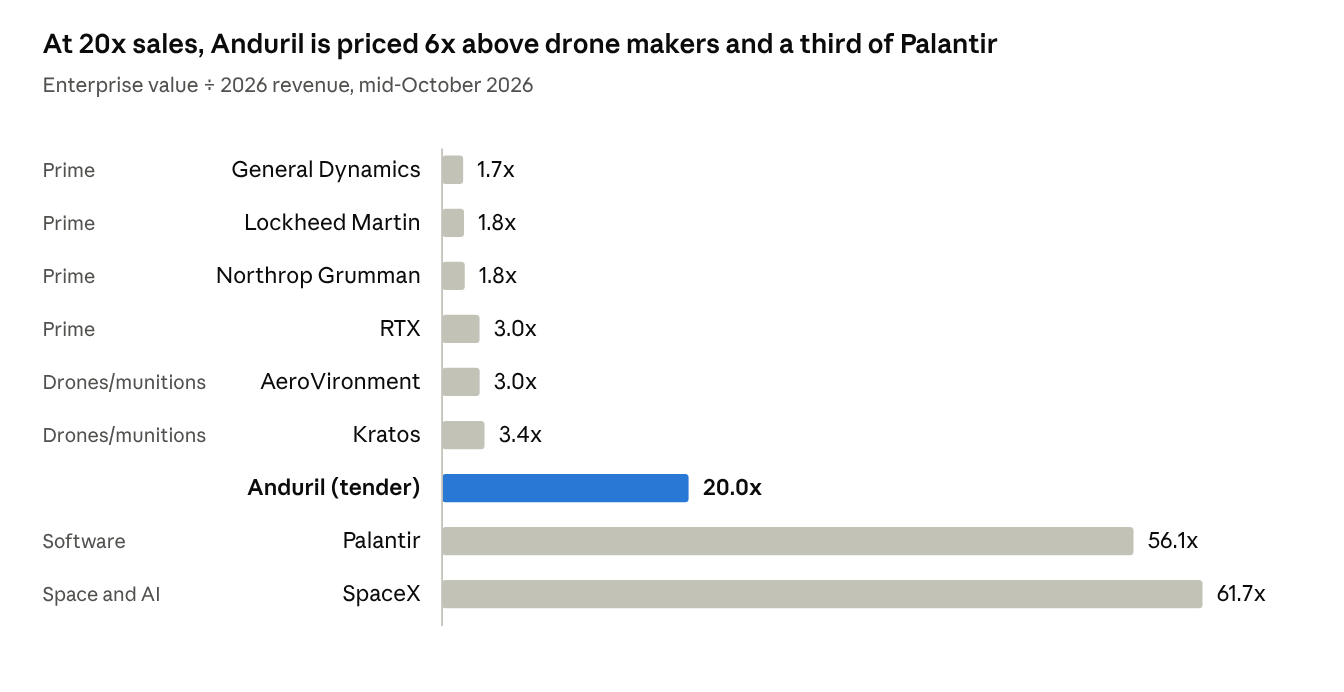
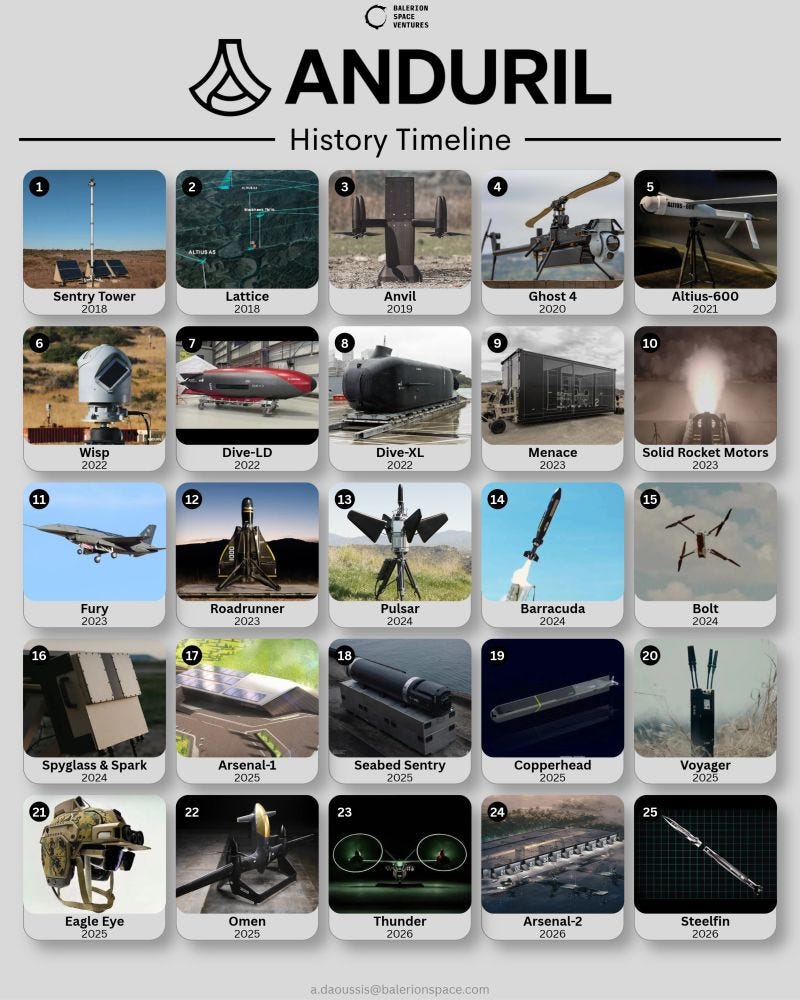
Anduril at $90B is priced as one-third software company. Kyle Briggs breaks down the October 13 tender that let employees in 16 countries sell up to $1.3 billion of stock at $94.80 a share: about 20 times sales, against 1.9 times for Northrop, on a projected $4.3 billion in 2026 revenue and a $1.2 billion operating loss. Only about a quarter of that projection traces to named contracts, and identifiable Lattice work totals about $50 million, roughly 1%. To triple late money in five years, Anduril needs about $31 billion in revenue by 2031, growing 49% a year. Its factory stack keeps raising too: Arda, founded by ex-OpenAI research chief Bob McGrew, emerged from stealth with $232 million, including a $160 million Series A at $1.5 billion from Altimeter, Accel and Khosla, with Anduril as first customer. Work instructions that took 10 hours now take 15 minutes. Anduril COO Matt Grimm: “We would be behind on our production goals without it.”
Helsing buys into its rival. Germany’s Helsing agreed to fund and partner with Destinus, the Dutch cruise missile and drone maker, taking a minority stake in a round valuing it at around €6 billion ($6.7 billion). Europe’s champions are consolidating before most of Canada’s have raised a Series B.
Interceptors and rocket motors scale up. Long Wall, the former ABL Space Systems, won a $75 million Missile Defense Agency contract to finish flight testing Cyclops, its low-cost interceptor, and will match it with $75 million of its own. CSIS counts U.S. Patriot inventories below 1,000, THAAD near 250 and SM-3 near 410, with legacy interceptors costing up to about $30 million each. L3Harris opened a Camden, Arkansas plant to double GMLRS motor output, one motor every nine minutes, after a record $250 million Lockheed follow-on, while the Army has floated 133,014 GMLRS rockets by 2034. The stockpile problem is now a factory problem.

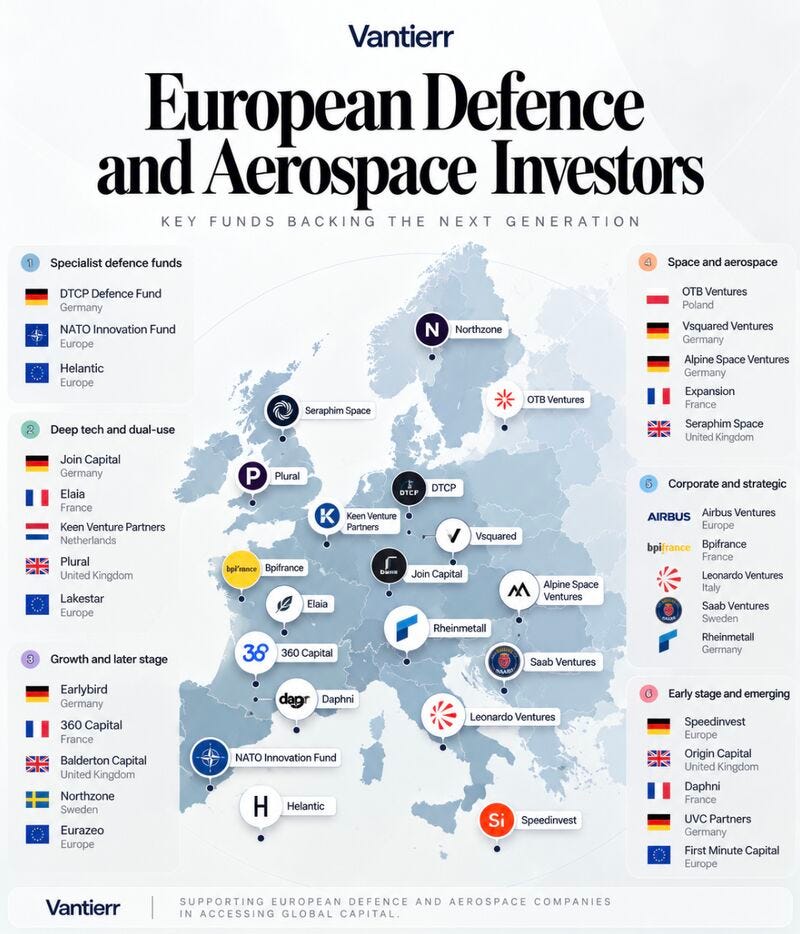
Related: POLITICO Europe finds Britain’s defence industry has a private investment problem, with 42 U.S. defence VC funds against “three, arguably four” credible early-stage investors in Europe, $19.6 billion raised by U.S. firms against $932 million by British ones in nine months, and Revolut closing a drone maker’s account, while Vestbee maps the deeptech and generalist VCs backing Europe’s defence startups, from Kima’s €150,000 cheques to Lightspeed co-leading Helsing’s $1.8 billion Series E, which doubles as a target list for Canadian founders raising abroad.

ADVERTISEMENT

Learn more.
ADVERTISEMENT

Learn more here.
⚔️ Combat Readiness
Pentagon reform watch. NewsNation obtained the letter that lays out a four-star Autonomous Warfare Command under Project Agincourt, run by DIU’s Owen West as CEO and Navy SEAL Senior Chief Max Strasiser as COO, with an October 1, 2027 target and products judged on competitions, exercises and real combat performance. Their thesis: “Low-cost drones have transformed the nature, pace, and economics of warfare.” Pete Newell, former head of the Army’s Rapid Equipping Force, warns that a four-star headquarters will not, by itself, make anyone faster: the Pentagon asked for $54.6 billion for autonomous warfare in FY2027 and the committees had written down about $1 billion. His metric is days from field problem to fix. DCMA’s Col. Dustin Thomas wants the Pentagon to plan to crash and replace a share of the drones it is already buying, turning training into a standing industrial exercise: “The objective shouldn’t be to enter the next war with the world’s largest warehouse of drones.” The Economist’s War Room flags the new command alongside a warning on Ukraine’s Starlink starvation, the two halves of the same lesson.
“The U.S. has 16,876 machine shops. A staggering 83% of them operate with fewer than 20 employees, and the average machine across these facilities runs about a quarter of the time. The capacity certainly exists, but it remains heavily fragmented”:

The war goes underground. The Atlantic goes into the pipes: a map shows at least 57 steel gas pipelines, most one to two metres wide, running under the front, and Ukraine’s Khartiia Corps has spent six months fighting through them on coal-mining wagons powered by electric-scooter motors, retaking about nine miles of pipeline in Operation Veles. Ukraine has retaken two pipelines. Dozens remain in Russian hands. Brig. Gen. Ihor Obolensky on why: “Day by day, the kill zone is expanding, getting wider and deadlier. So what’s the answer? You go underground.”
A JINSA report co-written by the IDF officer who ran Israel’s counter-tunnel fight after October 7 lays out what Israel’s underground war can teach other militaries, starting with treating the surface and subsurface fight as one, and a 2025 U.S. Army report already concluded American forces “may not be able to avoid a subterranean fight.” The drone kill zone pushed the infantry below ground. Sensors that cannot see there are now a capability gap.

Ukraine carried out world’s first medical evacuation of a human via drone from the battlefield the 30th mechanised brigade of Ukraine managed to save their injured comrade from a minefield.
🍁 Kit for Canada. DND plans 47 passive sensor stations from the Yukon to Alert under Project Crossbow, shipping-container units on metal legs, airlifted by Hercules and Chinook, solar and wind powered and unstaffed year round, with installs starting as early as next summer, initial capability in 2029, completion in 2032 and a 20-year life. Filings show two sites in Quttinirpaaq National Park and four in a Banks Island bird sanctuary. Sensors need people. Forbes profiles the 5,000-plus Canadian Rangers who cover roughly 70% of Canada’s territory, including a 5,200-kilometre snowmobile run across the Northwest Passage on Dominion Dynamics’ AuraNet mesh, feeding one picture to troops on the ice and to Ottawa. Col. Benoit Mainville: “Technology does not substitute for us; it serves as an additional tool in our toolkit.” Crossbow is the sensor layer. The Rangers are the network that already works.

The kill zone. Ukraine’s 3rd Army Corps twice drove armour behind Russian lines in Operation Vivaldi: four vehicles broke through, one was hit and drove out, and a second push went about 4.5 kilometres deep and dropped infantry onto Russian drone teams, who then fought nearly surrounded for days. Andrii Biletskyi: “Today, the use of armored vehicles is effectively a special operation.” The same lesson hit the U.S. Army at Hohenfels, where a detachment of Ukraine’s 412th “Nemesis” regiment caused about 70% of a U.S. armoured brigade’s casualties in three days, with more than 750 drone contacts in roughly 10 days, before Greywolf adapted, fielded 700-plus drones of its own and got drone casualties below 30%. The officers’ estimate: 60% of brigade counter-drone is fieldcraft and drills. Armour is not dead. It now moves only as a planned raid under a drone umbrella.

Counter-drone. Reuters, via Defense News, finds Europe weighing powers for utilities and infrastructure firms to bring down drones: France passed an August law letting approved operators like EDF and SNCF detect, jam and shoot, has catalogued 17 counter-drone systems and three integrators, and wants vital sites equipped by 2027. Austria is following, Poland already lets operator security units take down drones, and Germany still treats it as policing. Eurelectric’s Kristian Ruby: “there could be heating outages this winter due to hybrid attacks.” Fingrid’s CEO calls handing operators those powers “a very, very big change,” and Rheinmetall calls the segment “very fast-growing.” Liability is the blocker: nobody wants to be the utility whose interceptor drops a drone on a house.
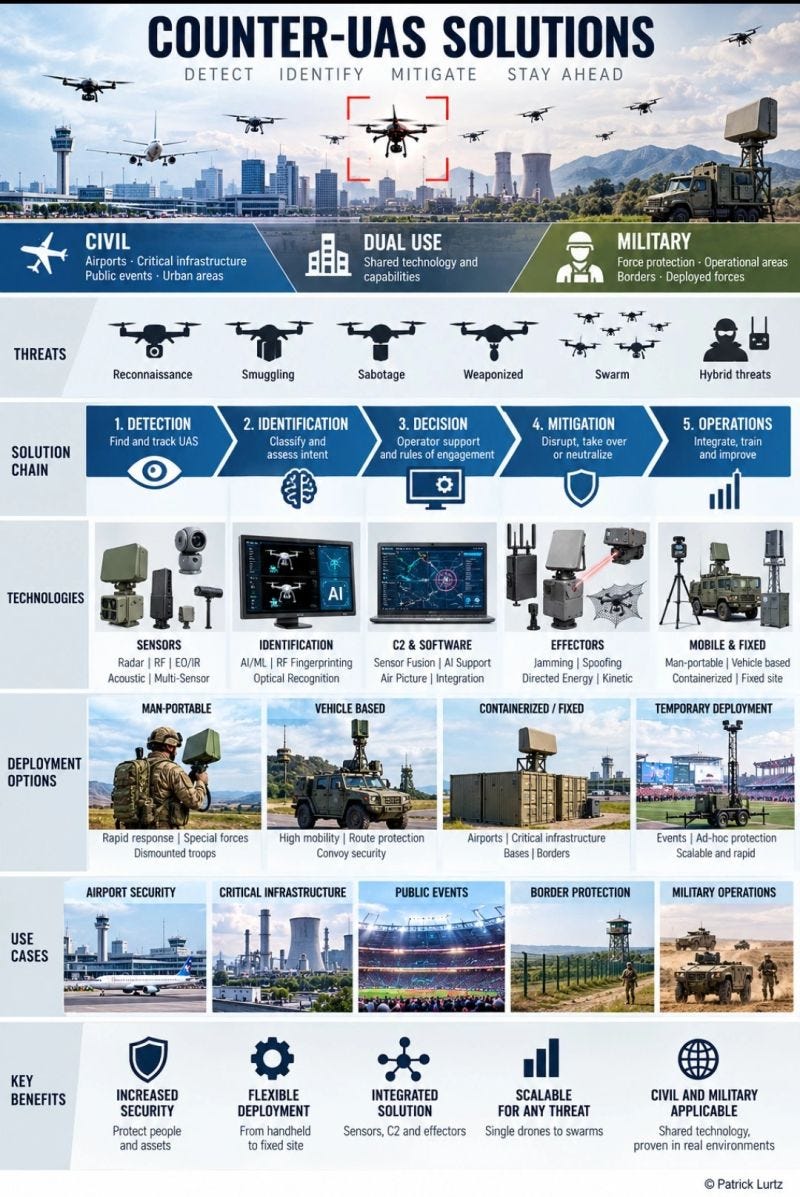
Counter-UAS has a signature problem: Repeated flights can reveal a pattern of response
What if drones could operate longer without needing to recharge?
The Canadian Armed Forces is asking industry how to protect its bases across Canada from drones
The off switch. For a week from October 14, Ukrainian drones flying faster than 100 mph lost their Starshield link, and Dmitri Alperovitch said “They are losing drones.” The WSJ reports Trump called Musk and asked him to lift the restrictions. By Saturday, Kyiv said both services were back above 400 kph. Reuters reported the throttle order came from inside the White House, and Musk said Ukraine “violated Starlink terms of service” with offensive strikes. It has happened before. Reuters reconstructed how Musk ordered at least 100 terminals switched off around Kherson in 2022. Kyiv has now signed a letter of intent with Nokia and ICEYE for its own satellite communications. Zelenskyy: “We must all rely on capabilities that we can control.”


🍁 Space. David McGuinty says Ottawa signed more than $3 billion in space contracts and agreements over the past year, including $2.3 billion to Telesat for Arctic military connectivity, $688 million to MDA for a radar satellite and the $105 million Launch the North program. New this week: $17.9 million in IDEaS satcom money, $4.7 million of it to Kepler for laser crosslinks, and a new Space Mission Operator trade with a first cohort of 25. McGuinty: “Canada cannot afford to depend on capabilities that we can’t access, that we can’t protect, or that we can’t replace when we need them most.”

🍁 NORAD’s quiet crack. The Atlantic reports that Canada now struggles to find senior officers willing to take U.S. postings at NORAD and other integrated commands, over career risk, shrinking access and families who do not want to cross the border. One officer: “will you use one of them to take up a position in the States, where you might be underemployed, with little access and little meaningful work to show for it?” David Perry: “The day-to-day relationship has deteriorated.” Almost half of Canadians now call the U.S. an enemy or potential threat. Former CDS Wayne Eyre calls it U.S. “self-harm.”

🍁 Casualty math. The fire at Wainwright that killed four and wounded 39 soldiers filled a 100-bed hospital with burn patients and exposed what two years of civil-military war games already showed: the CAF has no burn surgeons, relies on a civilian system running at capacity, and imports most of its tissue from the U.S. Canada has 15 tissue organizations to America’s 100-plus. Surgeon General Maj.-Gen. Scott Malcolm: “We simply don’t produce enough tissue in Canada, right now, in peacetime, to meet our demands.” He wants every tissue bank to hold about 1.5 million square centimetres of skin, roughly 11 parking spaces, which Héma-Québec says treats 75 to 150 severely burned patients at once.

Sensor to shooter. Brig. Gen. Steven Carpenter of Multi-Domain Command Europe tells War on the Rocks that his soldiers ran the full high-altitude balloon kill chain themselves in Arcane Thunder, more than 20 balloons, and that the hard part is filtering 99% of the noise so the right shooter gets the target. His pitch advice: if an adversary fires a $2 million interceptor at your $50,000 drone, “we win that exchange,” and the gap is attritable, reliable Group III drones. The data plumbing is the real fight. Anduril’s first NGC2 integration with the 25th Infantry Division in Hawaii ran into growing pains with legacy radios, with Lockheed’s Chandra Marshall admitting “some people are surprised at how much of a challenge it has been.” Brig. Gen. Shane Taylor: “It wasn’t seamless, and we learned a lot.” Every army fields onto legacy kit. Integration is the product.

Data centres are targets. Klaudia Klonowska and Michael Schmitt lay out the defender’s legal duty to protect civilians around military data centres: Russian strikes damaged at least six Ukrainian data centres in late September, one Kyiv attack killed four, Ukraine hit three Yandex sites and a Sberbank build, and Iranian strikes set AWS facilities in Bahrain and the UAE on fire. France now runs its Arcadia command platform from an underground data centre at Mont-Valérien, and the Dutch are building a sovereign military cloud. Every commercial cloud hosting military workloads is now a dual-use target.


Europe rearms, the Nordics first. UnHerd’s Lily Lynch documents how neutrality became a distant memory: U.S. forces now have “unimpeded access” to 47 Nordic bases, Finland finished a 200-kilometre border fence and lifted its blanket ban on nuclear weapons, and Imatra lost its Russian tourists and sits at 16.4% unemployment. Finland plans to build about a million anti-personnel mines for around $110 million, domestic production from 2028, every conscript trained to use them, after leaving the Ottawa Convention in January. Poland, Lithuania, Latvia and Estonia are leaving too. The treaty carries this city’s name. NATO’s front line is walking away from it.
Billions in Backlog, Three Chokepoints: Where Defence Production Is Stuck
🍁 Counter-drone, Suffield edition. Canadian Defence Review’s Richard Nghiem reports that IDEaS’ 2026 counter-drone sandbox at CFB Suffield shifted from detection to defeat. It brought 22 innovators from six countries and up to C$1.75 million in prizes. The scenarios: a 2.5-kilometre airbase perimeter, a five-vehicle convoy and an infantry squad on foot. Ukrainian air defence officer Sergiy Kuzyara: “Even small drones that can be assembled by a teenager can harm infrastructure that is critical for Canada.” The Canadian Press, reporting from Latvia, finds that countermeasures now arrive in about six weeks, and Riga’s Janis Kazocins warns against buying Ukraine’s best drones and warehousing them. Helsing’s answer is Contra, an AI air-defence system with two container-launched interceptors: the jet-powered AD-1 Inferno and the Mach 2.5 AD-2 Ambush. Niklas Köhler on the dilemma it replaces: “slow fair-weather drones, or million-euro missiles fired at cheap, mass-produced targets.”
🍁 The navy moves ashore. Capt(N) Chris Taitt says the RCN will move command of maritime operations to operations centres on land. It can no longer assume control of the spectrum it uses to command ships in the Pacific or Atlantic. He calls it “the most fundamental rethink since at least CF transformation in 2005” and the data problem “absolutely immense.” The secure digital backbone this needs is the industry opportunity. ReadyAyeReady maps where autonomy fits in guarding Canada’s approaches:
Kraken mine countermeasures kits for each coast
MDA drones on Halifax-class frigates by 2028
The two big underwater surveillance programs not due until the mid-2030s, with sailors still running one vehicle each
Middle powers hedge. Carney announced a strategic trade and defence partnership with Turkey and toured Baykar, maker of the TB2. He held up an industry that builds about 80% of its own kit: “This is not the case in Canada.” The baggage: Wescam cameras were diverted to Azerbaijan in 2020, and export permits stay case by case. Finland is doing the same with Ukraine. Sine Engineering, which supplies GPS-free navigation software to about 200 Ukrainian drone makers, launched a joint R&D initiative to build in Finland, as Kyiv and Helsinki signed seven deals worth €330 million. Ukraine is trading its combat know-how for factories and engineers abroad.
Shadow war. POLITICO reports the Pentagon is quietly building an elite technology sabotage agency, the Technology Support Office, set up by Steve Feinberg’s April 14 memo, merging two classified programs, building hacking tools and planning deception operations to get adversaries to install faulty components, with classified contracts likely “north of $1.5 billion.” Cyber Command and SOCOM both objected. The other side runs its own playbook. A joint alert co-signed by Global Affairs Canada and the RCMP warns that North Korean IT workers pose as foreign nationals to fund weapons programs, using AI, proxies and U.S. “laptop farms,” with red flags including refusing video calls, below-market rates and asking for crypto.


ADVERTISEMENT

View the agenda and apply now.
🔫 Hot Shots
🍁 Getting defence ready takes a year. Plant’s Mari-Len De Guzman walks SMEs through the certifications, clearances and capital it takes to compete under the 70% Canadian content target: CPCSC level 1 takes about three months, level 2 about a year, and 123 Defence’s Jonathan Clow describes the prime’s call: “Are you certified? No. See ya.” BDC’s defence platform is now $6 billion, with RBC at $1.4 billion and CIBC at $2 billion over five years.
🍁 Watch: Eliot Pence on building Ukrainian robots in Canada. CBC Morning Live’s David Common talks with the Dominion Dynamics founder about the Tencore partnership and what it means for Canada’s drone industry.
The Pentagon wants armed drone boats in 120 days, with $300M behind it. DIU and the Pentagon’s unmanned systems office launched a sprint for production-ready counter-air USVs. The boats must carry Hellfire, JAGM, APKWS or Stinger, cover 200 nautical miles and engage targets beyond three nautical miles. Bidders get 30 days to demo, with up to $100 million in prizes and $200 million set aside for follow-on production. DIU’s framing: the cost-exchange ratio “is heavily skewed in favor of the adversary.”
🍁 Floating chargers from Vancouver Island. Langford’s Mostar Labs builds Lilypads, modular floating battery banks with sensors, the largest about 5.5 metres long with 200 kWh, already pitched to Singapore’s port and to a Coast Guard that wants lighthouses off diesel. Output goes from two a month to 30.
SOCOM wants a common software sandbox. The command is seeking an integrated contracting vehicle for a PaaS environment near MacDill so traditional and non-traditional vendors can integrate, test and get to authority to operate together. RFI responses are due November 5.
The Army will test 15 counter-drone systems in Morocco. Tan-Tan hosts up to 15 drone-defence technologies in February and March 2027, with more trials at African Lion 2027 and winners in soldiers’ hands within 180 days. The ask: spot radio-silent small drones from nearly a mile, day or night.


European founders want AGILE made permanent. A coalition of defence founders and investors, from Project A and Expeditions to KEEN and Nordic Air Defence, wrote to Kubilius, Costa and Metsola on October 23 asking for continuous AGILE funding across the 2028 to 2034 budget after its 2027 pilot. Their line: “A programme renewed in stops-and-starts loses the agility it was created to deliver.”


Quantum needs a warfighter’s scorecard. After the Pentagon’s October 8 package of about $350 million, including $200 million for DARPA and a conditional loan of up to $150 million for PsiQuantum, Burak Oktenli shows how two dashboards can both read 83.3% post-quantum migration while one mission still fails on a single shared dependency. His fix: “’Not demonstrated’ needs its own status.”

Count ships, then weigh them. Visual Capitalist ranks the world’s militaries four ways: China fields 841 vessels to America’s 465, but the U.S. carries about 2.6 times the tonnage and flies 13,032 aircraft, more than the next four countries combined.

Warm hands, no gloves. The U.S. Army’s forearm heater boosted manual dexterity by up to 50% in Alaska field trials by pushing finger skin toward a 15°C breakpoint, since gloves cost 50% to 80% of dexterity.
🍁 CVCA and COVE build the on-ramp for defence capital. The two launched Canada's first Defence & Security Capital Markets Program. It puts angels, venture funds, private equity and pensions in a room with founders, military leaders and procurement officials, pegged to a defence budget expected to top $150 billion by 2035.
🍁 Kanata wants to build 10,000 drones a month. Robotics Centre tripled its footprint into a 70,000-square-foot Kanata plant. It is patenting flatpack drones that go together in 10 minutes with a multi-tool and zip ties, though it has no Canadian contract for its own drones yet. Carp’s AVSS grew from 20 to over 50 staff after a Defence Drone Initiative contract awarded in weeks. Josh Ogden on companies assembling licensed foreign designs: “If you assemble Ikea furniture, are you suddenly a furniture manufacturer?”
And the closer: cloned war dogs. Ben Lamm’s Warhound emerged from stealth with $200 million at a $1.2 billion valuation from Sequoia, 8VC, Corner Ventures and In-Q-Tel to gene-edit and clone Belgian Malinois and German Shepherds, suited up in Anduril vests and goggles, because more than 80% of U.S. military working dogs come from Europe and less than half are fit for service. First litters arrive early next year. Lamm on where the hardware goes: “on top of the dog, not in the dog.”


The Icebreaker is written for the people building Canada’s defence technology base. Forward it to someone who needs it.