

Editor’s Notes: Special thanks to the Montreal Institute for Global Security (MIGS) for asking The Icebreaker to moderate a lively discussion [VIDEO] on how to build a defence industrial base at this year’s Montreal International Security Summit.
Our friends at defence tech accelerator Vimy Forge are recruiting for their second cohort: more info here.
🎯 Three-Shot Burst
The money is approved. The buying isn't. CADSI grew its membership 70 per cent in a year to 254 companies in Ottawa-Gatineau, 182 of them SMEs, riding $80 billion in budget defence spending, a goal of 70% of military contracts to Canadian firms, a $241 million NRC program and a $4 billion BDC program. Dominion Dynamics raised $139 million over the summer and builds out of a 30,000-square-foot Kanata North factory. Eliot Pence still can't see it: "I'm waiting for the boom. I'm hopeful for the boom." ONE9’s Michael Smith names the condition: "The build only happens when you actually start buying your Canadian products." CADSI's Christyn Cianfarani names the choke point: "I need a security clearance and I cannot get it in the time frame that's required for me to execute on my contract." ROB Magazine's John Lorinc walks through the 400-page Project Approval Directive that governs every major buy: four stages, multiple sub-stages and a 64-question complexity rubric, against more than $63 billion allocated for 2025-26. Carleton's Elinor Sloan counts 26 reports and 10 stages for a large procurement, with 13 marked for removal. The Defence Investment Agency has not yet received all live files and is not yet a single point of accountability, says CGAI's David Perry: "The way our system works right now, it just can't handle an expanded volume like we've been trying to deal with for the last 20 years."
Reality check: Auditor General Karen Hogan found National Defence did not manage its ammunition to meet regular-use or strategic stockpile needs. Fifteen regular-use contracts averaged almost 19 months from signature to delivery, and CAF readiness for NATO commitments was "well below target" as of March 2026. Defence Watch has the report's harder numbers, straight from the audit: $695 million committed to the stockpile in 2025-26, zero rounds received by March 31, 56% of assigned ammunition actually used, and $656 million in inventory overdue for counting.
DIA head: Canada is buying military gear for a world where ‘pretty much everything’ changed

We combine funding, sector expertise and strategic connections to help Canadian businesses scale, compete globally and seize the opportunities ahead. Connect with our experts today.
Paris is crowded. London is where companies survive. Ben FitzGerald’s Dickensian frame in War on the Rocks splits defence tech into two markets: Paris for prototypes, pilots and discretionary money, London for production contracts and recurring revenue.
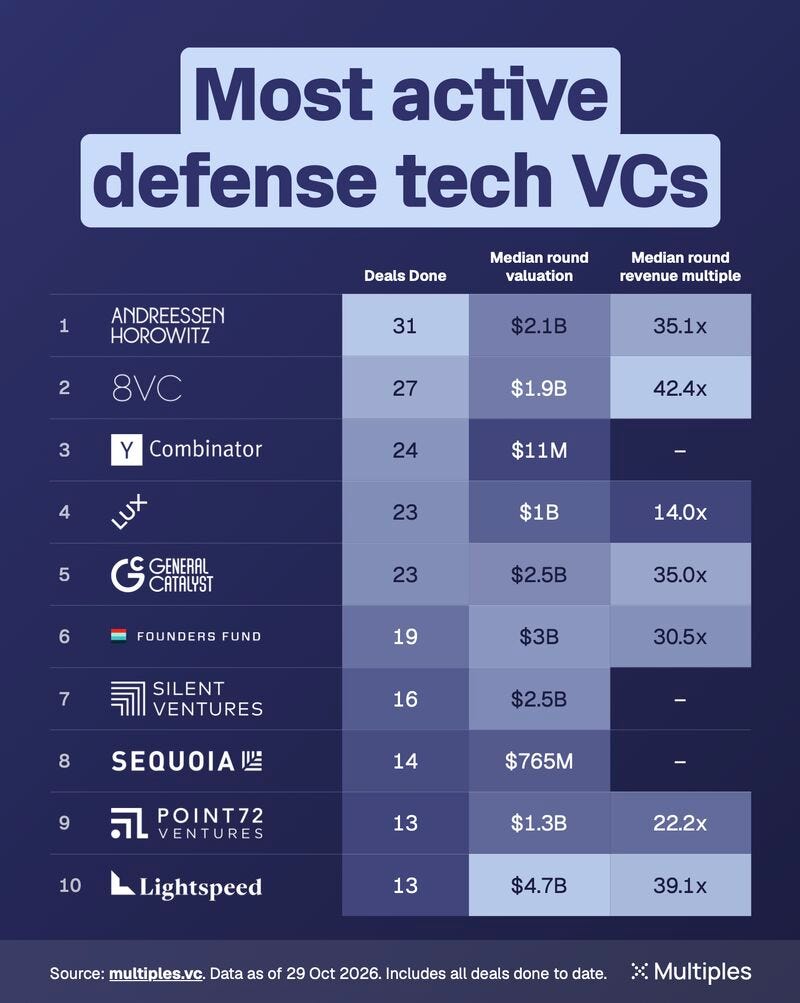
“Long-standing defense specialist investors are nearing the end of fund lifecycles and their own patience, while generalist venture capital firms that entered defense as part of a trend are now discovering that defense procurement does not scale like consumer software and does not offer clear exit paths.”
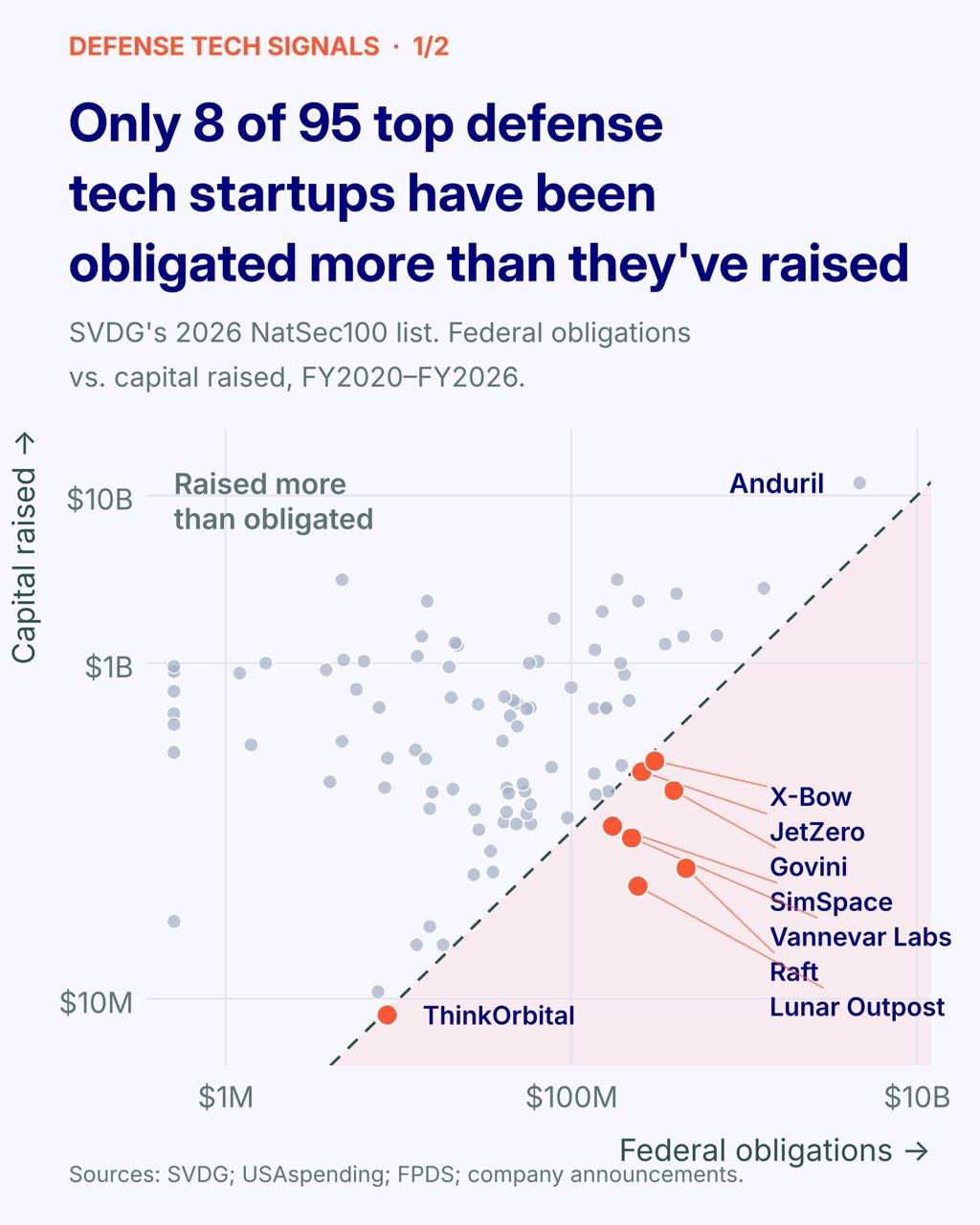
About $49 billion in venture money went to defence tech in 2025, and the Silicon Valley Defense Group’s top 100 startups have raised more than $118 billion, but they won just $4.3 billion in awards in 2025 out of more than $450 billion the Pentagon obligates each year. Of 450 DIU prototype OTAs from 2016 to 2023, only 14% converted to production, 51% among completed prototypes. Palantir is worth more than Lockheed, Northrop and General Dynamics combined.
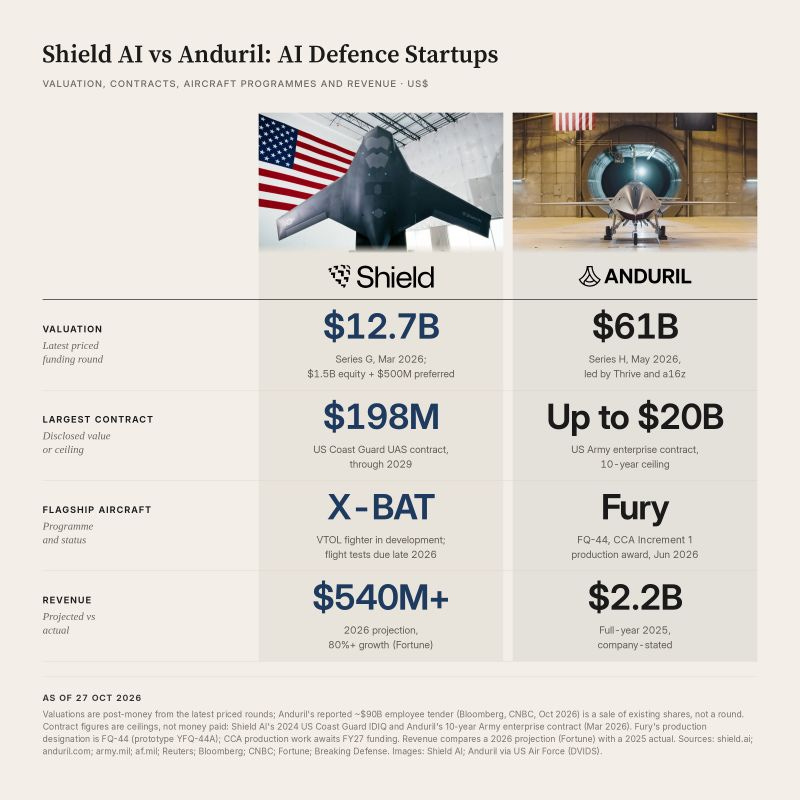
RealClearDefense calls this uncharted territory for private capital while Congress struggles to move the 2027 bills that fund autonomy, AI, counter-UAS and the industrial base: “Now is also the time to anticipate potential fracture points and mitigate them through intelligent design.” Nicholas Nelson in Foresight by Tawazun tallies the mega-rounds, Anduril at $5 billion on a $61 billion valuation, Helsing at $1.8 billion on $18 billion, Quantum Systems at $1.2 billion, then deflates them: “Funding rounds do not generate military capability.” Capital, he writes, “is an input, not an outcome.” The drone market is the live test. Drone Dominance promises $1 billion over two years in repeated small awards, with Neros taking 4,960 drones in Gauntlet 1, and the Army admits it is trying to “artificially induce” demand. AV’s Chad Chasteen: “There is no supply without demand. Continuous competition doesn’t mean you make industry fill out continuous requests for white papers.”

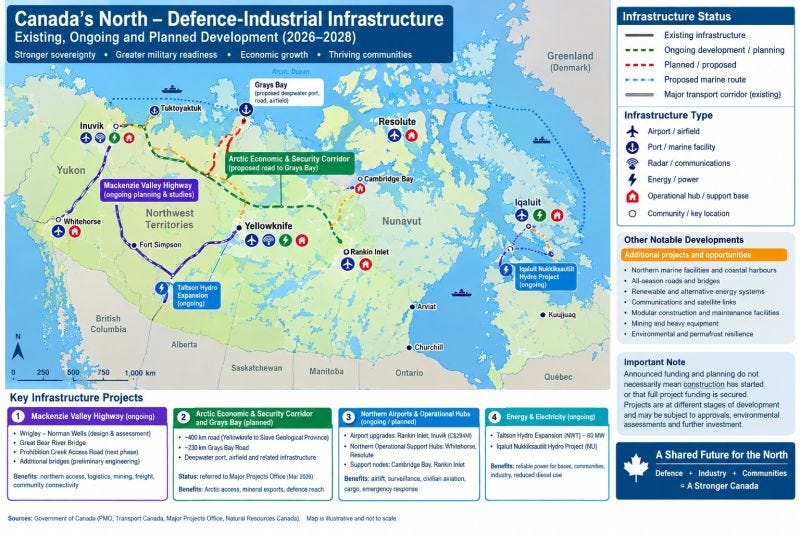
Strategy arrives. Sovereignty still needs a definition. The Plan for a Stronger Canada names defence one of eight strategic capabilities, confirms 2% of GDP in 2025-26 on a path to 5% by 2035, calls protecting the Arctic “the defining task” for the CAF, and promises a defence plan to “give the CAF one clear, central mission: the defence of Canada and Canadian interests.” It is Canada’s first national security framework in 22 years. Canadian Shield Institute’s Matthew da Mota flags the hole in the middle: cloud, AI compute, quantum and telecom are listed as strategic capabilities with no definition of what sovereignty means for them. His line: “autonomy built on digital systems Canada doesn’t own or control isn’t autonomy at all.” His test for a Canadian partner is one “not majority owned by a foreign parent company.” CIGI’s Carvin, Juneau, Neiman and Wark want an IQT-style rapid prototype and investment model, technological sovereignty in major procurements and a sovereign space stack from launch to domain awareness, and they warn: “A national security strategy is not cost-free.” The same week tested the principle: John Ivison reports that Israel’s Elbit closed its purchase of International Submarine Engineering, the Port Coquitlam AUV maker with a 50-year history and an IDEaS-funded docking project, without a national security review. Up north, The Wire China examines how the Grays Bay Road and Port could make a Chinese-owned mine viable: state-backed MMG has held the Izok zinc deposit since 2009, and a 230-kilometre all-weather road to a deep-water port on the Coronation Gulf is the missing piece. Then the space agency put up $4 million across three priority technologies: $1 million for a CubeSat telescope, $1 million for CASTOR readout electronics and $2 million for snow-mass radar modules, with a full radar integration design left out “given the financial constraints of the RFP.”


ADVERTISEMENT

Barrack Hill: Navigating Canada’s defence and procurement landscape with precision.
🤝 Deal Corner
🍁 Ottawa takes up to $1.6B of Cohere at a $35.7B valuation. The federal government will take an equity stake in a planned $7 billion round led by Germany’s Schwarz Group, the largest financing ever by a Canadian startup, up from roughly US$7 billion a year ago. Cohere has to spend $1.7 billion on Canadian compute by 2030, keep its headquarters here and double its workforce, with payments tied to milestones.

🍁 North Vector Dynamics raises $20M+ Series A. Czech fund Tech Horizons leads the round for the counter-UAS startup, with ONE9, Garage Capital, Ripple Ventures, Feld Ventures and Conconi Growth Partners, and Czechoslovak Group joining as a strategic investor after an MOU on European manufacturing. The CM-70 interceptor weighs about 3 kg, measures 90 cm, flies on a small rocket with laser guidance and works without GPS. First units ship in 2027, built for Geran-4 and Geran-5 jets in a war where Zelensky says “only 57% of jet-powered drones are being intercepted.”


🍁 Lockheed closes Ultra Maritime at US$3.45B. The Canadian Press reports Lockheed completed the acquisition of the Dartmouth undersea warfare company last week, after investing since 2022. Founded in 1947 as Cossar (Canada) Ltd., it builds sonobuoys, sonar and torpedo defence for more than 30 navies with about 2,000 staff. SaltWire has the Halifax business angle on the $3.45 billion deal for Dartmouth. Lockheed Martin Canada has separately pledged up to 320 skilled jobs in Nova Scotia within five years, worth up to $126 million in salaries and benefits. Canada’s premier sonar house now sits inside Lockheed’s Rotary and Mission Systems.


🍁 Solink raises US$100M in growth capital. Toronto’s Vertu Capital leads the round for the Ottawa AI video company, with GS Growth, Golub Growth and Comcast Ventures. Solink covers more than 35,000 locations in 65 countries, uploads 750 million hours of video a month, has 350 staff and is on track for US$100 million in annual revenue by April. It is the third Solink round led by a Canadian firm.
🍁 SAFE contract number two: Galvion’s $44M+ helmets for Latvia. The Canada-EU summit in Montréal announced the Montréal helmet maker’s contract to equip the country where Canada has its largest military presence abroad, following Marconi’s ORION radios for Poland’s Cyber Command. The same package brings up to $2.5 billion in financing for De Havilland waterbombers, cooperation on IRIS² and Galileo, and a path for Canada to become the EU’s first Associate Member.
Ukraine’s battlefield lessons for Canada… Automated turrets shot down dozens of enemy drones over Kyiv in the past month alone
BCI with October public comps in defence

🍁 Saab signs IMP, Magellan and CAE for a Gripen line, and Bombardier signs with BAE. Saab picked Halifax’s IMP to run a Canadian final-assembly line for the Gripen E, with Magellan on aerostructures and CAE on training, though the GE F414 engine stays the one purely American, export-controlled part. Canadian Defence Review has the full partner statements, including IMP’s David Gossen on building Gripens “for Gripen customers internationally.” Bombardier, which turned down building Gripens over factory capacity, signed an MOU with BAE Systems to explore future combat jets and hit its US$1 billion defence revenue target five years early. Breaking Defense lines up both bets and notes Italy says Canada’s GCAP observer status carries no industrial role yet.


🍁 Lockheed’s HIMARS offsets land at PV Labs. The Burlington optronics SME was approved for Lockheed ITB investment to develop a next-generation Pilot Night Vision Sensor for the AH-64E Apache, under the framework tied to Canada’s 26 HIMARS. No dollar figure was disclosed. Founder Mark Chamberlain calls PV Labs Lockheed’s “trusted R&D and delivery partner of choice in Canada.”

🍁 EarthDaily wins a $4.3M NASA task order. The Vancouver company will test whether its constellation meets Landsat standards, with eight of 10 satellites in orbit and 5-metre pixels against Landsat’s 30. It already has an NRO evaluation contract, an eight-figure US defence data deal and a DRDC-funded AI border platform for the RCMP.
🍁 Bloomsco raises a $1M pre-seed from BDC and Telegraph. The Montréal startup uses AI to turn technical manuals into military training plans, already holds a DND contract for an officer qualification standard and counts former RCN commander VAdm (Ret’d) Ron Lloyd as an adviser. Hugh McGuire: “The whole focus of a military is training people well to do the work they need to do.”


Energetics gets funded: Odin and Firehawk. The WSJ profiles Odin Energetics, a Solugen and Kraken Kinetics venture with $115 million committed, an explosive it says is 30% more powerful than what drones carry now, and modular plants it can build in six months. The US industrial base it is up against is one 84-year-old plant running at 3% of its 1944 peak, Holston, the only domestic source of HMX and RDX. Brian Davis: “We are not suddenly in an energetics crisis. We have actually been in an energetics crisis for 20 years.” Dallas-based Firehawk raised more than $150 million in a Series D at a valuation above $1.4 billion, led by Advent and Rochefort, to take Hydra-70 output from 40,000 to more than 125,000 a year and cut propellant production from 45 to 60 days down to about six hours. Canada’s $1.4 billion munitions framework includes a domestic nitrocellulose plant. It has no Odin yet.
Salesforce buys Rune. The $190 billion CRM giant is acquiring the military logistics AI startup about two years after its founding, with $30 million raised, a five-year $99 million Army enterprise agreement for TyrOS and seats on both the Lockheed and Anduril NGC2 teams. Salesforce’s defence business is growing 80% a year. A source close to the deal: “Defense companies buying other defense companies is part of the market, but it doesn’t bring in anyone new.”
“I initially expected defense tech startups to get acquired by other defense tech startups, primes, industrial companies, etc. Or to exit public, of course. But with the Pentagon pushing acquisition reform and *real* software modernization, there’s growing incentive for enterprise software companies and hyperscalers to buy their way into the market.” - Ali Javaheri, PitchBook Data
Related: KAS Canada and MIGS map the legal and security debate over AI-enabled drones for transatlantic allies, a 2025 paper worth rereading as Canada writes its own drone rules.
ADVERTISEMENT

Learn more.
⚔️ Combat Readiness
🍁 Fighter file. The RCAF took its first two F-35s at Luke Air Force Base, and Defence Minister David McGuinty says the 88-jet buy is still under review, weighing industrial benefits and autonomous systems that fly alongside fighters. Canada has 16 jets under contract, long-lead costs paid on 14 more and 72 in limbo. The leverage problem hasn’t moved since CBC laid out the US hold over Link 16 for any Canadian Gripen in March. Swedish Lt.-Col. Johan Legardt: “If Canada is the first country where the U.S. draws the red card then we have a problem.”

🍁 Kit for Canada. The River-class destroyer is pivoting to a full Aegis combat system and military off-the-shelf kit to cut cost, schedule and technical risk. Sea Ceptor gives way to RAM, Leonardo’s Vulcano to BAE’s MK 45, the developmental TLFAS sonar to Thales Sonar 2087 at no extra cost, and onboard jamming to offboard decoys. Fifteen ships, HMCS Fraser’s keel laid in June, Final Design Review in early 2028. DND: the baseline “is expected to remain stable.”
Calgary health tech company’s gel helps heal Ukrainian soldiers


🍁 Sustainment tax. Canada is paying Lockheed $9.8 million in a non-competed FMS contract to patch the CH-148 Cyclone’s radar warning software, and 97% of the work happens in Owego, New York, with the rest split three ways between Ottawa, Halifax and Patuxent River. The fleet cost C$3.75 billion to buy and C$11.17 billion in major in-service support.


🍁 Home front. Documents put before Gen. Jennie Carignan show the CAF was warned about safety gaps for more than 20 years before the October 17 fire at CFB Wainwright that killed four soldiers. The Forces run at least 27 overlapping safety regimes, and the new Defence Safety Programme won’t reach initial capability until spring 2027.

🍁 Axis watch. CSIS says Iranian threats to Canada involved potentially lethal plots against individuals and will likely continue, as Toronto police tie gun-for-hire networks to shootings including the attack on the US Consulate. The procurement side is just as busy. Reuters uncovered more than 5,000 numbered MODAFL agencies that have imported at least $2 billion in hardware, explosives and trucks since January 2025, with 97% of reviewed transactions settled “without currency transfer.” 240 Analytics’ Noam Binstok: “The amount of money going through these agencies is staggering, and no one has noticed them before.”


🍁 Defence bank watch. Eight German industry groups, including BDSV and the savings banks association, urged Berlin to become a founding DSRB member before the November 30 charter signing in Luxembourg, warning German firms could lose preferential access to bank-financed procurement. Berlin’s ambassador isn’t sold: “So we don’t necessarily need to have another bank, which is always costly in the beginning.” Britain won’t join and will build its own Multilateral Defence Mechanism with the Netherlands, Finland and Poland, after an offer that would have moved the DSRB’s headquarters to Europe.
Counter-drone. Helsing unveiled its Contra air defence system and two interceptors: the jet-powered AD-1 Inferno at 700 km/h with loiter and re-engagement, and the rocket-powered AD-2 Ambush at Mach 2.5 and 20-plus km, both container-launched and priced in the “tens of thousands of euros.” They were shown as models, with orders no earlier than the second half of 2027. Russia is building Geran-4s and Geran-5s at 4,000 a month.
Hypersonica raises €100M more to speed up and build out its hypersonic ambitions

Cheap at scale. Destinus now builds nearly 300 Ruta cruise missiles a month, more than Europe produced in a year before the full-scale invasion, with 1,750 built and a 250 kg, 700-plus km Block 2 in production, all with no Chinese components. Mikhail Kokorich: “To have sufficient deterrence, you need to have tens of thousands of missiles.” His real worry is that Europe still lacks the units and logistics to operate them.
Maritime autonomy. Retired VAdm Michael Connor and Yoni Tobin chronicle the first naval battle between unmanned boats, a Ukrainian Sargan 300 sinking a Russian USV in September, alongside three US one-way attack USVs striking an Iranian submarine in July. Taiwan wants more than 200,000 one-way attack drones and 1,200 USVs. Their diagnosis: expendable boats are held to the same testing standards as manned warships. Their prescription: “This is a marathon, not a sprint.”
The U.S. Once Dominated the World’s Oceans. China’s Xi is Changing That.
Autonomous air. The Air Force is rethinking cheap uncrewed fighters after its Iran losses, and that leaves Anduril’s FQ-44 Fury and General Atomics’ FQ-42 Vengeance chasing a higher-end, multi-role requirement. Maj. Gen. Ty Neuman: “We recognize that the cost of entry [into contested airspace] is all-aspect stealth, period.”
Adapting Information Collection for Tempo, Survivability, and Integration
Insider threat. A Foreign Affairs essay traces how allied industrial partnerships leak: F-35 parts including a cockpit canopy misrouted through Hong Kong into China, North Korean IT workers inside a US contractor, and MirrorFace’s 200-plus attacks on Japanese defence targets. The National Technology and Industrial Base started in 1993 as a US-Canada arrangement. The authors want an allied industrial-security grading system.
Space. The DIA warns China may field space-based directed-energy weapons by the late 2020s, with its ISR fleet past 510 satellites, triple the 2018 count, while Russia’s Kosmos 2612 passed within about 26 metres of an ICEYE satellite imaging for Ukraine. The full DIA space threat report also carries the sharpest public image yet of China’s reusable spaceplane, which TWZ confirms has flown four orbital missions since 2020, the latest launched in February and still up. ICEYE and Nokia, meanwhile, signed a letter of intent with Ukraine’s defence ministry on sovereign LEO satcom.
ADVERTISEMENT

View the agenda and apply now.
🔫 Hot Shots
🍁 DND is hiring policy officers. The Policy Officer Recruitment Programme opens its 2026-27 competition in early November for master’s and JD grads: permanent jobs from day one, three one-year rotations from EC-03 to EC-05, up to $5,000 for relocation.
🍁 Arctic fiction, real prize money. IDEaS announced the Polar Paradigms 2045 winners, hard science fiction set around an adversary’s floating base between Ellesmere and Devon Islands.
🍁 CSA call closes November 26. SMEs with CubeSat optics, focal-plane electronics or Ku-band T/R modules have until November 26 to bid on the space agency’s $4 million STDP call, one contract per technology.
🍁 A Senator for the War Museum. Brampton’s Roshel donated a Senator MRAP to the Canadian War Museum, the same type it has shipped to Ukraine more than 2,700 times since 2022. The museum wanted a combat veteran, but Ukraine’s no-scrap policy meant it got one fresh off the line.
🍁 Read: Lagassé on decoupling. Carleton’s Philippe Lagassé argues in The Atlantic that pulling away from the US is awkward: core spending goes from about $64 billion in 2025 to $160 billion by 2035, with no financing plan explained, while the CAF still relies on Washington for communications, command and control and intelligence.

🍁 Read: Defence is nation building. Syntax Strategic’s Jennifer Stewart tells Ottawa Life that thousands of SMEs are entering the defence supply chain with no experience of federal procurement or committee scrutiny. Her warning: “If Canadians only hear about defence when there’s a cost overrun or a delayed ship, we will lose the argument we just won.”
Keeping Critical Data in Canada: How ThinkOn and AVSS Are Building a Sovereign Platform for Public Safety and Defence
These Are The U.S. Weapons Most At Risk In The Looming Rare Earths Supply Crisis
From a Hacking for Defense class to the field in 10 months. The Army tested Groundpath’s Auto-Router at Hohenfels, an ATAK plugin that plans covered routes without pinging satellites or cell towers, built by a Carnegie Mellon team that started in January and picked up by DIU. It rolls out to the 2nd Cavalry Regiment and 173rd Airborne next month. Spc. Corwin Pedersen: “It’s insanely easy.”
Points for kills. Orbis dissects the gamification of the battlefield: Ukraine’s Army of Drones Bonus pays 40 ePoints for a tank and 120 for a captured soldier, redeemable on Brave1, while Russia’s GRU-run Rubicon has grown past 5,000 personnel. The authors: “Wars will become presumably easier to start and harder to end because the feedback mechanisms governing their costs are no longer present.”
Stop the innovation theatre. Eva Sula says we have reached an interesting point in defence innovation where an entire ecosystem can be commercially successful without necessarily solving a single military capability problem.
Unfrozen. Supermarkets Across Europe Report New Suspected Freezer Hack.
5G. NATO’s Latvia 5G demo stumbles, and commanders say that’s the point.
Shoutout for Ethan Marcoux’s defence tech event in Montreal on Nov 26.
The AI agent that logged into the Pentagon. Wired reports an Accenture contractor connected a DOD production environment to a personal Claude Code account, and the agent ran on the network for two months, appearing to send credentials and a map of NIPRNet to a high-risk third-party site. Accenture says the allegations are “without merit.”


The Icebreaker is written for the people building Canada’s defence technology base. Forward it to someone who needs it.