


🎯 Three-Shot Burst
The Globe & Mail argues that Venezuela’s fate is a warning for Canada:
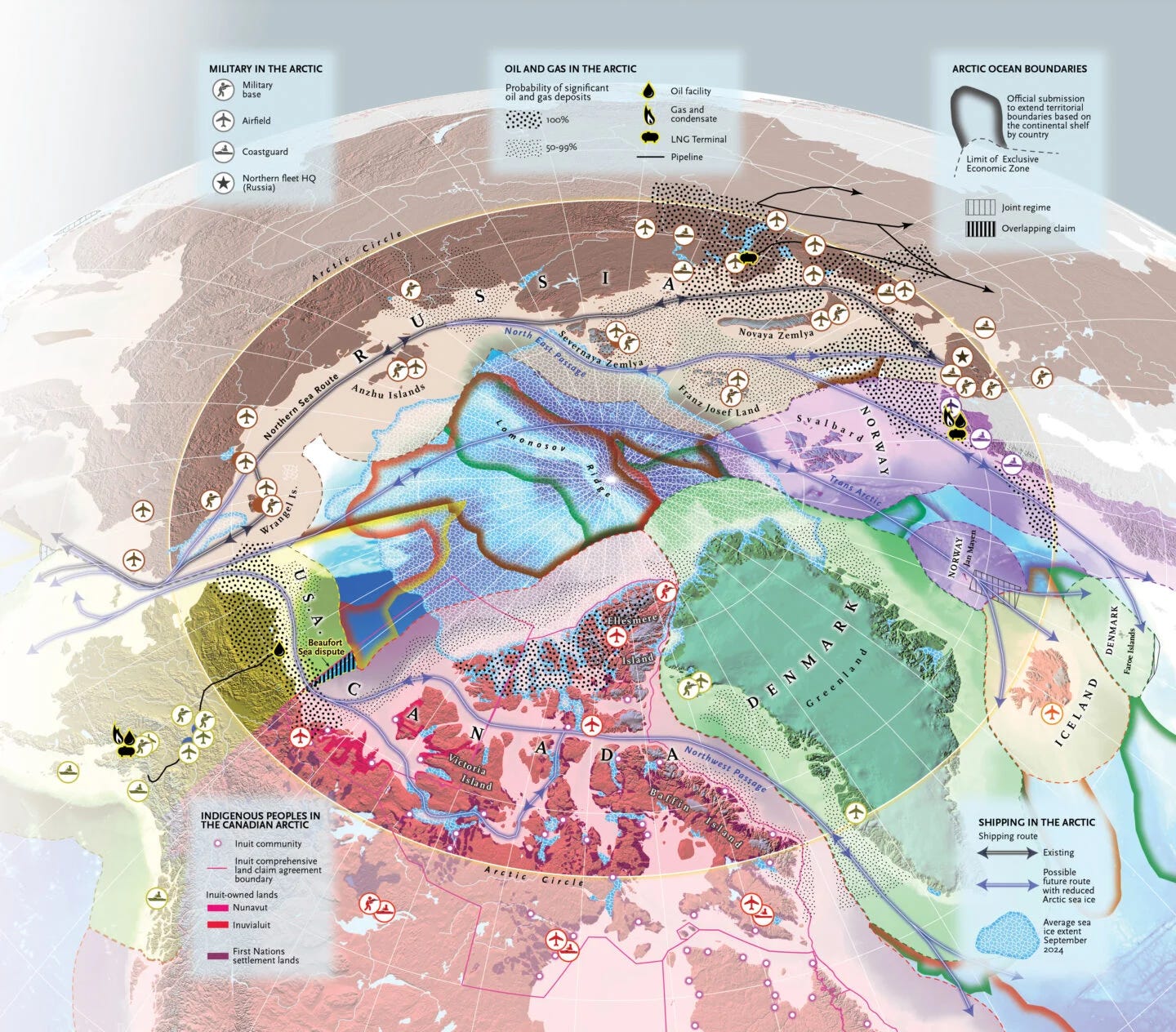
The government needs to lay out a road map to rebuilding Canada’s military capacity, with particular attention on Arctic defence. If Canada continues to leave a vacuum, the Americans will fill it. And they will stay, eroding and eventually displacing Canadian control of the Arctic.
Reality check: If Canada continues to leave a vacuum in the Arctic, it is not just the Americans we must worry about. The Arctic is strategic for our adversaries. China and Russia are already pulling ahead in Arctic drone capability. The Arctic won’t be “invaded.” It’ll be operationally controlled through infrastructure presence. In 2025, Chinese military and research vessels operated around Arctic waters in unprecedented numbers:
Last year, [China] built and deployed its first domestically designed icebreaker in 10 months.
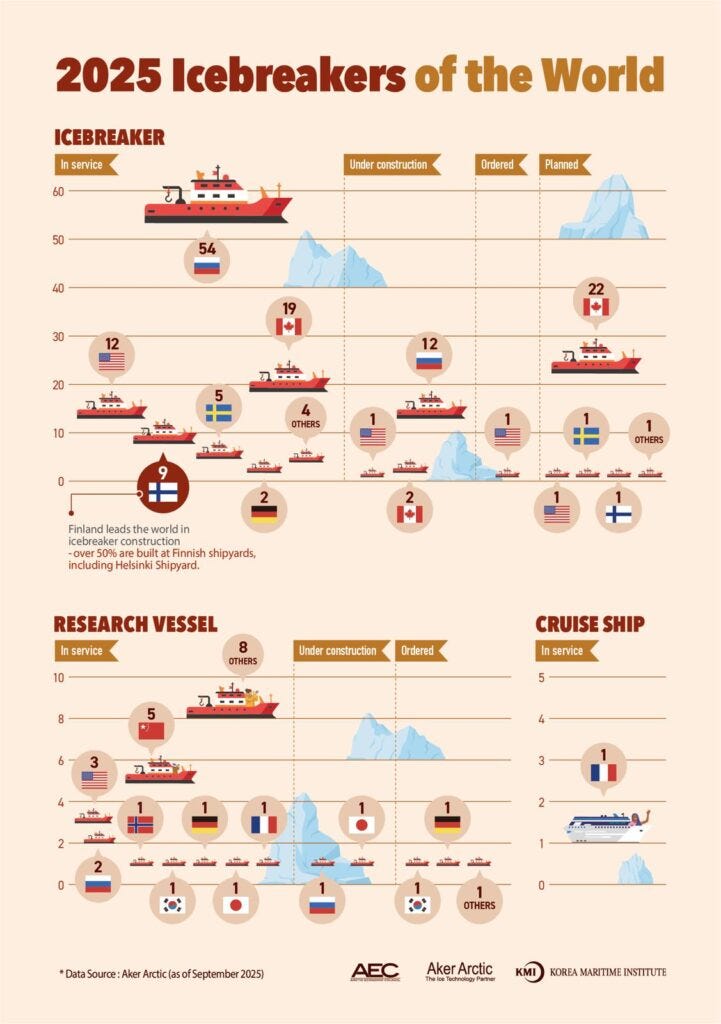
Bottom Line: The Arctic will be occupied, and Canada is not ready for an Arctic conflict. Our immediate focus must be on both increased surveillance — knowing what and who is poking around up there — and having military assets in place to deter any aggressor before they consider operating in Canada’s North.
Related:
Faster, please: This is an emergency, and Canada does not have a moment to spare… Feds’ promised Defence Industrial Strategy missing in action… Canada’s Defence Industrial Strategy must include procurement pathways for homegrown tech… Canadian defence procurement is surging: 1,221 contracts issued in six months. Q4 activity jumped 48.7% over Q3.

Arctic roundup: How many more Arctic warnings does Canada need?… Prioritizing Canada’s investment in Arctic infrastructure… As 2026 dawns, Canada’s North is on the national radar like never before… Arctic war games simulate Russia aggression in Canada’s North… Chinese Cargo Ship Converted To Launch Advanced Combat Drones Emerges… Our Arctic backyard is somewhat unfenced
Force level: The Challenge of Counting Icebreakers…Icebreakers in Canadian Waters… Climate impacts will increasingly strain Canada’s Arctic defence infrastructure
US reliability?: Canada beware, Trump’s Venezuela invasion is a clear warning shot… Canada has ‘no choice’ but to cooperate with White House on defence: McGuinty… The coming CUSMA squeeze and how security policy will rewrite the trade terms… Canada and the EU can win an arms race with Russia, even without Trump… A radical overhaul of Europe’s fragmented defence industrial and capability landscape
ADVERTISEMENT

Dominion Dynamics is expanding our team and we’re looking for ambitious Canadians who want to build sovereign technology for the future of national defence.
🤝 Deal Corner
Engineering professors Ashwin Iyer and James Hogan run an academic research centre focused on defence and dual-use technology that the University of Alberta calls the first of its kind in Canada.


The University of Alberta’s Centre for Applied Research in Defence and Dual-use Technologies (CARDD-Tech), which the two professors co-direct, develops military technology that can also serve to benefit civilians.


Related:
Leadership & training: How the defence sector is battling a skills crisis… The role of a Defence Tech CEO has become one of the most complex leadership jobs in modern industry
Here are benchmarks for deep tech companies that raised venture in 2025
Array Labs Raises $20M Series A
L3Harris to sell majority stake in space propulsion unit to AE Industrial for $845 million
Cambium Secures $100 Million Series B to Accelerate the Discovery and Scaling of Advanced Materials
Ukraine’s defence tech ecosystem may be seeing its first unicorn emerge: the owners of Ukrainian defence tech company Fire Point plan to sell a 30% stake to a sovereign wealth fund of the United Arab Emirates… Ukrainian defence tech company General Cherry has developed a new interceptor drone
The FDA is looking at making venture firms prime contractors who then subcontract to their portfolio companies. There’s a request for information from firms to figure out how this would work
Top 10 Ukrainian miltech startups that attracted the most investments in 2025

A defence bubble burst in 2026?
£1 billion GPS disruption risk prompts Royal Navy quantum navigation testing
Old tech powers new tech?: Bloomberg reports that a data center project in Alberta may reach €8 billion ($9.4 billion) in value over several years. The project, led by European companies Data District and Technologies New Energy, aims to build 1 gigawatt of data center capacity, leveraging the province’s abundant natural gas resources. The development follows a recent agreement between Alberta and the federal government to relax Canada’s clean electricity rules
CSMC tops Maclean’s Year Ahead in Climate top 10 to end the year 2025
Venezuela implications for Canadian oil: No one is rushing into Venezuela to roll the dice *again* on whoever replaces Maduro, and Venezuela lacks logistical means to displace Canadian supply
ADVERTISEMENT

⚔️ Combat Readiness
The Venezuelan “early warning” radar system, supported by China and Russia, was rendered useless after being instantly paralyzed by the US Air Force.
The Economist’s defence editor asks if America’s raid into Venezuela, involving more than 150 planes and stealthy helicopters, pointed to the enduring importance of traditional systems.


Over the past few years, Venezuela has invested heavily in procuring air defence and defence equipment from China and Russia, attempting to build a long-range early warning and interception system for the capital region. Among these, China’s JY-27 series radars have long been touted as “stealth fighter killers,” claiming they can detect the tracks of US F-22 and F-35 stealth fighters; the Russian-made S-300VM system has been portrayed as the strongest air defence shield in South America.
Publicly available materials also mention China as a key supplier, including the JYL-1 air defence radar and the JY-11B air surveillance radar; at the air force level, this includes K-8 series aircraft and Y-8 transport aircraft, used to support air situation awareness and mobility support.
Related:
Venezuela roundup: Did The U.S. Use Kamikaze Drones To Strike Venezuela?… The Chinese Military Is Built for Politics, Not Fighting Wars… Trump suggests US used cyberattacks to turn off lights in Venezuela during strikes… Spies, drones and blowtorches: How the US captured Maduro… Trump has created an oil empire stretching from Alaska to Patagonia
Meanwhile, in Taiwan: China conducts blockade exercise called ‘Justice Mission 2025’ [see visuals]… China flew bombers and fired long-range artillery during a second day of exercises designed to show its ability to claim the island-democracy by force
CDR has identified a number of weapon systems which could be suitable for the Long-Range Precision Strike (LRPS) (Land) project
Canada’s Joly Presses Lockheed for Jobs as Crucial F-35 Decision Nears
Canada has to defend this vital part of its infrastructure from America
Ukrainian specialists report the first confirmed detection of a Russian Shahed strike drone fitted with a man-portable air-defence missile system (MANPADS)
Russia is keeping its helicopters away from Ukraine’s naval drones, a special forces commander says. They were becoming ‘easy targets’
History shows how militaries actually change. It’s slower, messier, and more human than we like to admit
Toronto-based Kepler vies for a spot in the global space-data race
US Army establishes new AI, machine learning career path for officers
Inside China’s Six-Decade Campaign to Dominate Rare Earths… Critical Minerals and Irregular Warfare in the Gray Zone
Carney heads to Paris as allies discuss security guarantees for Ukraine
Could a German startup disrupt Europe’s arms industry?
ADVERTISEMENT

Barrack Hill: Navigating Canada’s defence and procurement landscape with precision.
🔫 Hot Shots
Grey war: Meta Buys Chinese AI Startup Manus for More Than $2 Billion… EVs are highly connected, software-driven platforms. Allowing ones running Chinese software to roam across Canada creates extensive cybersecurity risks… Building Citizen Resilience: Preparing Canadians for an Age of Grey-Zone Conflict… The Next Fight Demands Naval Cryptologic Expertise… Can COFFEE filters calm the spectrum tug-of-war?… Spy watchdog reviewing Canadian security agencies’ use of artificial intelligence… Cognitive Warfare: NATO Chief Scientist Research Report… A Cyber Force Isn’t Enough… Inside China’s Cognitive and AI Warfare

Bad kids table: Iran brands Royal Canadian Navy a terrorist group in act of ‘reciprocity’… Taiwan 2027: China’s target date for potential takeover fast approaches

Policy vs. execution: In this brave new world, Canada urgently needs a foreign human intelligence service… Toronto hate crime suspect denied refugee status in 2018… $50 Fine For Foreign Agents?
Drone corner: Toronto-born entrepreneur wants to bring counter-drone tech home as Canada focuses on defence… Most drones require a human pilot. But some new Ukrainian drones, once locked on a target, can use A.I. to chase and strike it — with no further human involvement… A drone swarm moving like a school of fish… How to Evaluate Drone Stocks: A Checklist for High-Growth Investors… Disrupting Russian Air Defence Production: Reclaiming the Sky… FEMA awards $250 million to boost drone security ahead of FIFA World Cup 2026… Canada must develop a national drone strategy… Ukraine’s milestone shows drones prevent defeat, but don’t secure victory… Europe starts learning how to shoot down drones… US Coast Guard: Approaches to Autonomous Ship Regulation
Moon base: NASA collaborates with Nokia to establish a 4G network on the moon
Reading list: How Canada and the United States became integrated militarily, financially, culturally and economically is a reminder to Washington on the importance of alliances
Map quest: Chinese illegal fishing on South American coasts, affecting the prices of their local products
Top risks 2026: The Eurasia Group’s annual list and implications for Canada
Government PSA: Join the Canadian Commercial Corporation (CCC) for an exclusive fireside chat on foreign defence opportunities on January 13… Does your research team have innovative ideas for defence and security research? The deadline to apply to become a MINDS Collaborative Network is January 19
Editor’s note: Eagle-eyed reader M.M. notes, in reference to the Buy Canadian policy, that Canada did not sign the procurement chapter of CUSMA and as such, has no procurement obligations under that agreement to US companies
If you’ve got battlefield intel, classified tips, or just want to call in an airstrike on our typos, hit “reply” and sound off. Whether it’s a new tech sighting, a rumour from the mess hall, or feedback on our comms, we want your SITREP.