

Editor’s notes: Tomorrow, The Icebreaker will take the stage at NGen’s N3 Summit, where Canada’s advanced industries converge on the topic of defence tech. Come and say hi if you’re attending.
One week to go: Make sure your voice is heard in the Icebreaker x BDC national defence census, which will help governments and capital providers understand the challenges and supports Canadian SMEs need to win in defence.
🎯 Three-Shot Burst
Special guest POV by 🍁 Katheron Intson, CEO at Sentinel R&D
A lot of people looked at Swarmer’s Nasdaq debut and saw absurdity: a company with just $309,920 in 2025 revenue and a net loss of about $8.5 million trading like it had already arrived. On a conventional software screen, that looks detached from fundamentals. But conventional screens are built for normal commercial markets, not for companies whose products are still being validated under live battlefield conditions.

Reality Check: Swarmer is not a normal software company. Public reporting linked the company to Operation Spiderweb, the June 1, 2025 Ukrainian strike inside Russia. The clearest public account described Swarmer as “the invisible brain” behind the operation’s autonomous drone control layer. That does not mean Swarmer alone created Spiderweb, or that it should be credited with the entirety of the operation’s outcome. It means the company has been publicly tied to one of the most consequential drone operations of the war, which proved that low-cost autonomous systems could help impose strategic costs on extremely expensive military assets.
Think Bigger: Swarmer has been in its combat testing and validation stage. Yet according to both its SEC filing and company materials, drones equipped with its Trident OS have already flown more than 100,000 combat missions since 2023, and the company says those missions were conducted under active electronic warfare and GPS-denied conditions. That is not peacetime testing. It is live operational validation at a scale almost no Western defence software startup can match.
This is where the usual valuation language starts to break down. Revenue is one metric. Backlog is another. But neither fully captures what investors may actually be looking at here: a wartime autonomy stack being refined through repeated operational use, and through its demonstrated contribution to losses imposed on the adversary, before commercialization has fully caught up.
Public markets may be trying to price not merely software sales, but combat-proven relevance, battlefield-hardened data, and the possibility that this testing phase is already producing an asset of genuine strategic value.
That matters because value does not begin only when a contract is signed. In defence technology, especially during wartime, a system can be enormously valuable long before procurement channels have translated that value into recognized revenue. If software contributes to missions that destroy or degrade assets worth many times more than the company’s own current income, the absence of near-term sales does not necessarily mean the absence of substance. It may simply mean that the machinery of acquisition is moving more slowly than the machinery of war.
That does not mean Swarmer should be valued dollar-for-dollar on the reported damage associated with Spiderweb or any other mission. Damage is not revenue, and combat contribution is not the same thing as durable market power. But it does raise a serious and underexplored question: how should markets value a company that appears to have contributed to an operation associated with billions in reported losses, and to more than 100,000 combat missions beyond that, while still effectively in the validation phase of its life as a business?
Bottom Line: Swarmer’s debut makes more sense if you stop looking at it like an immature software company and start looking at it like a combat-validated autonomy layer. The market was not buying $300,000 of revenue. It was buying the possibility that software tested across more than 100,000 real combat missions, and publicly linked to a major strategic operation like Spiderweb, may already have demonstrated a kind of value that conventional financial statements are too early to capture.
Related:
Volatus Aerospace Announces Strategic Collaboration with Sentinel R&D to Support Canadian Sovereign UAV Capability
Defence tech founder warns Canada is getting “wishy-washy” about defining sovereignty
DND seeking innovative solutions for Sentinel Shield: Wide-area detection for early warning against uncrewed aerial systems
The Defence Industrial Strategy’s initial spending is not as Canadian as hoped… Canada formally launches Defence Investment Agency, expected to reduce $100-million contract minimum… What comes next on the contracting front?
The Icebreaker’s parliamentary testimony frames final government report on reforming defence procurement:
“The old approach to procurement does not work at the speed of modern threats.”
ADVERTISEMENT

Dominion Dynamics is expanding our team and we’re looking for ambitious Canadians who want to build sovereign technology for the future of national defence.
🤝 Deal Corner
Canada Ex-Defence Minister’s Startup Juno Sees Anduril-Type Role
Vancouver-based Juno Industries Inc. hopes to close a Series A round of about C$10 million by mid-April.
Founded last April, the company is developing a hub for communications, drones and sensors in Arctic environments called Polar Nexus, which CEO Hunter Scharfe said will be “the first of many sensor nodes and deployment platforms” from the company.
“Autonomous systems are going to become the forefront of defence investment,” and “those systems are very powerful and have a lot of different data capabilities,” Scharfe said. But the issue, he said, is what platform will be trusted to trawl through the data, interpret it, and provide officials options for action.
Juno’s ambition is to be a “neo-prime,” a term used for fast-growth startups like Anduril Industries Inc. that are racing with the traditional “prime” defence contractors like Lockheed Martin Corp. to deliver new security technology.


Related:
Behind the scenes in Canadian defence procurement:
Not long ago, I was entrusted to lead the business development effort, technical compliance strategy, proposal structure, and OEM engagement for a bid valued at up to $60M. Here’s what that looks like.
Pitchbook: “The Most Investable Corner of Defence? Electronics”
Uncrewed Mine Warfare Is Emerging as a Scalable Defence Industry Segment
The most innovative defence tech companies of 2026
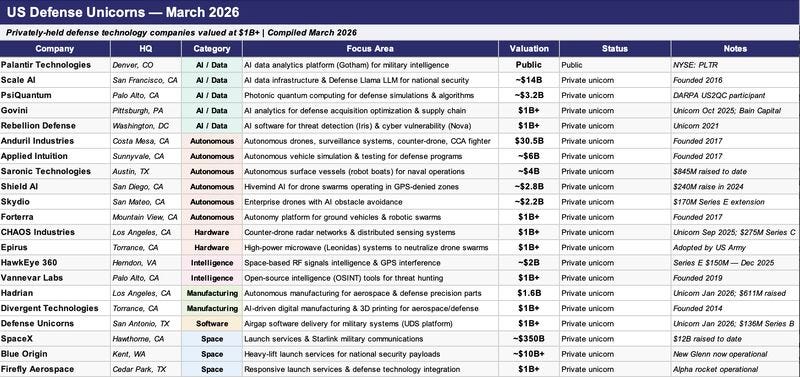
The United States Department of War announced 25 companies competing for its $1.1B Drone Dominance Program. Check out their cap tables
Shield AI Raises $2B Series G at $12.7B Valuation
Anduril, Palantir Developing Golden Dome Missile Shield’s Software, Source Says
SBQuantum wants to help the world navigate in a post-GPS era
Denvr signs two defence deals to deepen sovereign AI push in Canada
Edmonton’s Wyvern Inc. to track rogue vessels as feds earmark $6M for defence research
Cohere teams up with Swedish defence firm Saab on AI for surveillance jets
Airbus and L3Harris Win $1.1 Billion Deals for Canada Fleet Support
Carlyle Said to Plan Defence Fund as Governments Hike Spending
Sailbotix announces initial deployment of one of the most advanced hand-deployable data buoys
UK risks losing defence tech start-ups to relocation amid funding delays
South Korea’s Defence Startups Surge as Global Conflicts Flare
Canada Advances New Global Security Architecture: The Defence, Security and Resilience Bank
Ontario seeks private-sector manager for new $4-billion Protect Ontario investment fund
Pete Hegseth’s broker attempted to make defence investments before Iran war

ADVERTISEMENT

Barrack Hill: Navigating Canada’s defence and procurement landscape with precision.
⚔️ Combat Readiness
Former top general says we need to start building our own long-range missiles
Wayne Eyre, who was Canada’s top soldier as Chief of the Defence Staff until summer 2024, said this country desperately needs its own production lines for many of these munitions. “This includes using our inherent strength in the aerospace industry to produce our own long-range strike and air defence missiles, along with lower cost drones and counter-drone systems,” he said in an interview:

Ottawa’s defence spending plan has ambition, but half of the equation is missing
Money alone does not build security: capacity does
Ukraine Is Making Home-Brew Long-Range Missiles
In 1952, Canada was spending 8% (!) of GDP on defence
Canada’s push to develop nitrocellulose hinges on real industrial integration… CellCore Technologies Emerges from Stealth at DEFSEC West, announces plans for new nitrocellulose facility
As Canada hits NATO 2% goal, Carney vows more as warfare ‘rapidly’ changes
Rheinmetall CEO Armin Papperger said Ukrainian drone makers were housewives with 3D printers and that their work was not real innovation. Ukrainians responded.
“If every housewife in Ukraine can really make drones, then every housewife in Ukraine can be the CEO of Rheinmetall,” Zelenskiy told reporters in a WhatsApp chat.
ADVERTISEMENT

Security Compass aligns engineering outputs to SA&A security expectations with structured evidence and change-aware monitoring. Make reassessments simpler by showing what’s implemented, what changed, and what’s validated.
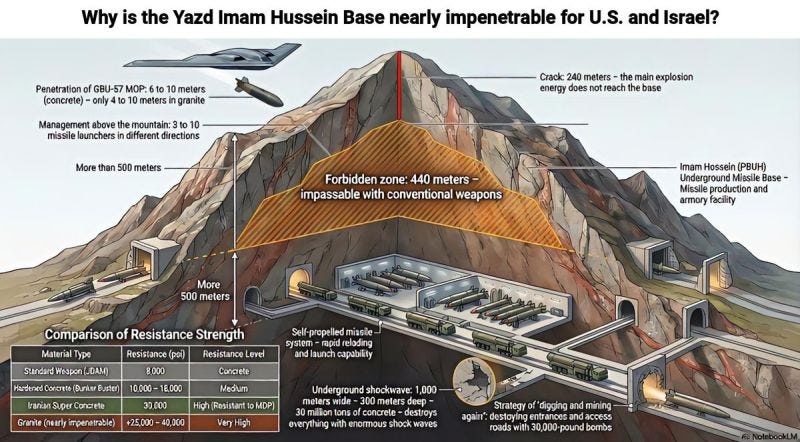
Iran roundup: Ukrainian cheap interceptor drone blows up Iranian Shahed drone in spectacular hit [VIDEO]… Iran built a vast camera network to control dissent. Israel turned it into a targeting tool… Images show destroyed US E-3 Sentry AWACS at Prince Sultan Air Base… Iranians Don’t Have a Missile Alert System, So Volunteers Built Their Own Warning Map
Electromagnetism Secretly Runs the World
China’s robot wolves have been put through a simulated street battle [VIDEO]
A blueprint for Chinese global leadership
Why China Is Stepping Up Its Reusable Rocket Push
Hellscape Taiwan: A Porcupine Defence in the Drone Age
US and UK teaming up to destroy underwater drones
Omniscience, Omnipresence, and Omnipotence: Meet the Gods of AI Warfare
Canadian bacon: The push to create a Canadian rival to GPS… Calgary-born astronaut to be voice link to Artemis II moon mission… Canada clears NATO’s 2% bar — after years of lagging and a last-minute lift… Saab CEO says company, Canada still in ‘intensive’ talks… Toronto Argonaut turned military outfitter wants Canadian Army to be ‘brilliant at the basics’… Farewell, Victoria! On Hanwha Ocean’s Bid for the Canadian Patrol Submarine Project… As oil pipelines become an ace in ‘Canada’s deck,’ should country place bet on path south or west?… Canadian Army overhaul looms as DND finalizes mobilization plans
Thought leadership: The Luxury Beliefs That Broke Europe’s Energy System… NATO on how emerging technologies advance… Artificial intelligence is increasingly being incorporated into maritime surveillance, navigation, and decision-support systems… Kraken Robotics’ Chief Technology Officer, David Shea, “Dispelling Myths About Synthetic Aperture Sonar”
Drone wars: Noah Gairn on CUAS… Dutch armed forces to add drone operators to combat brigades… VW in talks with Israel’s Iron Dome maker to shift from cars to missile defence… Kinetic interception, Russian style [VIDEO]… Yesterday, a $𝟱,𝟬𝟬𝟬 𝗱𝗿𝗼𝗻𝗲 destroyed a $𝟲,𝟬𝟬𝟬,𝟬𝟬𝟬 𝘁𝗮𝗻𝗸 equipped with the world’s most advanced protection system… The Pentagon Copied Tehran’s Technology but Is Still Struggling to Keep Up
Arctic shelf: In Canada’s far north, some fret Carney’s military plan overlooks everyday needs… Scenes From the Canadian Arctic
From the Ukrainian front: Ukrainian drone architect talks to 60 Minutes on the cost per kill metric… Ukraine is offering Gulf states 1,000 drone interceptors per day. Each Sting interceptor costs $2,100. Each Patriot missile it replaces costs $3.9 million… Vibe-coded visualization of publicly available data relating to Unmanned Systems that have been used during the Russian invasion… A choice of deadly drones is a few clicks away for Ukrainian troops… Ukraine Is Building the Drone Warfare Machine NATO Still Does Not Understand… Ukrainian drones have made artillery and armored vehicles look obsolete. Why is the world still buying them?
Why defence can’t scale innovation, by Stuart Lodge:

ADVERTISEMENT

Canada Rocket Company is building our sovereign launch capability. We’re hiring 10+ roles. Apply here.
🔫 Hot Shots
Grey war: Reservists killed in Kuwait a few weeks ago were targeted using adtech; Iranians used it to trace their movements to the port… Chinese Hackers Caught Deep Within Telecom Backbone Infrastructure… APT Iran hacking group advertises 375TB of data purportedly exfiltrated from Lockheed Martin for $600M… Buy a cheap satellite dish and listen: SMS, payment data, and military secrets will fall from the sky… Hacked hospitals, hidden spyware: Iran conflict shows how digital fight is ingrained in warfare… Iran-linked hackers breach FBI director’s personal email, publish photos and documents


Odds & ends: “Ronnie, the Bren Gun Girl” was a Canadian icon representing nearly one million Canadian women who worked in the manufacturing plants that produced munitions, weapons, and equipment during the Second World War… More money for Canada’s military should mean more transparency and accountability… Why foreign investment has surged into Canada


If you’ve got battlefield intel, classified tips, or just want to call in an airstrike on our typos, hit “reply” and sound off. Whether it’s a new tech sighting, a rumour from the mess hall, or feedback on our comms, we want your SITREP.