

🎯 Three-Shot Burst
$2 billion behind Canada’s SMB defence builders.
CIBC is committing $2 billion over five years to finance Canadian defence and dual-use small and medium businesses, a pledge confirmed to include infrastructure, energy, cybersecurity, digital capabilities and advanced technologies. The bank frames the money as economic strategy:
“Defence is no longer a secondary consideration to investment decisions…. Canadian businesses in the defence and resiliency ecosystem have the expertise and ambition to lead” — CIBC president and CEO Harry Culham
An official press release layers on a national defence-specialist network and an expanded Military Banking Program. BetaKit’s running tally of Carney’s investment summit places CIBC’s pledge inside a push toward $1 trillion in five-year Canadian investment commitments.


Canada Investment Summit prospectus lists four space opportunities
Ottawa hands out its first drone money.
The federal government awarded its first Defence Drone Initiative contracts worth up to $50 million to six Canadian companies. Each winner must first deliver 100 low-cost surveillance drones at $5,000 or less per unit, or two uncrewed ground vehicles, before Ottawa will order up to 4,900 more drones and 10 more ground systems.
“In the years to come, we will need millions,” Prime Minister Mark Carney said in the same announcement.
One of the six, Volatus Aerospace, landed a five-year contract worth up to C$25 million to supply an initial 100 tactical ISR uncrewed systems, scalable to 5,000 units total if Ottawa exercises every option
Reality check: The same week, the Hill Times reported that the head of the Defence Investment Agency reportedly eyes the exit even as observers praise “unprecedented” procurement speed, with a defence analyst warning: “You can only bypass [the bureaucracy] so much. You need to change the way it works if you really want to make really substantial reform.” Ottawa kept issuing new money calls regardless, opening a challenge worth up to $6.75 million for radio-frequency data fusion proposals due October 20.
Big kudos to General Molstad, Duncan Stewart, and the teams at CJFC and the DIA!



Canada and Ukraine sign a 100-year pact.
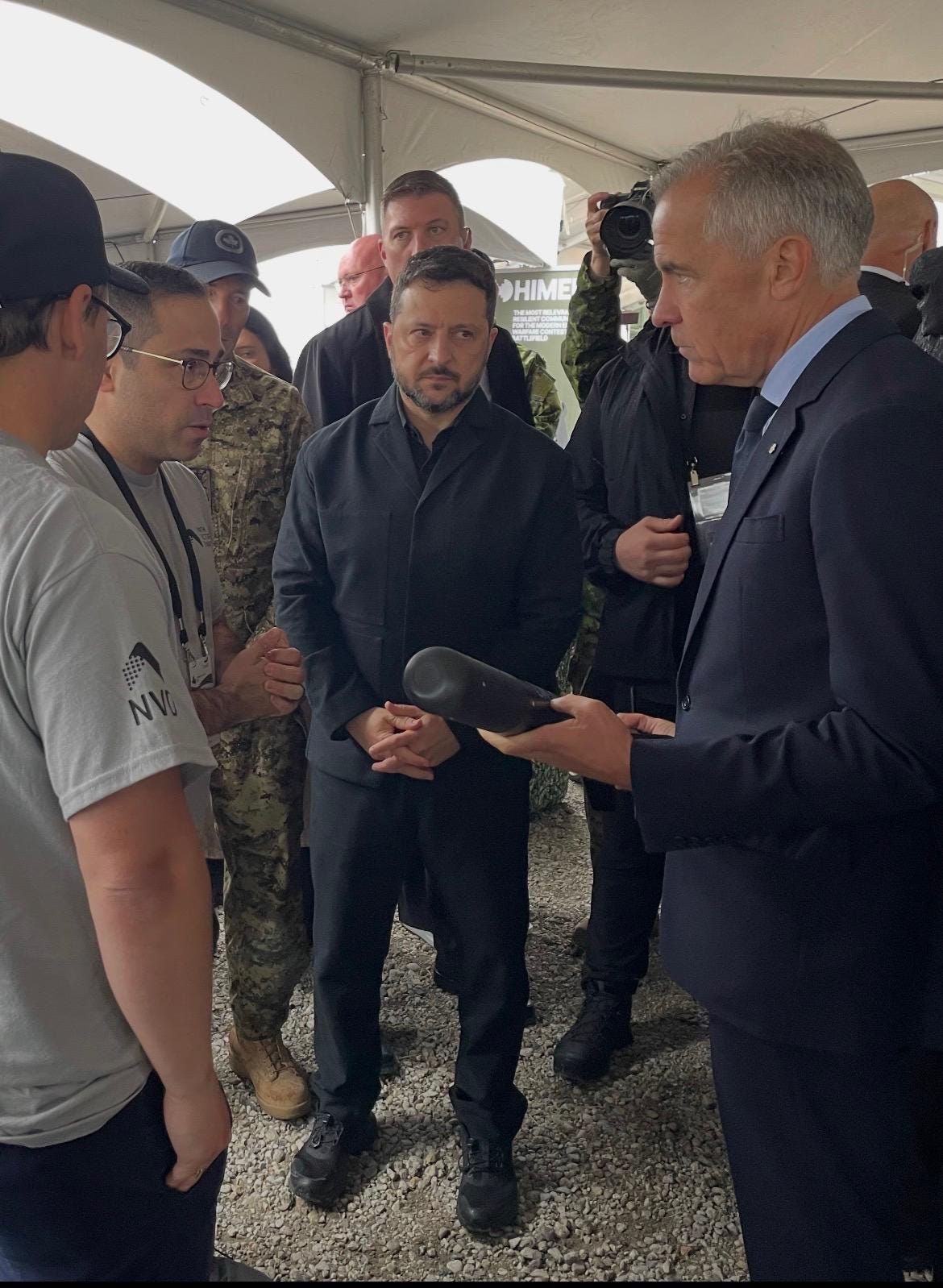
Prime Minister Mark Carney and President Volodymyr Zelenskyy signed a 100-year strategic and political partnership in Calgary, built around a shared plan to scale Canadian drone production into the millions, with one in three drones destined for Ukraine’s front lines. Carney called it part of a broader industrial buildout.
Ottawa paired the drone pledge with $350 million for Ukrainian air-defence interceptors, close to $435 million in loan guarantees for energy security, $200 million in concessional reconstruction loans and up to $40.1 million for Ukrainian veterans and their families. The stakes on the water are already visible: Ukraine’s navy claims its Sargan 3000 uncrewed surface vessel sank a Russian drone boat in what it calls the first naval battle in history between unmanned boats, using a remote 12.7mm gun rather than a missile. Ukraine’s ousted tech-forward former defence minister Mykhailo Fedorov, as covered by The Defender, is reportedly plotting the country’s largest venture fund for defence tech after a US fundraising trip, with Euromaidan Press reporting his three priorities as frontline sensorization, jet interceptors and cheap strike missiles.
Under heavy cloud cover, Russia fires massive drone barrage at western Ukraine
Ukraine is the laboratory for the future of war
Russia Is Churning Out Smart, Cheap New Weapons Faster Than Ukraine or the U.S.

ADVERTISEMENT

Barrack Hill: Navigating Canada’s defence and procurement landscape with precision.
🤝 Deal Corner
🍁 BMO puts up to $70 billion on the table for a decade.
Bank of Montreal will deploy up to $70 billion in new capital over 10 years to defence and security, energy, infrastructure, mining and AI computing.
🍁 Scotiabank builds Canada’s first defence bond framework.
Bank of Nova Scotia published a Canadian Defence Issuance Framework aligned with NATO’s target of 5% of GDP by 2035, becoming, according to Vanguard, the first Canadian institution with a dedicated framework for labelled defence issuances, independently assessed for the first time globally by Sustainable Fitch.
Canada’s Defence Spending: A Number in Search of a Strategic Framework
A New Canadian Defence Company, Built on a 50-Year Track Record
🍁 Volatus locks a contract that could scale to 5,000 drones.
Volatus Aerospace was awarded a five-year Government of Canada contract to supply the Canadian Armed Forces with an initial 100 low-cost tactical ISR systems. The company is attempting to build a complete sovereignty stack.
🍁 Inkas bets its next 30 years on Canada instead of exports.
Toronto’s Inkas, which built its business exporting armoured vehicles and safes, is pivoting toward Canada’s own emerging defence market with two new platforms: the M1 light tactical vehicle and the Anuri counter-UAV system. The company currently builds 300 to 400 vehicles a year and expects to roughly double that with expanded Canadian capacity, even as it also opens a facility in Charlotte, North Carolina.
🍁 CSMC wants a reactor plugged into every Arctic base.
Canadian Strategic Missions Corporation unveiled three reactor platforms: POLAR-1 for defence installations and Arctic communities, JAY-1 for lunar bases, and ORCA-1 for research and training, with POLAR-1 targeting first criticality by 2028. CSMC has pulled in more than $17 million in government grants, contributions and contracts since 2022, per a duplicate writeup of the same announcement. Founder and CEO Daniel Sax: “Reliable energy is becoming the crucial national strategic capability.”
🍁 Stellantis may hand its idle Brampton plant to armour maker.
Stellantis signed a memorandum of understanding with Roshel, a deal reported in more detail by CBC as covering the possible sale of its idle Brampton assembly plant and more than 2,000 jobs. Roshel CEO Roman Shimonov frames it as the kind of domestic industrial reuse Canada’s defence buildout needs.
🍁 Fourteen Canadian drone builders gang up on Ottawa’s wallet.
A coalition of 14 Canadian companies making drones and related hardware is pushing the federal government, covered in more detail by RALI, to buy more from homegrown suppliers that build and control their own hardware and software, sharpening the debate over how far Ottawa’s Buy Canadian policy actually reaches once Defence Drone Initiative money starts flowing more quickly.

🍁 A flow-through share pilot wants Canadians, not Ottawa, picking tech winners.
A new proposal would extend Canada’s Flow-Through Share model into a capped, three-year “FTS-Tech” pilot for qualifying technology startups, letting private Canadian investors rather than government bureaucrats choose which companies get funded. The pitch leans on an estimated US$1.6 billion-plus cumulative seed-to-Series-A funding gap, with Canadian seed rounds reportedly 40% smaller and five months slower to close than comparable US rounds.

Erik Prince’s Swarmer buys a Ukrainian robot maker for up to $224 million.
Austin-based Swarmer, whose autonomy software already controls up to 690 drones per swarm, agreed to acquire Kyiv’s Ratel Robotics, reported in full by The Robot Report, in a cash-and-stock deal worth up to $224 million if every earnout milestone lands. Ratel’s uncrewed ground vehicles already account for roughly 37% of Ukrainian UGV procurement spending this year, and more than 300 of its employees are expected to join Swarmer.
Mach Industries adds another $600 million, pushing its valuation to $3.7 billion.
The 22-year-old MIT dropout behind Mach Industries, Ethan Thornton, closed a $600 million Series C extension that pushes total fundraising past $1 billion and valuation to $3.7 billion, up from $1.8 billion in June, with the money aimed at scaling long-range strike and counter-UAS production simultaneously rather than betting on one platform.
Fortaegis raises $50M to scale secure silicon for defence. Amsterdam-based Fortaegis will use the funding to move its hardware-rooted security technology into mass production.
Poseidon raises $60 million to build cargo drones the size of small planes.
Bay Area-based Poseidon Aerospace closed a $60 million Series A led by TQ Ventures, ten months after an $11 million seed round, for its 4,000-pound-payload Egret cargo drone and a seaplane variant with a 1,650-nautical-mile range.
Smack Technologies raises $61 million for a wrist screen soldiers can read under fire.
Smack Technologies pulled in a $61 million Series B, pushing total funding above $90 million in roughly five and a half months, to expand from its Omega command software into Alpha, a forearm-worn tactical display built for communications-denied environments. Gen. James Mattis gets quoted in the company’s own materials: “The most important six inches on the battlefield is between your ears.”

Covenant emerges from stealth with $250 million and a missile built to be mass produced.
Covenant, founded in 2024, came out of stealth with $250 million raised across three rounds for Anthem, a production-ready, long-range strike missile carrying more than 200 kilograms. The company has already booked roughly $150 million in orders and plans combined annual production of 12,000 missiles across Dallas, Germany and Israel. President Abby Denburg: “We were designed for the China fight.”
Andreessen Horowitz picks Florida as its defence-money capital.
A16z plans to open a regional headquarters in West Palm Beach in 2027 to run its American Dynamism fund, which has raised $1.18 billion for national-security and industrial-economy startups, in a state whose military and defence industry already generates $102.6 billion in economic impact.

Isengard Industries launches out of Y Combinator with $10 million in revenue already booked.
Isengard Industries, co-founded by Francisco Serra-Martins, launched out of Y Combinator building precision-strike and counter-drone systems that allied nations can manufacture domestically, reporting $10 million in revenue and a $350 million pipeline across the US Army, Ukraine and other allies. Serra-Martins previously scaled Terminal Autonomy to $60 million in revenue inside Ukraine, and doesn’t undersell the new venture: “We call it Weapons of Mass Production.”
Related: Red Cell Partners landed a Pentagon contract that could generate $100 million for its portfolio startups, the Pentagon’s own Defense Innovation Unit is prototyping a Bridge Program to fast-track security clearances for venture-backed startups, and California’s Bulwark Dynamics closed a smaller $6.8 million seed round to scale autonomous landing craft for contested last-mile logistics.
“The world has defense primes. I think it now needs a resilience prime”
Sweden’s concept of “defence” long predated its NATO membership


ADVERTISEMENT

Learn more here.
⚔️ Combat Readiness
Kit for Canada 🍁: Ottawa began negotiating for six Saab GlobalEye surveillance aircraft before confirming the jets met Canada’s military requirements, and subsequent assessments found gaps in radar coverage, range, crew stations, NORAD connectivity and in-flight refuelling.
Meanwhile a German shipbuilder is trumpeting “Arctic-proven” submarines for Canada’s planned fleet even as experts doubt the vessels can actually operate under ice, and a separate piece on ITAR-avoidance economics argues Canada’s F-35, Gripen and GlobalEye dependencies will only shift once substitution costs and domestic capture make it worthwhile, pointing to Germany’s recent $21 million buy of ITAR-free thermal sights as the template.
Export push 🍁: Canada led an unprecedented push into Europe’s defence market at Poland’s MSPO exhibition with more than 230 Canadian companies and associations on the floor, as Europe mobilizes up to €800 billion for defence over three years. Robotics Centre CEO Charles Barlow on the new pace: “It’s not like the old days when you could sit down, design a ship, start building it and take it into service eight years after you conceived of it. Now, we have to get it out within eight months.” EDC is coaching Canadian exporters that success in Europe depends on local partnerships and supply-chain integration, not just price, citing Poland’s nearly C$70 billion defence spend in 2025 alone. Not everyone is convinced Europe is the answer: MLI’s Ed Fast and Richard Shimooka warn Canada has no substitute for America’s security umbrella, noting continental Europe still takes just 17% of Canadian arms exports.

European rearmament race 🍁: That tension sits underneath the EU and Canada’s reported plans for a far-reaching new alliance, which other outlets say could see Ursula von der Leyen unveil the pact September 16 in Strasbourg, building on Canada’s status as the first non-EU country inside the bloc’s €150 billion defence procurement fund. Europe’s underlying industrial muscle is real: Rheinmetall’s order backlog hit a record €80.5 billion after first-half sales rose 39% to €5.2 billion, cementing its role rearming the continent, while Rafael, Lower Saxony and Aurelius Capital are turning a shuttering Volkswagen plant in Osnabrück into a defence production hub, with Rafael CEO Yoav Tourgeman framing it as protecting “Germany and Europe.”

Home front 🍁: The Canadian Army is undergoing its most extensive reorganization in more than 30 years, replacing four regional divisions with three capability-focused formations. The new 1st Canadian Division, headquartered in Edmonton, will add roughly 1,000 soldiers to CFB Edmonton over the next few years. Ottawa-based industry association ACDC has a new Kyiv-born executive director, Dasha Cohen. And a Walrus feature argues Ottawa’s plan for six new Coast Guard icebreakers still leaves Canada without the heavy Arctic fleet it needs, pointing out the $720 million Diefenbaker polar vessel promised in 2008 remains undelivered.


Space Force has ‘space control weapons’ on orbit. Air Force secretary Troy Meink didn’t elaborate on what “weapons” the US deployed, but revealed new info on other space and unmanned Air Force programs.


Software sovereignty: Canada’s window to migrate sensitive systems to post-quantum cryptography is narrowing fast, with Canadian and allied watchdogs targeting 2035 even as Google moved its own deadline up to 2029.
CDA Institute argues Canada should build its own interoperability rather than keep borrowing it from Washington, warning that dependence on US cryptographic keys and ITAR-controlled components leaves Ottawa exposed as political relations sour. The same dependency logic runs through cyberspace: a Palo Alto firm built an AI hacking tool in just over a week that can compromise a WeChat account without a single click, CEO Thai Duong calling the flaw “remarkable.”
Drones can hack your ground control station


The kill zone: Russia’s jet-powered drone attacks have grown from 350 to 2,800 a month between June and August, with Ukraine’s interception rate falling from the mid-90s to as low as 60%, a shift also flagged in the New York Times original. Eric Schmidt’s own account of sheltering underground in Kyiv as Russian ballistic missiles closed in makes the abstraction concrete.
Missile math: A US infantry company that trained against Ukraine’s “Nemesis” drone unit at Hohenfels came away convinced human operators remain the weak link: “The sky, in perpetuity, not just sporadically, was now part of the battlefield.” Ukraine’s own missile shortfall is structural, not tactical: an Economist analysis, reconstructed via Euromaidan Press, reports Patriot PAC-3 stocks near zero and describes Kyiv’s Freyja interceptor project as a roughly $700,000-per-round alternative to a $7 million Patriot round.

Counter-drone: US officials say drone activity probing the Rio Grande Valley dropped roughly 75% after the first operational use of a high-energy laser in late August, which has since destroyed 11 drones over 10 days and led to AeroVironment’s first high-energy-laser contract, worth $465 million. The US Army is meanwhile planning a November interceptor “shoot-off”, with roughly 147 proposals submitted after Lt. Gen. Frank Lozano, as reported by Bloomberg Law, said: “Ukraine and Iran have clearly shown relatively inexpensive drones can impose significant costs and operational challenges.”

Pentagon reform watch: The Pentagon codified its pause of CMMC Phase 2 in a September 3 memo after a 60-day review of more than 1,100 industry responses, with DOD CIO Kirsten Davies drawing the line: “Compliance equals compliance. Compliance doesn’t equal security.” A National Interest op-ed argues US Cyber Command remains poorly integrated into joint planning despite roughly 6,200 personnel, a gap authors Mark Montgomery and Matthew Ferren say a peer conflict with China would expose brutally. And a New York Times interactive on supplying US warships during the Iran war describes resupply runs of up to 3,700 miles after Iran destroyed a critical Bahrain logistics base on the war’s first day, a posture the paper calls unsustainable with four of the Navy’s 11 carriers tied down in the region. A Washington Post opinion piece pushes the budget math further, arguing the US federal budget cannot actually survive a major war, with rising Social Security and health care costs already crowding out defence spending before Trump’s proposed $1.5 trillion annual defence budget even lands. Former Joint Chiefs chairman Michael Mullen frames the stakes bluntly: “The most significant threat to our national security is our debt.”


Big think: Anthropic disclosed it blocked five attempts to use Claude for bioweapons research and prevented Iran from using the tool to target US naval bases, while separately reporting Yemeni militants used Claude in three guided-weapons programs, test-firing one rocket that failed. Anthropic-linked reporting in The Telegraph also alleges that Chinese municipal police used Claude to seek intelligence on anti-Beijing protests in Canada.
The US Army’s updated biodefence strategy aims to “fight through” AI-enabled bioweapons by 2035, while a New York Times magazine feature on grid vulnerability revisits the 2013 sniper attack on PG&E’s Metcalf substation, warning a large enough failure of America’s aging, hand-built transformers could black out the country for years. Separately, Johns Hopkins APL researchers say a new sintering process could build hypersonic-grade carbon-carbon composites in days instead of months.

Maritime autonomy: Anduril confirmed Iran recovered a largely intact Dive-LD underwater drone near the Strait of Hormuz, attributing the loss to a malfunction even as the modular vehicle’s attritable design was meant to make exactly this outcome survivable. A Consultative Shipping Group of 18 maritime nations including Canada is warning that shadow fleets and geopolitical fragmentation threaten freedom of navigation, a concern first raised in a Wall Street Journal piece on the same warning. NATO allies separately foiled a Russian plot to sabotage undersea cables linking Svalbard to mainland Norway.
Axis watch: A Chinese state-owned firm allegedly shipped 46 tons of carbon-fibre precursor to Russia’s sanctioned Alabuga-Volokno plant disguised under a civilian customs code, enough, physicist David Albright estimates, to build up to 1,300 kamikaze drones. The Telegraph’s version of the same shipment ties it directly to an August attack on a Ukrainian shopping mall that killed at least 16 people. Canada and China, meanwhile, held their first defence coordination talks in more than eight years, restarting communication frozen since Beijing’s 2018 detention of Michael Kovrig and Michael Spavor. Retired Gen. Wayne Eyre: “Throughout history, maintaining communication with an adversary has been useful to deepen understanding and avoid unintended escalation.”

🔫 Hot Shots
The UK puts a drone testing site up for sale. A property near Swindon used by the UK Ministry of Defence to test drones is going on the market, a listing agents say will test investor appetite for real estate with a military past.
Sea, Space and Cyberspace. All Are Under Siege.
The CIA wants more engineers, not more spies. Deputy Director Michael Ellis says China’s economic leverage and AI-enabled cyber operations are forcing the agency to chase more technical expertise from the private sector, even as it brings on its largest Directorate of Operations class in 20 years. Ellis: “The outcome of that competition will be dictated by who has the superior technology.”

US Marines test fighting from two coastal outposts at once. The 13th Marine Expeditionary Unit ran simultaneous forward sites near Camp Pendleton, one for maritime surveillance and drone tracking, the other combining command operations with aircraft refuelling and rearming, testing the Corps’ distributed Expeditionary Advanced Base Operations concept.
Seafloor to global force. Halifax’s Kraken Robotics expanding its footprint beneath the waves.
How venture studios plan to break into the defence market.
Hermeus wants to sell hypersonic test flights as a service. The company unveiled Ramjet-X, an expendable ramjet-powered vehicle air-launched from its Quarterhorse drone at roughly Mach 3 before climbing toward 100,000 feet and Mach 4, with integrated flight testing planned for 2027.

A think-tank traces how fast Russia iterates its kamikaze drones. A CSIS analysis charts how Russia turned Iran’s Shahed-136 into the constantly evolving Geran platform, backed by a $1.75 billion domestic-production deal and battlefield feedback loops the authors say Western acquisition processes cannot match: “The cycle ran faster than any Western procurement program could plausibly match.”
A cyberwarfare report says US Cyber Command’s own force-generation system is broken. Mark Montgomery and Matthew Ferren argue Cyber Command remains poorly integrated into joint planning and tactical operations, despite roughly 6,200 personnel across nearly 150 Cyber Mission Force teams: “America’s cyber force generation system is clearly broken.”
A New York Times feature asks what happens if America goes completely dark. A magazine piece on grid vulnerability revisits the 2013 sniper attack on PG&E’s Metcalf substation, which disabled 17 transformers in about 120 shots, arguing the grid still runs on thousands of aging, hand-built transformers that could take years to replace if enough failed at once.
European defence stocks catch a bond-market chill. Rising government borrowing costs are pressuring defence shares and the continent’s spending targets, with France’s 10-year yield up 32 basis points to 4.21% in a month, ahead of Italy’s 4.17%, while the UK reportedly weighs shelving its own 3%-of-GDP-by-2030 target.
Close: A group representing 18 major shipping nations, Canada included, warned that a “two-tier” maritime trade system is emerging around sanctioned shadow fleets and chokepoint disruptions: “Strong international cooperation is not a constraint on sovereignty; it is a prerequisite for effective governance in an interconnected world.”
The Icebreaker is written for the people building Canada’s defence technology base. Forward it to someone who needs it.