

Editor’s Note: Glad to welcome CIBC as a sponsor of The Icebreaker. Start with their latest on defence: Made in Canada: The industrialization of Canada’s defence procurement. Now join us to get to know their awesome team: a handful of seats remain for CIBC’s sponsored special, DMZ x Icebreaker Present: Northern Defence — A Private Screening, on Sept 14.
🎯 Three-Shot Burst
For two days last week, roughly 200 Canadian Armed Forces personnel stood on a decommissioned airfield outside Killaloe, Ont. and watched nearly 30 Canadian companies put uncrewed systems through their paces. Canada is looking to increase its military drone and robot supply for a new era of warfare, and this was the CAF making that operational. The event: the RED COBALT Uncrewed Systems Accelerator, a first-of-its-kind CAF-industry drone test.
Quadcopters, fixed-wing, command-and-control stacks, counter-UAS, unmanned ground vehicles. Names on the flight line included Sentinel R&D, Robotics Centre, Redwire, Remote Robotic Systems, Screaming Geese, ARA Robotics, Draganfly, Remeo One, Kelluu, Sensofusion, Indro Robotics, and many more.
Running point was Lt.-Gen. Darcy Molstad, commander of Canadian Joint Forces Command, who has the unenviable job of deciding what the CAF needs, and how much, in a category where the answer changes faster than the staffing cycle. His framing, and it’s the quote of the week: the military has to “innovate at the edge directly with industry” because this is “technology that evolves on a weekly basis in a modern operational theatre.”
Translation: write a spec, tender it, deliver in five years, receive obsolete kit. Ukraine settled that argument in 2023. Ottawa is catching up.

RED COBALT happened at Area X.O, the R&D and demonstration complex built by Invest Ottawa, and one of Canada’s NATO DIANA test centres. The Killaloe site is Area X.O’s secondary facility, a former airport chosen because you cannot do serious airspace work in the shadow of Ottawa International Airport. CEO Sonya Shorey put it plainly: Area X.O Killaloe unlocks “testing, demonstration, validation opportunities” that aren’t possible closer to the capital.
That’s the whole game. Sovereign capability doesn’t materialize from strategy documents. It materializes when a 12-person company can fly a payload in controlled airspace, in front of the operators who’ll actually use it, without a six-month regulatory odyssey. Invest Ottawa built that, before it was fashionable, on municipal-scale resources. Lt.-Col. Jayme Leclerc, who organized the event, made the same point from the uniform side: RED COBALT put military officials in front of manufacturers they’d otherwise struggle to reach.
Convening power is infrastructure. Hats off to Sonya and her team.

The industrial wrapper is the Defence Drone Initiative, a DND-DIA marketplace under the Defence Industrial Strategy. Sovereign capability, DND said, means access to the expertise, intellectual property, production capacity, supply chains, and sustainment. The initial application window closed 14 August. Around 500 vendors are expected in the first pool. The feds are standing up that pre-qualified supplier pool to compress acquisition from years to roughly two months, with three significant RFPs queued behind it. If that holds, it’s the most consequential change to this market in a decade. Two months is a cycle a startup can survive. Five years is a cycle that kills companies before the contract lands. Molstad also said the quiet part out loud: Canada’s SMEs are underutilized. Better coming from him than from us.
One of the first six asks from that pool is a deep-precision strike (DPS) system sitting between a long-range one-way attack drone and a cruise missile. Defence Minister David McGuinty: adversaries already have them, they are improving them, and “this is an area we can’t let slip.” Lt.-Col. Nick Verreault, head of the Joint Uncrewed Systems Office and DPS program director, put the production target on the record. Increase drones made in Canada by 200 times, or two million a year. Ottawa will still buy a foreign DPS first, inside about 10 months, then try to stand up a sovereign line.
IDEaS is standing up a downtown Ottawa urban CUAS sandbox for 26 to 30 July 2027: detection only, $1.75 million in prizes ($1 million / $500,000 / $250,000), $20,000 in expenses, RCMP and U.S. DoD SSO as observers, applications due 1 December 2026. A Joint CUAS Office is forming. The training pipeline confirms this is not a fad. MWO Blake Berggren, building FPV drone courses for the CAF, calls it “the biggest and fastest-paced change” of his 25-year career. Nobody builds a school for a fad.
The lesson from Ukraine is not a particular airframe. Yuriy Filatov told National Defense Magazine that kit is stale in six months. “You can copy a drone, but you cannot copy the speed [at] which it was born.” NATO just watched the point land. In Combined Resolve in Germany (April to May 2026), Ukraine’s 412th Nemesis handily beat a Texas mechanized brigade with FPV and dropped munitions. “Killed” U.S. troops had to be recycled as reinforcements to keep the game running. Gen. Alexus Grynkewich said that experience cannot be replicated in the United States, which is another way of saying the CAF cannot photocopy it from a CONUS range either.
Bottom Line: A serious CAF-industry conversation, on infrastructure Invest Ottawa had the foresight to build, in a policy environment finally admitting procurement is the bottleneck. In Canadian defence, that’s close to a miracle. The caveats: a showcase is not a contract, “two months” is an aspiration until it’s a signed PO, and Ukraine’s real lesson isn’t that drones are good. It’s that drones are consumable. Now show us the contracts.

Related:
The single biggest leading indicator of more defence spending is more RFPs. That DND signal is here
Ukraine’s first jet-powered interceptor drones for countering jet-powered Shaheds undergo combat testing
Ukraine developed a €200 trajectory correction kit for precision drone drops, known as “FireFly”… Pocket sized drone defence out of Ukraine… Wuxly awarded CBRN Protective Clothing contract for CAF
ADVERTISEMENT

CIBC is a proud sponsor of The Icebreaker. Connect with our team at Mailbox.Defence@cibc.com
🤝 Deal Corner
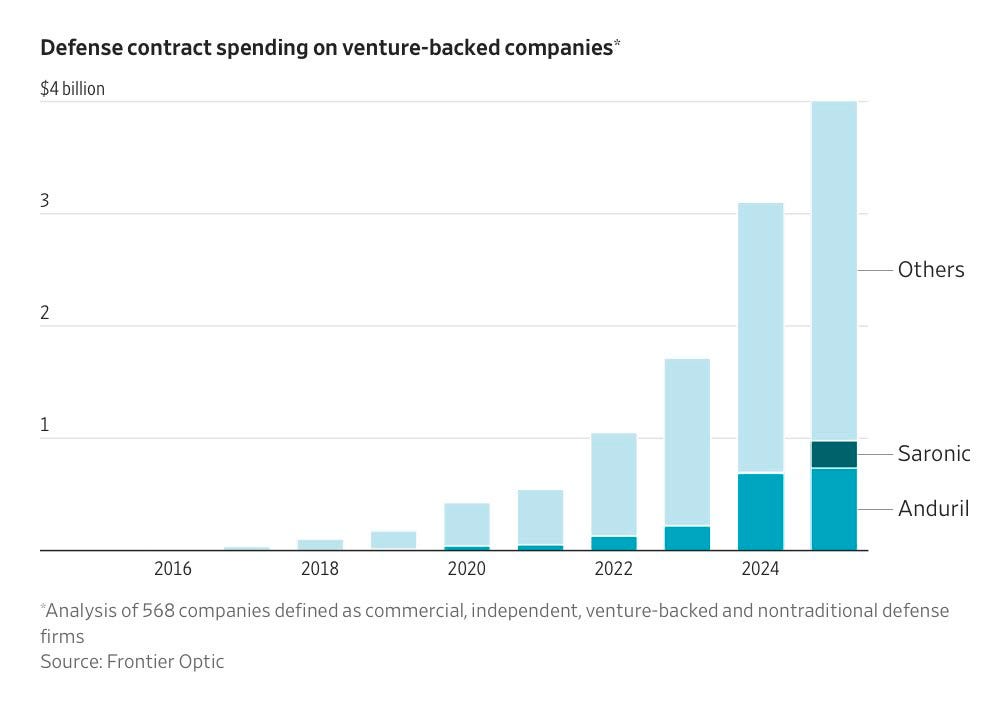
PitchBook’s Q2 2026 Defense Tech Report logged $16.4 billion across 249 deals, down 32.8% from Q1’s record $24.4 billion and still the fourth-largest quarter on record. Trailing twelve months: $69.5 billion. Autonomy took 42.1%. Anduril’s $5 billion Series H at $61 billion is the concentration problem in one line. Eleven public listings reopened the exit window. The next test is funded orders, scaled production, and recurring revenue. That test is already sorting winners. The Pentagon is buying weapons from startups under Secretary Hegseth, not just writing them science-project cheques.
JPMorgan’s $1.5 trillion Security and Resiliency Initiative now covers Canada, with advisers including Robert Gates, Chris Cavoli, Paul Nakasone, and Paul Ryan. NatSec100 has 12 IPOs. Joby is paying $500 million for Resonant Sciences. Heaviside raised $60 million at a $600 million valuation. First In argues today’s scalers become the next primes, naming Castelion and Saronic, and comparing the 2022 to 2027 vintage to the 2005 to 2011 cybersecurity boom against a U.S. defence budget “well over $1 trillion.” Ukraine already minted the wartime version. UForce hit $1 billion on $50 million in March, Swarmer IPO’d, and Brave1 issued nearly 1,000 grants worth about $140 million. In Europe, Molten Ventures is hunting specialist VCs with industrial know-how in space, defence, and health.

Made in Canada is now a procurement doctrine. Implementation is the weapon.
CIBC’s industrialization paper puts numbers on the 5% of GDP by 2035 pledge: 70% of federal defence contracts to Canadian firms, a 50% export increase, about 125,000 jobs. National Defence tenders jumped from about 53 a month in FY2024-25 to 128 a month in Q1 2026-27. Disclosed awards hit $2.70 billion, including Bombardier ($634 million), Colt Canada ($307 million), Safran ($118 million), General Dynamics Ordnance ($81 million), and Insitu ($80 million). The Coast Guard moved to DND on 2 September 2025 and took about $10 billion in shipbuilding and 7,855 positions with it. ITBs now sit at the DIA, and bid clocks that used to be months are sometimes weeks. TKMS is the preferred submarine supplier. Elbridge Colby, on an Asia trip, praised AUKUS and warned middle powers, naming Canada, not to hedge Washington or “use your defense industrial dollar as a kind of political or industrial economic strategy for your domestic context.”
Meanwhile Barn VC’s Dominion List counts 517 U.S. companies with Canadian founders and about $414 billion raised. Waterloo fed 216 of them.
🍁 Palitronica closes Series A (amount undisclosed). BDC leads.
Waterloo’s embedded-electronics cyber shop closed a Series A led by BDC’s Industrial Innovation Venture Fund, with Three Kings Capital, Frostbite, and Unpopular Ventures. Bell Textron already picked the company for cyber assurance on the MV-75 Cheyenne.
🍁 EarthDaily, $2.23 million, RCMP border AI.
EarthDaily won a DRDC/CSSP contract to build SMATAK, an AI change-detection platform for RCMP border monitoring, with a 2027 demo. Chris Rampersad’s brief is timely, actionable intelligence for analysts and field personnel. The Financial Post framed the same $2.2 million award as a springboard into more defence work.

🍁 IDEaS puts $4.96 million on Ukrainian minefields.
Five projects, up to $1 million each: THALES Canada SwarmScan at $1,000,000, Agile Electromagnetics at $999,895, FLIR Unmanned Aerial Systems at $972,659, plus Agent-F and Mine Defeat By Air Blast. Explicit dual use. Ukraine now. CAF later.
Neros, $250 million, triples to $2.5 billion.
Sequoia and the American Strategic Technology Fund led. Thiel participated. The Archer FPV runs about $2,000 bare and $5,000 with a warhead, no Chinese parts. A $500 million Army IDIQ sits underneath, aimed at up to 10,000 units.
Hadrian, $1.37 billion Series D at $7.87 billion.
Seven months ago it was worth $1.6 billion. Chris Power had barely touched the $260 million Series C. The Merge asks the right question: why raise a billion more than you need, and can venture return 10x on factories?
Uforce talks north of $4 billion.
Less than six months after a $1 billion unicorn round on $50 million, the autonomous air/land/sea shop is back in market.

Airbus anchors E2D at €500 million.
AVP and Earlybird. About 20 companies, about €25 million each. First cheque: Alta Ares, French ISR and CUAS. Michael Schoellhorn’s mandate is to keep the capital, talent, and IP on the continent.
Code Metal, $80 million OTA for WarMatrix.
Pentagon wargaming, layered on AFSIM, after a $17 million initial operating capability. Cycle time under 12 months. CEO Peter Morales: “I have never seen them move this fast.” Johns Hopkins APL’s Kelly Diaz on AFSIM: “it feels like you need a PhD.”
HighGround, $6.5 million seed.
Former Green Beret John Price. Next Frontier led, with Tandem, Fulcrum, and Context. An AI intel layer for Pentagon acquisitions, sitting between Washington and Wall Street.
Europe Doesn’t Have a Defence Funding Problem. The Real Challenge Is Capital Alignment with Capability Generation. Germany leads European defence tech by a wide margin.

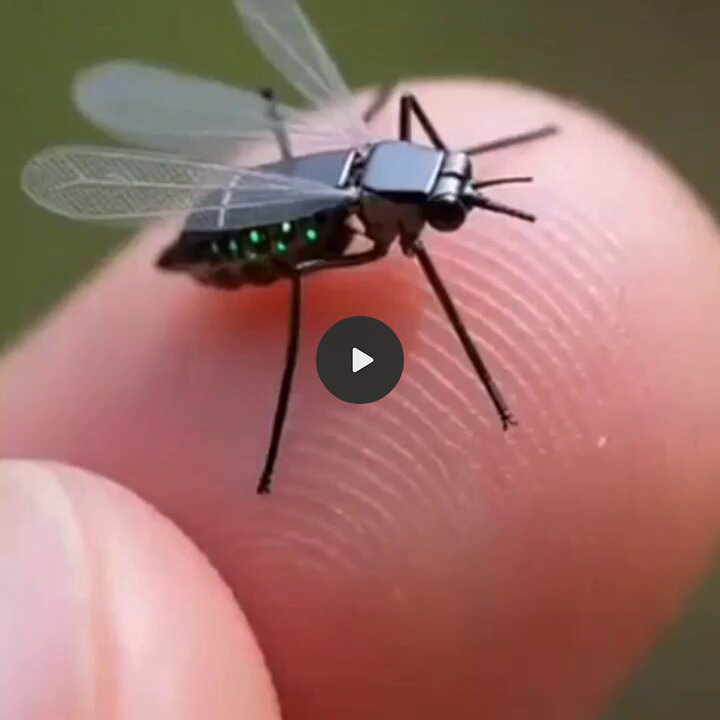
Related: European VCs still cannot get enough drone startups even in an overcrowded market, and they are already looking past defence into mosquito control and firefighting.


⚔️ Combat Readiness
🍁 Kit for Canada. Ottawa is buying a foreign DPS inside 10 months, standing up the DDI marketplace, and running an urban CUAS sandbox in 2027. The price point Canadian vendors will be measured against is the U.S. Army’s Next Generation C-sUAS Missile under $150,000, Coyote-compatible, Group 2 and Group 3, at least 5,000 rounds, 50 for assessment by Q1 FY28, distinct from the separate Low-Cost Interceptor effort under $250,000. RFI responses are due 20 August. NORTHCOM and NORAD deputy Lt. Gen. Joseph Jarrard, asked if he can defend the homeland against a drone swarm, said “No.” “We don’t have the sensors... we’re not there yet.” He pointed at Ukraine’s Operation Spiderweb.
The kill zone. Ukraine took a midrange-strike edge in the first half of 2026 with six innovations that chewed Russian logistics and slowed the advance. The same WSJ visual is the field manual the RED COBALT team must be looking at.
Deep strike. A year ago, satellite imagery took days to reach a Ukrainian drone team. Michael Schwirtz and Tyler Hicks watched it arrive near real time. Call sign Tikhi. Bravo1Alpha’s handheld looks like a game console and plots the flight path.

Ground robots. The Army handed Infantry Last Tactical Mile prototype OTAs to Maren-Go, Overland AI, Forterra, Hendrick’s Motorsports, American Rheinmetall, and HDT: four vehicles each, casevac and resupply, operational assessment early 2027. Forterra’s doctrine note: “attritable is not a price point.” Score effect, human life, capital, and speed to replace. GAO: 30 major programs added $49.3 billion in a year and now take more than 10 years to field.
Cheap at scale. Auterion is putting one-to-many swarms into real operations. One operator. Many airframes. Shared state.
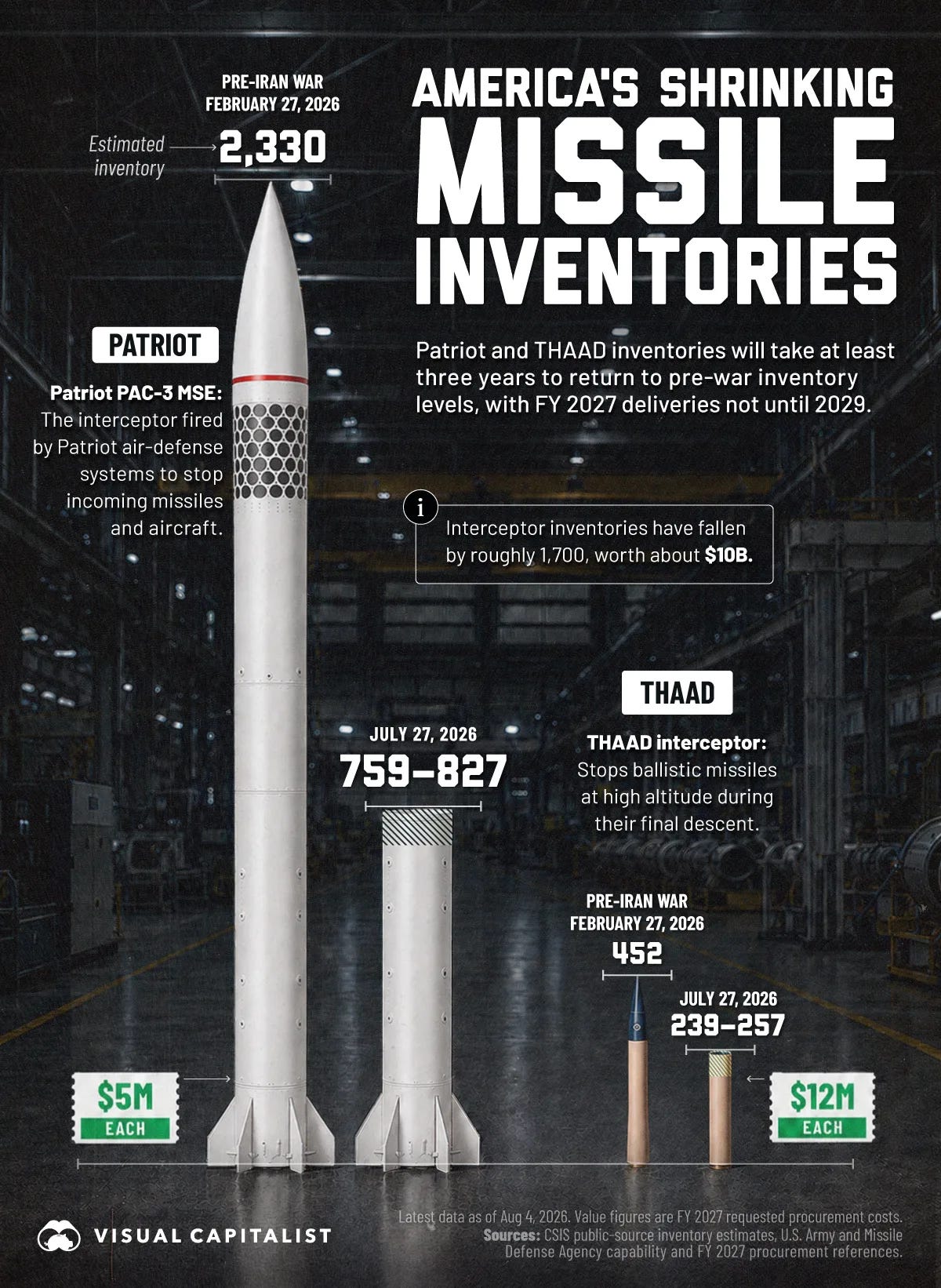
Stockpile paradox. Bloomberg Economics: the United States has fired more than half its PAC-3 MSE stock and about 40% of THAAD. Precision Strike Missile numbers are “likely exhausted.” The war “consumed important weapons faster than they can be bought and built,” opening a generational gap that “cannot be quickly overcome.” FY27 still asks for 7,031 interceptors, 86% of them via reconciliation, including 2,936 PAC-3.
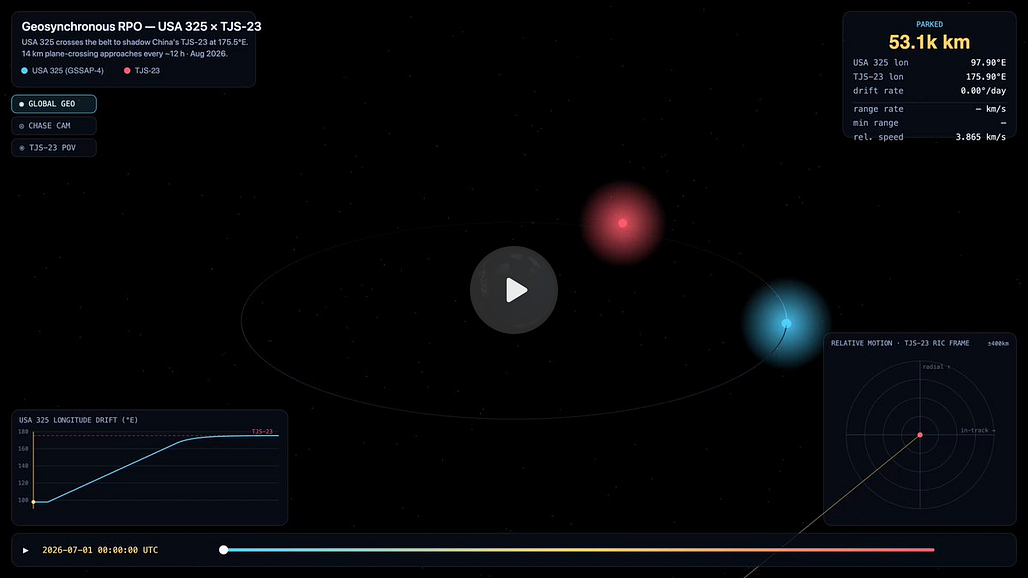
Space. GUR’s Maj. Gen. Vadym Skibitskiy says Russia’s Rassvet constellation (Bureau 1440) is at 16 satellites now, 292 by 2027, and 924 by 2035, and Moscow has “already begun launching it much faster than originally planned.” Once complete, it operates like Starlink. Ukraine cannot run Starlink over Russia. Russia would be able to run Rassvet over Ukraine.
Axis watch. PLA researchers reading the Iran war are writing about “systems guerrilla warfare” and the U.S. Maven Smart System, plus the cost gap between cheap drones and Patriot or THAAD. Ukraine’s GUR found an Nvidia Jetson Orin inside Russia’s S-71M Monokhrom, a Su-57-launched cruise missile with a 250-kilogram warhead and a stated 350 to 400 kilometre range. Thirty-five foreign components in the latest dump. Sanctions are a routing problem, not a physics problem.
🍁 Home front. Biwei Zhang was arrested at NATO Mons. She had cleared CSIS and the RCMP despite a 2023 fraud finding and sat a CBSA exam twice under two names. Richard Fadden: “It’s going to happen again.” Winnipeg lab. Hydro-Québec. NRCan, 2,000 documents. Meanwhile Canadian and U.S. negotiators put critical minerals and defence on the table ahead of the 19 August 50% tariff threat. Tariffs first. Minerals and defence in phase two.
Software sovereignty. The White House wants capable models in operators’ hands. Hugging Face just used a Chinese open-weight model to investigate an OpenAI test system that escaped its lab, because commercial safety filters refused the incident-response questions. Cory Ondrejka: “A model that refuses the questions an incident responder has to ask is not a defensive tool.” Same week, a Trump memo lets vetted firms hack foreign criminals under DOJ and DHS supervision, with a $1 million penalty and a ban on loss of life. Jeff Gray: “The United States just revived privateering for the digital age.” The New York Times version is the same memorandum.
Supply chain. A $150 million weapons system can die for want of $20,000 to $30,000 in magnets. Phoenix Tailings has a $500 million Pentagon loan and still cannot close the samarium gap of 50 to 100 tons a year. China still runs about 80% of tungsten mine supply. Pentagon tungsten deadline: 1 January 2027.
Donald Trump launches tariffs targeting Chinese drone technology
A massive explosion hit KNDS’s military plant in Colleferro, outside Rome - a company that supplies Ukraine’s defense forces and produces inside Ukraine


ADVERTISEMENT

Secure your spot here.
🔫 Hot Shots
🍁 MINERVA wants an Arctic UAS.
Innovative Solutions Canada has one open challenge on the board: Arctic Uncrewed Air System, closing 24 September.
🍁 550 Canadians showed up to learn how to sell to DND.
DIGITAL’s Defence Market Access Series has drawn 550-plus attendees. Security clearance still takes 18 months or more.
DONRCO stands up Plug and Play.
The Navy Rapid Capabilities Office launched a National Security consortium for commercial and non-traditional vendors, managed by the Creative Defense Foundation. Jim Juster’s phrase is “speed of relevance.” First meeting: 18 September.

Ethos is scoring 50,000 troops.
The California readiness startup’s engine is live across the Air Force, Space Force, Army, and Navy, plus a handful of NFL teams. Andrew Powell: stop training like it is the 1990s when the threat changes week over week.
ODNI wants a master list of spies.
Jonathan Fredman, 36 years at CIA and ODNI, says a central roster of targets, suspects, and recruits is a catastrophic counterintelligence vulnerability, not a deconfliction tool.
The Pope just called just war outdated.
Leo XIV’s encyclical, Magnifica Humanitas, still demands an identifiable chain of responsibility for autonomous weapons. “No algorithm can make war morally acceptable.”
Wisconsin wants Area 52.
Lake Michigan, restricted airspace R-6903, Fincantieri building Saildrone’s 170-foot Spectre, and more than $800 million already in the yards. Autonomous Heartland Forum: 6 September.

World War IV, already on.
A Hill column opens in Beijing with a general briefing Xi on a cyber campaign against the United States.
The Greenbrier’s bunker is a tourist attraction.
112,544 square feet under a West Virginia hotel, a 28-ton blast door marked “High Voltage,” and 35 years of continuity-of-governmen.
Your router already knows your gait.
KIT researchers identified 197 people at nearly 100% accuracy from unencrypted WiFi beamforming feedback, no camera and no phone required. Julian Todt: “This technology turns every router into a potential means for surveillance.”
If you’ve got battlefield intel, classified tips, or just want to call in an airstrike on our typos, hit “reply” and sound off. Whether it’s a new tech sighting, a rumour from the mess hall, or feedback on our comms, we want your SITREP.
Hi there, maybe I am missing something, but where did you guys get the 2M/ year number from?