

🎯 Three-Shot Burst
They Walked These Streets: one Toronto teacher is putting the fallen back on their own front lawns
On November 9, 2020, during the loneliest Remembrance Day most of us can remember, 13 poppies went up on a lawn in Toronto’s west end. Ian Da Silva’s children had made them from pool noodles on bamboo skewers. Next to each poppy was a name. All 13 belonged to men who had once lived within a few minutes’ walk of that lawn, and who went to war and didn’t come home.
A small group stood for a moment of silence. A neighbour played “Reveille” on a cellphone. That was the whole ceremony, and it was the start of something.
The person who made sure those names were right is Katy Whitfield, a history teacher at Bloor Collegiate Institute in the Toronto District School Board. In 2015 she won the Governor General’s History Award for Excellence in Teaching, and she was once education coordinator for the Vimy Foundation. Alongside her teaching, and with a growing network of volunteers, she has built They Walked These Streets… We Will Remember Them into one of the most moving acts of remembrance in the country.
The idea is simple: Remembrance usually happens at a cenotaph, in front of a wall of names that most of us can’t connect to anyone. Whitfield’s project takes those names back to where the people lived. Each November, displays go up on the lawns of churches, schools and homes. Each one carries information cards with a soldier’s name, photograph and story, the school or church he attended, and a QR code linking to his record in the Canadian Virtual War Memorial.
Click here for the Google Map of Soldier Stories
So when you walk down Durie Street, you meet Pte. Charles Jesse Twist, 20, of number 513, killed at Gallipoli in August 1915. A few doors away is Pte. Donald Barrington Taylor, 21, of number 257, killed at Dieppe. Up the road is Seaman Harold Steven Porter, 24, of number 296, lost when HMCS Ottawa went down in 1942. Then there’s Pte. John Ross Pollard of number 582. He was 18.
These are not abstractions. These are your neighbours, separated from you by a few decades.
From 13 names to more than 1,300
What began with 13 soldiers grew to 60, then 240. By last November the project had prepared more than 1,300 soldier cards across seven neighbourhoods, from Humbercrest United Church to Bloor Collegiate in Parkdale. It now covers the stretch between the Humber River, Dufferin Street, St. Clair Avenue West and Lake Ontario. Churches, schools, local historical societies and families have joined in. In one case, the family now living in the house where brothers Leonard and Leslie Dutton grew up asked for a display. Both brothers died in the Second World War.
All of it rests on careful, painstaking research. Whitfield started from journalist Patrick Cain’s Poppy File map of fallen Torontonians’ homes. From there she and a growing network of volunteer researchers work through archival records, cross-check addresses and track down families. She protects the accuracy of that research fiercely. Every card has to be right, because every card is a person.
“He lived on my street!”
The part that matters most is what happens to the kids.
Whitfield’s Bloor Collegiate students curate exhibits and build scrapbook pages for individual soldiers. During a sabbatical, she took the project into other schools, where each child chose one soldier to learn about. She recalls the reaction: “That pilot lived right in my house. He lived on my street.”
“I’ve had students shriek at me, ‘He lived on my street!’” Whitfield told Canada’s History. Grade 12 student Lauren Dick said she was “very surprised by the number of soldiers who attended Bloor.” Her own school’s hallways had sent young men to Vimy, Ortona and the North Atlantic.
What comes next
Whitfield is open to working with others who want to bring it to their own part of the city, as long as the research holds to her standard.
ADVERTISEMENT

Barrack Hill: Navigating Canada’s defence and procurement landscape with precision.
🤖 Hundreds qualified under the Defence Drone Initiative: An interactive map of who does what
While Canada continues to build its defence industrial base, one question remains surprisingly difficult to answer:
Who actually makes what in Canada?
Not who has the most interesting prototype. Not who has the best pitch. Who can manufacture, with the suppliers, partners and production capability to back it up?
Technology alone isn’t the strategy. Production is.
Canada’s drone ecosystem contains far more than aircraft manufacturers. Companies that produce sensors, batteries, electronics, software, communications systems, advanced materials, navigation technologies, payloads, manufacturing equipment and specialized services are all part of the industrial base. Together, that base determines whether a product can be manufactured, scaled, and maintained.
Most of these capabilities remain hidden from view. That’s why NGen built Canada’s Interactive Drone Supply Chain Map.
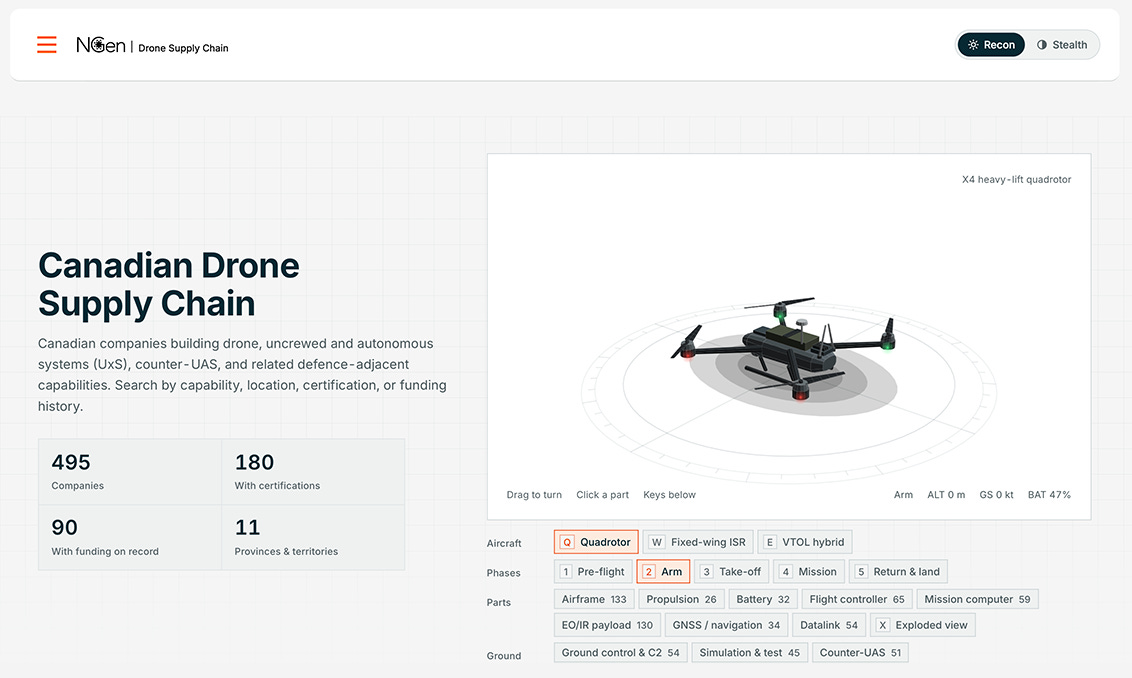
The tool provides an interactive view of the companies and capabilities that make up Canada’s drone ecosystem. Founders, investors, procurement leaders, defence stakeholders and policymakers now have line of sight to a real production network that can help Canada meet its security objectives.
Trying to find a supplier? A development partner? An acquisition target? Want to know Canada’s domestic capability in a specific area of drone manufacturing, or find gaps in the supply chain?
If production capacity is the basis for sovereignty and security, then visibility is the first step. You can’t build coordinated industrial capability around assets you can’t see.
Icebreaker readers get a first look for 48 hours. After that, become an NGen member for full access.

🤝 Deal Corner
Three ways out: defence tech exits get real. Shield AI’s $5.3 billion purchase of Echodyne is now a signed deal, expected to close in early 2027. Echodyne keeps its team and keeps selling its MESA radars as standalone products to customers in more than 40 countries. Exit two is the roll-up. Amsterdam-based Onodrim raised a $300 million Series A at a $1.3 billion valuation led by Lux Capital, and is in talks with 10 companies to buy controlling stakes in European aerospace, defence and industrial suppliers. The FT says the Palantir alumni behind it want to “wake sleeping giants” in European defence. CEO Aistis Šimaitis says in Onodrim’s announcement that “Europe has no shortage of exceptional companies,” and that the gap is resources to scale. Co-founder Christian Garrett: “We’re not focused on building drones, cruise missiles, or platforms.” Exit three is the big software buyer. Salesforce agreed to buy logistics AI startup Rune for a reported $375 million in cash and stock, almost three times its last $127 million valuation, two years after Rune was founded. Rune will feed Missionforce, Salesforce’s national-security unit, which grew 80% last year. Strategic buyer, roll-up, enterprise acquirer: three exit routes for defence tech founders.

Related: Saiesh Reddy runs the numbers on the Echodyne price: on an assumed $100 million in revenue, $4.8 billion at closing is close to 50x, “a software multiple for a business that builds hardware in a factory,” and partly paid in Shield stock that was just repriced at more than double its March value. Ali Javaheri points out Echodyne was last valued around $485 million in 2022, and offers the line of the week: “Turns out the new primes might be doing the acquiring before the old primes get around to acquiring them.”


🍁 MDA lands $100M+ on IRIS² and a 7% stock pop. MDA Space signed an authorization to proceed with Thales Alenia Space worth more than $100 million for AURORA digital phased array antennas on 66 Layer 1 satellites of IRIS², the EU’s sovereign secure-connectivity constellation, all designed, built and tested in Montréal, with first launches in 2029. Two days later the stock jumped 7.15% on third-quarter results: revenue of $498.1 million, up 22%, net income of $30.9 million and 2026 revenue guidance raised to $1.90 billion to $1.95 billion.

🍁 Algoma Steel books $182M in polar steel. Algoma and Stigterstaal Canada will supply up to 24,000 tonnes of structural steel to Seaspan for up to six multi-purpose Coast Guard icebreakers, 4,000 tonnes a ship, plus steel for the heavy polar icebreaker CCGS Imnaryuaq. Each ship runs about 100 metres and nearly 9,000 tonnes with Polar Class 4 icebreaking.
🍁 $2.3B for drones, and AVSS shows what the money buys. Budget 2026 gives the Defence Drone Initiative $2.3 billion over five years from 2027-28. AVSS, one of six firms sharing up to $50 million in the first marketplace contracts, now has orders for more than 1,000 drones and equipment for the federal government, sold more than 2,500 units commercially this year and goes from 55 staff to 70 by December in a facility tripling in size. It redesigned its avalanche release from five pounds to 50 in months because it owns the hardware. Josh Ogden: “If we’re going to build, let’s be honest about what that means. Building means building our own product.”


🍁 Galaxia gets $5.7M from DND for OSPREY. The Halifax company is building a satellite to pull data off legacy spacecraft and process it in orbit for Arctic ISR, funded through the IDEaS Gateway to the Stars challenge. Kepler took $4.7 million from the same $17.9 million pot for laser links, leaving about $7.5 million in unannounced awards. Galaxia raised a $4.5 million seed round partly to meet DND’s secure-hardware standards.
🍁 $61.9M buys a ticket to a €60B market. Ottawa will pay $61.9 million over four years, then $109.2 million a year, to join the EU’s Ukraine Support Loan facility, which lets Canadian companies compete for €60 billion in procurement for Ukraine’s defence.
🍁 Cohere’s $1.6B stake, minus the veto. The Globe tests Ottawa’s equity stake in the $7 billion round at a $35.7 billion valuation, and Jim Balsillie asks the defence question: what rights does Ottawa have if a foreign buyer comes calling?
🍁 OSI Maritime comes home. Novacap is buying Burnaby’s OSI Maritime Systems at the head of a Canadian consortium that includes EDC and BDC. OSI’s navigation and bridge systems are installed or contracted on more than 1,000 warships and submarines across 27 navies, up from 16 navies 15 years ago. The deal puts OSI under Canadian ownership, with its core IP and product development staying in Canada.


The Pentagon’s lender hits $6.5B. Emerson Garnett tracks the Office of Strategic Capital’s loan book: $1.4 billion committed in its first 10 months, $5.1 billion in the last three. The newest is up to $450 million for Neros to build drones and their motors, radios and batteries in Torrance, aiming for one million drones a year by 2028. The money has gone to 12 companies in 15 months, including $1.9 billion for rare earths and magnets, $1.5 billion for Wolfspeed’s chips and $1.4 billion for Sila’s batteries. Patient government debt next to equity means less dilution for the founders who can get it.
Europe’s defence tech record. Anton Bosredon counts $7.4 billion raised by European defence startups so far in 2026, nearly three times the $2.6 billion raised in all of 2025, and profiles six repeat founders including STARK’s Florian Seibel (€500 million in June) and Helsing’s Torsten Reil. Most are second-time founders bringing exits from fintech, gaming and AI into hardware.
Machina Labs gets $9M to build attack drones in pop-up factories. The Pentagon handed the Los Angeles robotics startup an 18-month trial to make metal airframes for LUCAS, the Low-Cost Uncrewed Combat Attack System, in modular factories that go up fast.
🍁 Raise now or wait for the contract? Zighra’s Deepak Dutt walks founders through the defence financing trap: raise early and you build a cost base around a buying timeline you don’t control, wait and you may lack the capacity to compete when the opportunity arrives. He splits traction into three proofs: the technology works, a customer can buy it, and the company can deliver it repeatedly. “A paid pilot, a funded requirement and a repeat order answer different questions.” Required reading before your next round.
From wildfires to the front. Anton Bosredon tells how Robotto.ai went from smoke-spotting drones to Ukraine. The Aalborg University spinout’s autonomy software now runs on about 5,000 Ukrainian drones, with a company-reported 80% to 100% hit rate where GPS is jammed. It opened a Ukrainian subsidiary in March and made the NATO DIANA 2026 cohort.
Related: Keen Venture Partners is mapping every European NATO defence ministry one country at a time, and Resilience Media unpacks the new French guide, where about 90% of a €57.1 billion budget’s equipment money is already committed and 92.7% of suppliers are French. Keen’s Ties Klinkhamer: “Of the four, France takes the longest to get into and gives the most back once you are in.”
ADVERTISEMENT

View the agenda and apply now.
⚔️ Combat Readiness
🍁 Budget math. Budget 2026 adds just $11.2 billion in new defence spending over five years, against last year’s $84 billion plan. Core spending hits 2.2% of GDP this year, then flatlines at 2.6% through 2030-31, roughly $37 billion short of the 3.5% path by 2030. Add the security-related bucket and CBC gets the budget to slightly more than 4% by decade’s end, about $157 billion a year in 2030-31, $99.2 billion military and $58.3 billion infrastructure, with no roadmap past 2030. Global News tallies $451 billion in core military spending over five years and $6 billion over 10 years for CSIS. Now read the fine print on “core.” The budget defines core defence to include the Canadian Coast Guard, which was folded in last year. Scuttlebutt in Ottawa says the entire CSIS budget is now counted too, a first. Some of the growth is accounting, not kit.

🍁 Who counts as Canadian. David Pugliese counts two key defence firms sold abroad with no objection from Ottawa: Lockheed’s purchase of Ultra Maritime for more than $3.4 billion, whose sonar sits on the Halifax-class and will go on the River-class, and Elbit’s purchase of Port Coquitlam’s ISE. Both appear to have gone through without a national security review.
On Parliament Hill, the Alliance of Canadian Defence Companies pushed for ownership to count in procurement. Executive director Dasha Cohen wants “critical capability areas that should be prioritized for Canadian-owned, Canadian-controlled companies,” plus a graduated approach: small, fast first contracts and bigger orders as milestones land. The Canadian Shield Institute writes the definition Ottawa lacks: “A Canadian company is a Canadian-headquartered firm that is not majority-controlled by a foreign parent or foreign government.” Today Buy Canadian’s 10% bid discount goes to any firm incorporated here, and the DIA’s Strategic Partnership Framework runs 161 words. The same gap showed up at the CRA, which gave a $12 million security contract to Allied Universal’s Canadian subsidiary over veteran-staffed Commissionaires on a 0.8% price gap. The minister calls the winner Canadian. Under today’s rules, it is.


🍁 Mobilization, still on paper. David Pugliese reports the military has yet to present its mobilization plans to the government. The plan calls for a 300,000-strong supplementary reserve, up from 4,384 today, and for growing the primary reserve from 23,561 to 100,000. The plan’s goal is 300,000 volunteers.

🍁 Losing on the balance sheet. Canadian Defence Review makes the case for a layered counter-UAS network to protect Canadian troops in Latvia and critical sites at home. The math: a $4 million interceptor fired at a drone worth tens of thousands. The fix runs from jammers and high-power microwave to lasers, guns and interceptor drones.
Drone teams are weapons teams. Tim De Zitter breaks down a new US Army paper on fielding small UAS and loitering munitions at company level, drawn from the first six Transformation in Contact rotations. Flying the drone is the easy part. Integrating it into training, manoeuvre and command is hard, and the authors compare that discipline with learning crew-served weapons. They treat battery power like ammunition and propose a matrix that syncs drones with fires and recon. Procurement, operator qualification and unit readiness are three different milestones.

Battery sovereignty. Retired MG Bill Crane and RADM Peter Brown show how a US-invented battery ended up made in China. EnerVenue’s nickel-hydrogen cell came out of taxpayer-funded Stanford research, needs no lithium or cobalt, and is rated for 30 years and 30,000 cycles. The company dropped a $264 million, 450-job factory in Kentucky and started production in Changzhou in September.

🍁 AI wingmen, without a contract. CBC’s Jennifer Yoon asks whether Canada is ready for AI warfare, as Anduril’s Fury fires live missiles and the UK spends £5 billion on drones and autonomy. Dominion Dynamics is building Scout, a collaborative combat aircraft meant to fly three or four to a jet. Eliot Pence has raised about a third of the $500 million the prototype needs, but has no government prototype contract. DND says “no decision has been made” on buying CCAs, and Canada has none.
Space is an integration problem. A RealClearDefense essay argues space power now depends on integration, not platforms, and that Golden Dome will mean stitching together hundreds of government and commercial capabilities, many of which already exist. “Our greatest challenge is not generating innovation but integrating it into operational missions quickly enough to maintain our competitive advantage.”

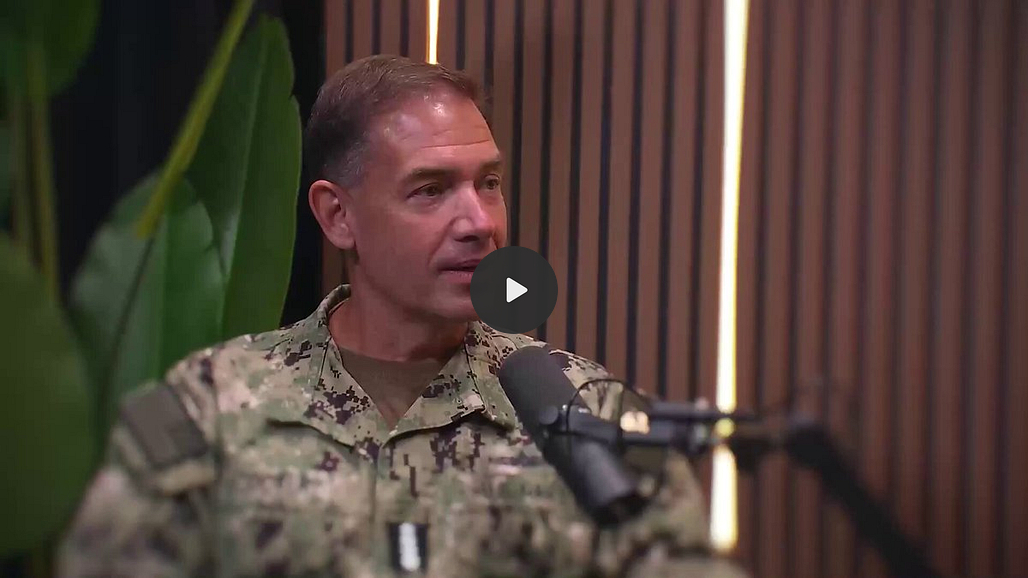
🍁 Veterans wanted, two hours each. Ruth Casselman is recruiting veterans with operational experience for Built for the Field on December 4, where Canadian tech companies pitch their kit and veterans tell them what would fail in the field. She wants people from operations, logistics, maintenance, medical, signals, intelligence, aviation, naval, combat arms and engineering. No procurement experience needed.
🍁 The DIA gets a chequebook. Vanguard’s Steve Ladurantaye reports how the Defence Investment Agency would deploy up to $1 billion under Bill C-40, which makes it a Crown corporation with equity, loans and other financial tools. ADM Vincent Robitaille named the first use case, a struggling Canadian company sitting on critical IP: “We would not necessarily want to allow another country to buy it on favourable terms.” The second is upside for taxpayers who carry risk through advance payments: “Taxpayers should be able to share in the benefits if it’s successful.”
At The Logic Summit, DIA CEO Doug Guzman says the old system was built for a world that’s gone: “We were a free trading country. We trusted our allies. We committed to not favour Canadian businesses.” Deputy Minister Christiane Fox ran a “sludge audit” and found 34 steps to every procurement decision, 17 with no bearing on the outcome. Lt.-Gen. Darcy Molstad wants spending authority pushed down “to the level of discomfort.”

🍁 Production is the strategy. NGen CEO Jayson Myers argues dual-use means nothing without a production line: “Technology readiness gets all the attention. Manufacturing readiness … barely gets discussed at all.” His pandemic proof: a ventilator already in National Defence service, built mostly from Chinese parts, that “was a Canadian product in name,” against NGen’s rebuilt Winnipeg design that reached market in five months at a fraction of the cost. He wants smart manufacturing for defence suppliers, critical production networks and deployable micro-factories, and points to more than $700 million in industry money levered against roughly $600 million in public funds across 280-plus projects. “A drone system built on impressive quantum sensing or advanced electronics is not a deterrent if it exists only as a prototype.” The budget funds R&D hubs. Myers is asking who builds the thing.
🍁 Big think. The Globe’s editorial board marks 85 years since Hong Kong, where 2,000 under-equipped Canadians were overrun 17 days into the fight, and notes about the same number now stand in Latvia. The CAF had about 2,000 drones in September and has contracted to reach about 20,000. Ukraine makes about 10 million a year, so it matches the entire CAF inventory in under two hours today and a little over 17 hours after the expansion. Maritime fleet readiness sits at 59.6% against a 75% target, land at 51% against 80%, and the deadline to close the gap moved to 2036.
CTV’s Adrian Ghobrial reports from the Latvian line, where a Canadian commander oversees 3,000 troops in a defensive battle-ready position near the Russian border.


🍁 Software sovereignty. CBC reports DND has run Palantir’s Gotham since 2020 under a contract flagged “not for public disclosure,” first valued at $14 million and now worth up to $63 million, per IJF documents. DND says the data cannot leave Canada and the US CLOUD Act has no reach over Canadian servers.
The National puts the sovereignty fears on camera in a 10-minute segment that deserves a full watch. France and Germany ended Palantir intelligence contracts in July. Ottawa’s dependency runs through orbit too. IJF’s Katrina Clarke finds the federal Starlink contract grew more than ten-fold, from about $2.3 million in February 2024 to $28.9 million, with options that could run to 2029, after Musk admitted throttling Ukraine’s access and Carney promised to diversify away. Telesat’s first two Lightspeed satellites launch “in the coming months,” with global service in early 2028.
🍁 Kit for Canada. CBC’s Murray Brewster and Daniel Leblanc report Canada wants eight TKMS Type 212CD submarines up front and four later, a split that could trim Germany’s promised $86 billion in Canadian investment, including a heavy torpedo plant, a Port of Churchill upgrade and hypersonic co-development.
FlightGlobal puts the Hornet replacement on a “knife-edge timeline”, with the last CF-18s leaving operational use in 2032-2033 and the F-35 buy still in limbo. The defence policy update that should settle all of this has its own history: a 2024 Globe story blamed “sticker shock” for delaying it and counted about $100 billion in unfunded capital.
🍁 Spies abroad. Ottawa will expand CSIS’s powers to collect intelligence overseas, says national security adviser Dominic Rochon, starting with human intelligence inside CSIS and possibly a CIA- or MI6-style agency later, with foreign collection at 5% to 10% of the total at first. “We have been a net importer of intelligence. There is no secret about that.”
🍁 Space. Budget 2026 makes Canadian medium-lift rockets a formal goal, expanding DND’s Launch the North and adding DND-run launch and test facilities inside a $2.7 billion, five-year defence industrial package built from previously announced money, with no line item for space. NordSpace, Canada Rocket Company and Reaction Dynamics each hold $8.3 million toward a small rocket on four days’ notice by 2028, and Reaction Dynamics’ six-tonne Borealis targets 2031.
🍁 Golden Dome. In War on the Rocks, Frederick Lamb and Laura Grego call the dome destabilizing and dangerous: tens of thousands of orbiting interceptors, as little as 25 seconds of fly-out time against a submarine launch, and decision windows that push toward pre-delegation and automation. “Nuclear arms control agreements remain the only historically successful approach to reducing the nuclear threat to the United States.” The money is shaky too. SpaceQ notes Democrats now hold both chambers, only about $25 billion came through reconciliation, and under $400 million of the 2027 ask sits in the regular budget; Senate Armed Services Democrats call it a “slush fund.” Kepler, Telesat and MDA have positioned technology for it. Raymond Floreani and Concordia’s Julian Spencer-Churchill pitched a cheaper Canadian alternative in July: a national aerospace command running by 2031, Israeli radars from Shilo to Cambridge Bay, seven Arrow-3 batteries and 29 Barak MX batteries for about $70 billion including satellites, against the $100 billion Trump floated for a third of the dome.
The spectrum fight. Russia is fitting drones with bigger antennas to beat jamming: HUR says Kometa modules with 16-element arrays are in use at scale, 20-element arrays are entering serial production, Shaheds with 32 elements have hit Kyiv, and Russian firms ordered more than 100,000 Kometa modules this year. Serhii “Flash” Beskrestnov: “it is easier for the enemy to increase the number of elements on an antenna than it is for us to add electronic warfare sites.” Zighra founder Deepak Dutt argues Canada must put AI at the core of electronic defence, with a continuous acquisition pathway for EW software, recurring industry access to operational data and test ranges, and modular buys that keep the code Canadian.
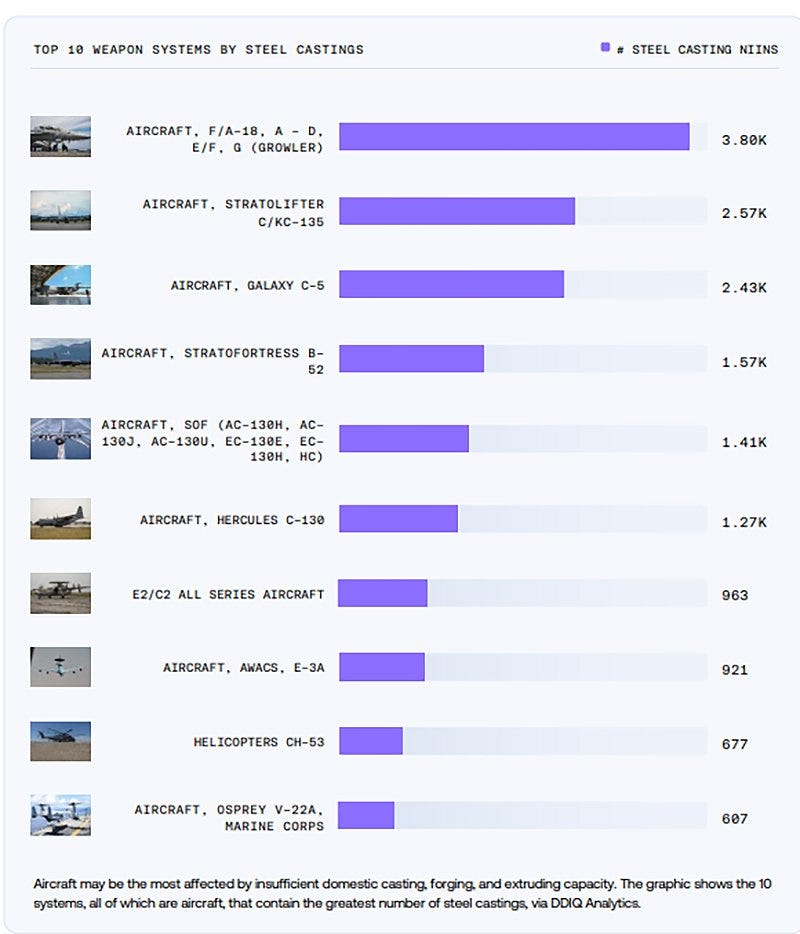
Stockpile paradox. TWZ’s Hope Hodge Seck maps the US weapons most exposed to the rare-earths squeeze, using an SCSP and Exiger study of nearly 9 million parts: more than 28,000 components across 1,400 systems contain antimony, gallium, germanium or tungsten. A Virginia-class boat needs 9,200 pounds of them and an F-35 needs 900:
Europe rearms. The Commission will choose between two hypersonic interceptor consortia by November 30: Diehl and SMS’s HYDEF, or MBDA’s HYDIS, whose four-stage Aquila targets threats up to Mach 17. Phase two has €100 million from the European Defence Fund and €133 million from 11 HYDIS nations, with a TRL 6 demonstrator by 2030 and service around 2035. MBDA says one launcher could cover the Netherlands. At Euronaval, Naval Group unveiled the SCX 26 drone carrier concept, 170 metres and 8,000 tons with more than 100 VLS cells, an electromagnetic gun and a crew of 150, and signed with the DGA for an uncrewed combat underwater vehicle demonstrator that goes to sea in 2028.
Pentagon spending watch. POGO’s Mark Thompson asks why the Navy is spending $19 billion on “flying gas stations”: 76 MQ-25 Stingray tankers at about $256 million each, with initial capability slipped from 2026 to 2029. The new 10-year F-35 framework targets at least 850 US jets and up to 710 for foreign buyers, while US F-35s could fly at least one assigned mission just 44% of the time in 2025, down from 67% in 2021, and GAO sees $38 billion for early engine replacement.
Who authorizes the machine. As the US Army pushes NGC2 apps out to I Corps, Burak Oktenli in MWI asks who authorizes one app’s output becoming another app’s order, and proposes five integration drills to test it. “A common data layer is not a common permission to act.”
🔫 Hot Shots
🍁 The Icebreaker in BetaKit. BetaKit’s Budget 2026 roundup quotes Icebreaker co-founder Matthew Lombardi on the $2.3 billion Defence Drone Initiative: a “positive signal,” but only if Ottawa follows with ongoing, timely orders that let companies build factories here, “otherwise, they’ll keep selling prototypes while our allies buy the full production runs.” BetaKit also flags that the budget carried little new defence-tech money and no new procurement measures.
🍁 Congratulations, Alex MacDonald. NASA’s first chief economist is the new president of the Canadian Space Agency, named November 4 by Industry Minister Mélanie Joly to succeed Lisa Campbell. The Canadian Press notes he helped build NASA’s Moon to Mars strategy and Artemis and was founding program executive of the Emerging Space Office.
🍁 The founder who came home. The Financial Post profiles Dominion Dynamics CEO Eliot Pence, who left Anduril and the US to help build Canada’s war machine and has become a key figure in the push to remake the sector.
🍁 Medevac, hybrid-electric. CTV looks at Horizon Aircraft’s VTOL for northern Ontario, built at Lindsay airport: six passengers, up to 450 km/h and 800 km of range, its own onboard generator, and an MOU with Constance Lake First Nation toward a purchase.
🍁 Polaris resurfaces. Montréal’s Polaris Aerospace is back with ITAR-free orbital launch plans and a liquid engine test this winter, with Maritime Launch’s Stephen Matier as adviser, after Concordia won a provisional injunction in January over its Launch the North bid.
🍁 Chart of the week. Apollo’s Daily Spark ranks NATO spending by member for 2026: Lithuania at 5.3% of GDP, Estonia 5.1%, Latvia 4.9%, and Canada at 2.1%, behind Montenegro and Albania. The US is down to 3.2% from 3.8% in 2014.
X-BAT goes shopping in Europe. Shield AI cofounder Ryan Tseng teases a “snowball of activities” on X-BAT orders in Europe, pricing the VTOL fighter drone at $25 million, about a quarter of a Eurofighter or F-35, and claiming a 10-fold lifecycle saving.
Wargaming meets AI. The Naval War College’s wargamers report lessons from Global 21, its largest game ever: 700 participants, nine 20-hour days, and the Air Force’s MAGE engine plus LLMs crunching the data.
The Gundo, up close. The Blaze spends time inside El Segundo’s hard-tech scene, from Valar Atomics and Rainmaker to Josh Steinman’s Discipulus Ventures, where a twice-yearly cohort draws hundreds of investors to demo day.
Your audio is a map. A YouTuber called Colsto shows aircraft noise can geolocate a recording to within 100 metres using under a minute of audio, Doppler curves and public flight data, even when the planes are inaudible and high-pass filters can’t scrub them out. “Something with literally zero visual clues could be located using this.”
Ukraine's Defence Builder wants your tech. URK Accelerator has extended the Batch 4 deadline to November 15 for its four-month hybrid Defence Builder programme. Ten companies will get a starting grant, 80+ experts and access to 30+ Ukrainian military units for field days and demos to procurement officers, plus sessions with NATO and DIU. Applications are open globally to defence and dual-use teams with a TRL 4+ demonstrator and a real need on the Ukrainian front, from counter-UAS and alternative navigation to ground robotics and components. Canadian founders who keep hearing "prove it in Ukraine" should take this as the invitation.
The Icebreaker is written for the people building Canada’s defence technology base. Forward it to someone who needs it.