

Editor’s note: One year ago, The Icebreaker sent its first issue to a handful of defence tech investors and curious founders.
Today, we’ve been cited in RBC’s defence finance white paper, featured on CIBC Capital Markets’ podcast, quoted by Canadian and international media over a dozen times, and invited to testify before Parliament. We’ve helped deploy $300K into Canadian startups, hosted the country’s first defence tech hackathon, brought over a dozen corporate sponsors into the fold, conducted two national studies that created proprietary defence tech data, and spoken at business forums across the country as a subject matter expert. None of it happens without you — thousands of community members holding us to a 45%+ average weekly open rate. Year two starts now.
🎯 Three-Shot Burst
Defence startup VC funding has already hit $14.6B in 2026 — eclipsing the full-year record of $9.6B set in 2025. Just six years ago, the number was $1.6B.
The shift is structural, not cyclical: Anduril’s $5B Series H alone at a $30.5B valuation anchors the surge, with Mach Industries ($300M at $1.8B), Shield AI ($2B), and Saronic ($1.75B) filling out a roster of newly minted unicorns. Applied Aerospace & Defense just went public on the NYSE at a $3.25B valuation — raising $650M. The exit landscape is maturing.
Doing our part:
DMZ Ventures is launching a $100K Dual-Use & Sovereign Tech Investment Prize, live at Startupfest in Montreal next month. The Icebreaker will be a guest judge.
We’re looking for founders building companies that matter, not just to markets, but for Canada.
Here’s the deal:
$100K investment from DMZ Ventures
Direct access to our network of operators, founders, and investors
Fast-tracked entry into DMZ’s flagship Incubator
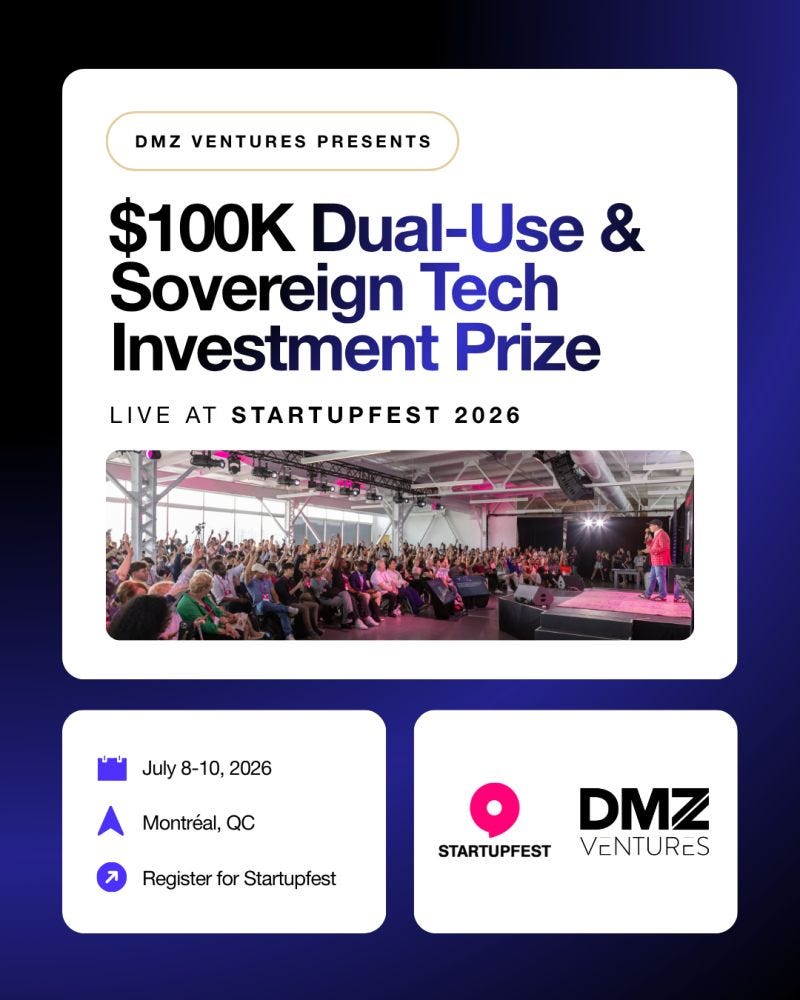
No long application. No gatekeeping. Just show up. Pitch. Win.
ADVERTISEMENT

Barrack Hill: Navigating Canada’s defence and procurement landscape with precision.
🤝 Deal Corner
Canada confirms $2.6B HIMARS purchase — 26 M142 High Mobility Artillery Rocket Systems from Lockheed Martin, via US Foreign Military Sales. Delivery starts 2029. Range: 300km precision-guided — vs. the Canadian Army's current ~40km howitzers. Designed to incorporate future land-based anti-ship missile capability and protect Arctic coastlines. No Canadian manufacturer exists for the system. CBC confirms DND called this the only option that met operational requirements
Canada's first autonomous combat aircraft — Ottawa-based startup, founded by Eliot Pence (ex-Anduril), has C$21M seed (led by Georgian) + C$50M internally committed + C$500K NRC contract. Building a delta-wing ACP (Autonomous Collaborative Platform) for RCAF's Northern mandate: short/unimproved runway takeoff, Arctic range, heavy weapons load, satellite-linked ground supervision. Moving into a 35,000 sq ft Ottawa facility June 1. Subscale prototype target: 18–24 months
Calian + Cohere: sovereign generative AI for Canadian military ops — The two Ontario firms are partnering to deploy Cohere's North platform (secure enterprise AI) through Calian's defence training and mission support infrastructure. Use cases: mission planning, training assessments, workflow optimization. Extended through Calian VENTURES to give Canadian SMEs access. Cohere emphatically confirmed it is not working with Palantir — "Palantir is not a customer or partner." Context: DND has paid Palantir $46.8M to date
Zighra awarded DND contract for IntentHunter — Ottawa-based Zighra gets Innovative Solutions Canada contract to test IntentHunter: an AI platform that infers drone intent from multi-sensor fusion (RF, EO/IR, radar). Behavioural intent detection — not just signature matching. Designed for counter-UAS operator decision support
Allen Control Systems raises $200M at $2.2B valuation — Austin-based Bullfrog counter-drone AI turret company. Uses standard M240 machine gun + AI computer vision to kill drones. Series B led by Smash Capital. $120M+ in contracts: USSOCOM, Navy, Army, UAE, South Korea. Releasing thousands of units in next 12 months. Up from $170M valuation just a year ago
Mach Industries raises $300M at $1.8B valuation — Series C co-led by Infinite Capital + Ribbit Capital. CEO is a 22-year-old college dropout. Products: Stratos (stratospheric platform), Viper (turbojet one-way attack UAS), Pike (long-range strike drone), Dart (kinetic interceptor), Glide (high-altitude strike). Acquired propulsion firm Exquadrum for $50M. All publicly released products are under contract
Anduril $2B counter-drone sale to Kuwait — State Dept approved ~$1.98B FMS deal days after Iran attacked Kuwait’s airport with missiles and drones (June 3, 1 killed). Systems: Roadrunner-Munition, Anvil-Kinetic, Pulsar EW, Lattice C2, Sentry Towers. Kuwait’s pivot: from Patriot-only to layered low-altitude network
Deterrence + General Dynamics team up on munitions manufacturing — Automated manufacturing startup Deterrence (founded 2023) deploying AI-driven robotics and factory optimization software at GDOTS’s Mesquite, TX facility (155mm artillery projectile bodies). Long-term partnership; evaluating expansion across GDOTS ecosystem
Scotiabank: Canada’s defence scale-up by the numbers — Defence strategy targets: 70% Canadian share of acquisitions, 50% export growth, 85% R&D increase, 240%+ revenue growth. To hit 5% of GDP by 2035, PBO estimates ~$68B/yr above baseline — federal debt rises 6+ percentage points. The harder problem: Canada’s defence supply chain is still only 55% domestically captured. UAS domestic content: 30%
Defence Tech Grows Up: The question for families and investors is not simply whether defence tech matters. It is whether a specific company can move from promise to procurement, from demonstration to production, and from strategic relevance to repeatable revenue.
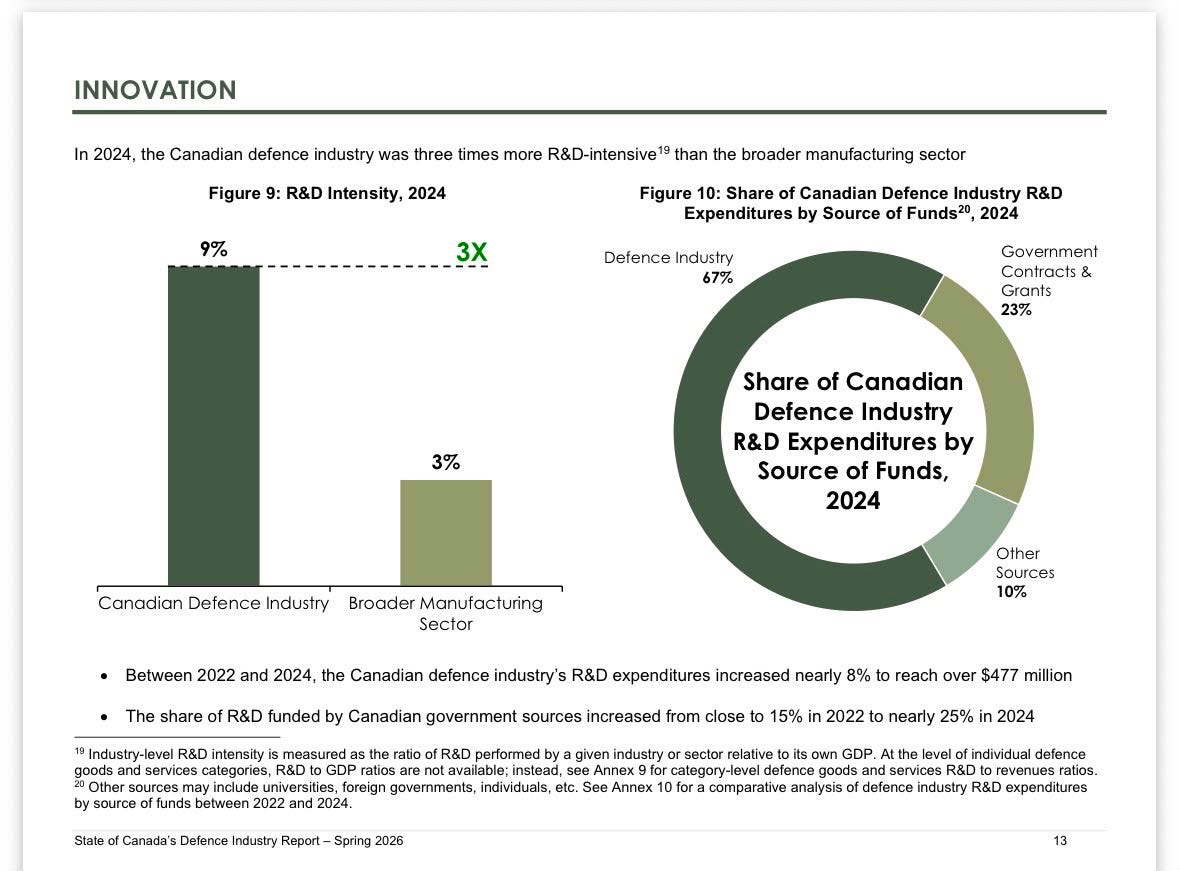
Vanguard Canada’s data portrait of the industry — $17.3B revenue (+87% since 2014), 70% of exports go to Five Eyes, European sales up 78% since 2022, R&D grants up 309%:


Related:
General Petraeus is warning that $54.6B in autonomous warfare spending — a 24,000% year-over-year increase — won’t produce an effective fighting force without doctrine, training, and force structure. Less than 2% of the autonomous warfare budget is directed toward doctrine and integration. “A drone without doctrinal concepts for employment is not a weapons system — it is an asset on a spreadsheet.” The bottleneck isn’t money or hardware. It’s the institutional machinery that turns both into capability
Andreessen Horowitz has led an $11M seed round in Westmag by David Hansen, a new drone motor company in the US
Six companies — AZAK, HavocAI, Leonardo DRS, Allen Control Systems, Picogrid, and Anduril — walked into a demonstration with separate products and walked out days later with a fully integrated autonomous hunter-killer ground vehicle system, presented directly to the Secretary of the Army. Built in under a week. The Hunter: AZAK chassis + Leonardo DRS ACHR radar. The Killer: AZAK chassis + Allen Control Systems Bullfrog counter-drone turret. Picogrid integrated the data flows. Anduril’s Lattice ran command and control. This is what modular open architecture actually looks like in practice — not a slide deck
KPMG on the Defence, Security and Resilience Bank — Canada hosting HQ, 6 Canadian banks signed on as partners, AAA-rated bonds, World Bank model
CD Howe: C.D. Howe did this in 1939 — Canada was the 4th-largest allied war materials producer within years; annual defence spending could approach $150B within a decade
BetaKit on public procurement as a growth lever — Buy Canadian policy currently reserves only 25% of contracts over $25M; US Buy American threshold is $10,000
CGAI on unlocking the minor capital portfolio — double the allocation to $1B/yr, raise threshold to $99M, ring-fence SME access
CIGI: Canada at economic war — 360-degree threat environment, every form of national power is a potential weapon
Canada as a global defence finance center
ROAR brings together the people shaping the future of robotics, autonomy, and public safety innovation in Canada

This year, we are honoured to feature General Wayne Eyre, former Chief of the Defence Staff for the Canadian Armed Forces, as a keynote speaker. With more than 40 years of military leadership experience, General Eyre has led through some of Canada’s most complex domestic and international security challenges, offering a rare perspective on leadership, readiness, and the rapidly evolving role of advanced technology in modern operations.
Join us at ROAR for an inside look at how robotics, drones, autonomous systems, and emerging defence technologies are transforming public safety, industrial operations, and national security. This is where operators, innovators, agencies, and industry leaders come together to see what is next and what is already possible.
Get your tickets: https://www.roarconference.ca/conferences/east
⚔️ Combat Readiness
Ukraine’s Droid TW 12.7 robot held a contested intersection for 45 days — 12.7mm M2 Browning, operated from 10km, serviced every 2 days. Zero casualties. Zelenskyy wants 50,000 UGVs minimum. Russia already fields 32 distinct ground robotics systems
China published HG-STR — a “kill them all” swarm algorithm: autonomous targeting across a jammed, vision-blocked battlefield. Fixed-wing drones. 100% coverage rate in ideal conditions. Designed to hunt and eliminate every enemy target with no human command
Modern warfare aspires to be pan‑domain. What does that mean for western militaries?
Helsing officially launches Area 9 research division + RX-1 robot dog — Europe’s answer to Boston Dynamics. Led by Helsing Chief Scientist Antoine Bordes. Partnered with ETH Zurich and INRIA Paris. “Until now, robotics research in Europe meant depending on platforms built elsewhere.”
Thales RapidDestroyer RF directed energy weapon swept 80 drones in trials. Four-panel effector. Longer-range engagement
Lockheed blasted a Shahed-style drone using a JAGM from a Grizzly containerized launcher at Yuma Proving Ground — first time. Managed by AI-driven Sanctum platform + Fortem R40 radar. Integration completed in under 45 days. Grizzly fits in a standard 10-foot shipping container
Anduril set to win sole-source Marine Corps ACV counter-drone contract — Pulsar-L EW platform (25 lbs, Yeti-cooler size) for Amphibious Combat Vehicles. “Unusual and compelling urgency.” Already holds a $642M, 10-year Marine Corps cUAS program of record
Estonia rolls out drone detection network across 25+ cities. Meanwhile Canada has no national UAS detection architecture
Related:
Canadian bacon: Canada in discussions to join $1.6-billion NATO Innovation Fund… DND’s Strategic Partnership Framework is live: time-limited MOUs, 5-year reviews, sovereignty-first requirements (substantive decision-making authority in Canada, IP in Canada, audit rights). Selection: DIA + ISED + DND at Deputy Minister level. Approval: Secretary of State (Defence Procurement). UAS currently has only 30% Canadian content — the lowest of any sovereign capability area
Assured access to space underpins navigation, communications, and surveillance for the Canadian Armed Forces and our allies
Defence Advisory Forum structure: co-chaired by Secretary of State (Defence Procurement), Minister of National Defence, and Minister of Industry. Meets twice yearly. First meeting: September 2026. Industry members serve on rotation. Does not address specific procurement
Open IDEaS challenges this week — AI sensor fusion (up to $6.75M, deadline July 14) | Urban AI situational awareness (up to $6.75M, deadline July 14) | True North Precision: laser ranging on small drones ($2.1M, deadline June 10) | Sentinel Shield counter-UAS wide-area detection (up to $1M + $20M follow-on, deadline June 25) | ISED satellite cybersecurity ($2M, deadline July 2)

Iran roundup: A $35,000 Shahed drone costs 220x less than the Patriot interceptor used to kill it. Gulf states burned through over 1,000 Patriots in the first 10 days while Patriot production runs at ~600 per year. The US won’t replenish Tomahawks until late 2030. The lesson isn’t just about restocking — it’s about rethinking what “layered defence” actually means. Fences, helicopters, and gun systems do most of the work. Prestige platforms handle the rest
New era of air and missile defence: four structural failures exposed — magazine exhaustion, limited penetrations still had strategic effect, insufficient coalition integration, cost asymmetry. Fix: fire-control-level integration + disaggregated survivable architectures + affordable magazine depth + offensive action as the centre of defence. Fixed systems are targets. Mobility is a survival requirement
NYT interactive on Iran war drone cost asymmetry: Shahed-136 = $35,000. APKWS II intercept = $65,000. Coyote = $253,000. SM-2 = $4.2M. PAC-3 MSE = $8M per two-shot salvo. Directed energy laser = $3/shot. DoD allocated $1B in FY25 to research directed energy
Elbit America + Anduril team up on SIGMA mobile tactical cannon for Army self-propelled howitzer modernization — 155mm, 52-caliber, fully automated, on an Oshkosh 10×10. Anduril integrating Lattice. Built in the US with 300+ suppliers
Mapping Canada’s Defence Innovation Landscape
Canada’s defence ecosystem is moving quickly.
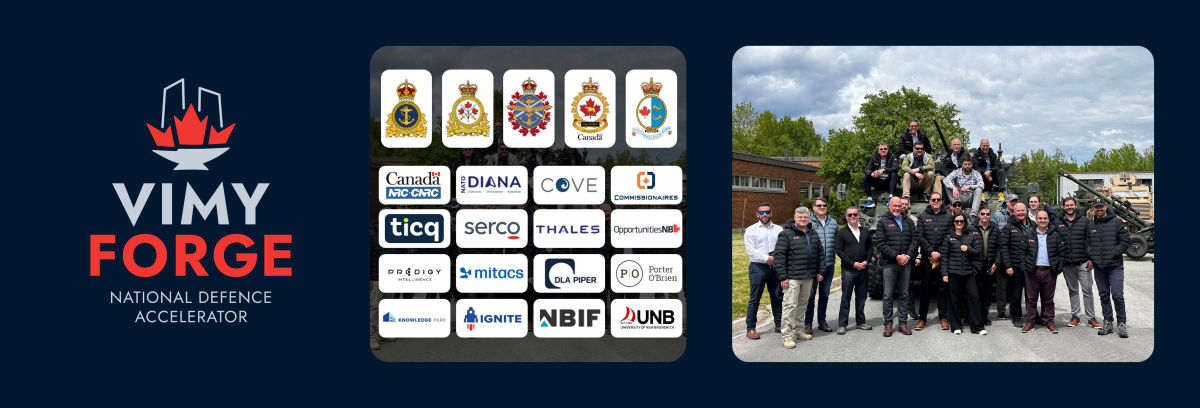
Over the past several months, Canada’s defence and security accelerator, Vimy Forge, has had the opportunity to engage with founders, operators, investors, government officials, and industry leaders from across the country. We recently concluded our second residency week with the Black Flight cohort. One observation continues to surface:
There is significant innovation happening in Canada’s defence and dual-use sectors, but there is no comprehensive picture of where that innovation exists.
As governments make decisions on policy and funding, financial institutions evaluate investment opportunities, and organizations like Vimy Forge design programs to support innovators, everyone is asking similar questions:
Who is building what?
Where are those companies located?
What capabilities are being developed?
How mature are those technologies? Where are the gaps?
Today, there is no single source of truth that provides those answers.
To help address this challenge, Vimy Forge is launching a national initiative to map Canada’s defence, security, and dual-use innovation landscape.
The objective is simple: build a living picture of Canadian capabilities, aligned to Canada’s Key Sovereign Capabilities and Technology Readiness Levels, creating better visibility across the ecosystem for innovators, industry, government, investors, and end users.
This is not an application to a Vimy Forge cohort or accelerator program. It is a collaborative effort to better understand the landscape and strengthen the connections needed to accelerate Canadian capability.
If your organization is developing technology relevant to defence, security, resilience, critical infrastructure, or sovereign capability, you are invited to participate.
Learn more about the initiative or complete the Expression of Interest to help map Canada’s defence innovation landscape.
🔫 Hot Shots
AI war: OpenAI, Anthropic, Google DeepMind, and Microsoft AI CEOs all signed a letter calling on Congress to mandate DNA synthesis screening — the AI biosecurity threat is real: AI lowers the knowledge barrier to engineering pathogens. A 2017 precedent: Canadian researchers recreated horsepox for $100,000 in mail-ordered DNA. Gene synthesis is now cheaper… Anthropic Urges Global Pause in AI Development, Flags ‘Self-Improvement’ Risk
Why does AI in War matter?
Trump signed an AI security executive order — stops short of mandatory safety tests. Instead: voluntary 30-day government review window before public model release. Creates an AI vulnerability clearinghouse. Delayed two weeks over innovation-stifling concerns
DoD expanded classified AI work to 8 companies: SpaceX, OpenAI, Google, NVIDIA, Reflection, Microsoft, AWS, Oracle. Anthropic excluded — blacklisted as a “supply chain risk” after contract dispute over ethical constraints on AI in warfare
Grey war: Five Eyes (FBI, MI5, Australia, Canada, New Zealand) issued an unprecedented joint warning on Chinese LinkedIn spying — targeting government and military personnel with access to classified info via professional networking sites… New cyber force would cost up to $11 billion to start, commission says
Electronic warfare does not arrive politely after the operation begins
A Ukrainian naval drone lost control under Russian EW and self-detonated in Romania’s Constanța port — a NATO member state. Three other Ukrainian drones blew up the same day. Russia’s EW is now routinely redirecting weapons into allied territory… Ukrainian drones are now autonomously intercepting Shaheds
War on the Rocks: the Pentagon’s AI edge is being distilled away — adversaries don’t need to hack US systems; they harvest frontier model outputs through APIs. The “Arena” leaderboard gap between US and Chinese models has narrowed from 17% in 2023 to 2.7%. Stanford researchers distilled Meta’s Llama for $600 vs. $82,000. Anthropic accused DeepSeek and Moonshot AI of generating millions of fraudulent API calls to extract Claude’s capabilities
Small Wars Journal on covert drone warfare: third-party state intervention via drone allows combat participation with near-zero political cost and high deniability. Creates “stalemate without the hurt” — reducing the pain threshold that drives peace negotiations
China’s new sailless mystery submarine spotted at JN Shipyard in Shanghai satellite imagery (June 1). ~120m long, X-form rudders, no traditional sail. Possible pumpjet propulsion. Faster, quieter, potentially seabed-focused. A second similar boat may have launched at Huludao — the nuclear-only shipyard. China has launched 15–20 submarines in 5 years across at least 8 new classes
Odds & ends: VanTech Journal: “Buy Canadian” in defence software is hollow without teeth — a vendor can satisfy one of three requirements (auditability, data residency, Canadian-controlled IP) and still win a contract. Azure holds ~4x the federal cloud volume of AWS. The F-35 review is still open because the data-control question turned out to be real
Canadian Shield Institute: data residency ≠ data sovereignty — CLOUD Act and FISA allow US agencies to compel data from US-headquartered cloud providers regardless of where servers are. Microsoft’s own lawyer confirmed before French lawmakers that European-held data could be transmitted to US authorities
CBC: Canada’s cloud market is “broken” — Amazon, Google, Microsoft control ~85% of Canadian cloud market. Switching costs are prohibitive. Domestic “sovereign” providers are “maplewashed dependencies” without interoperability rules
Xona Space Systems ($170M Series C) targeting Canadian Arctic with LEO Pulsar PNT network — signals 100x stronger than GPS, jam-resistant, cryptographically secure. DRDC funding: $850K. NRC + ISED partnership to distribute Canada’s UTC standard through the network. North of Edmonton: GPS coverage degrades
DIANA’s Challenges for 2027 have launched!
Ghost Bat sales poised to take off
Introducing the UK’s 13 defence unicorns
Anduril engineers introduce a pre-execution reliability layer that verifies and repairs agent decision before any execution occurs
The CAF wants UGVs
Japan’s Hidden Arsenal: The Sub-Component Revolution Nobody Is Talking About
Government as customer and capital source: Silicon Valley itself was built on this defence relationship
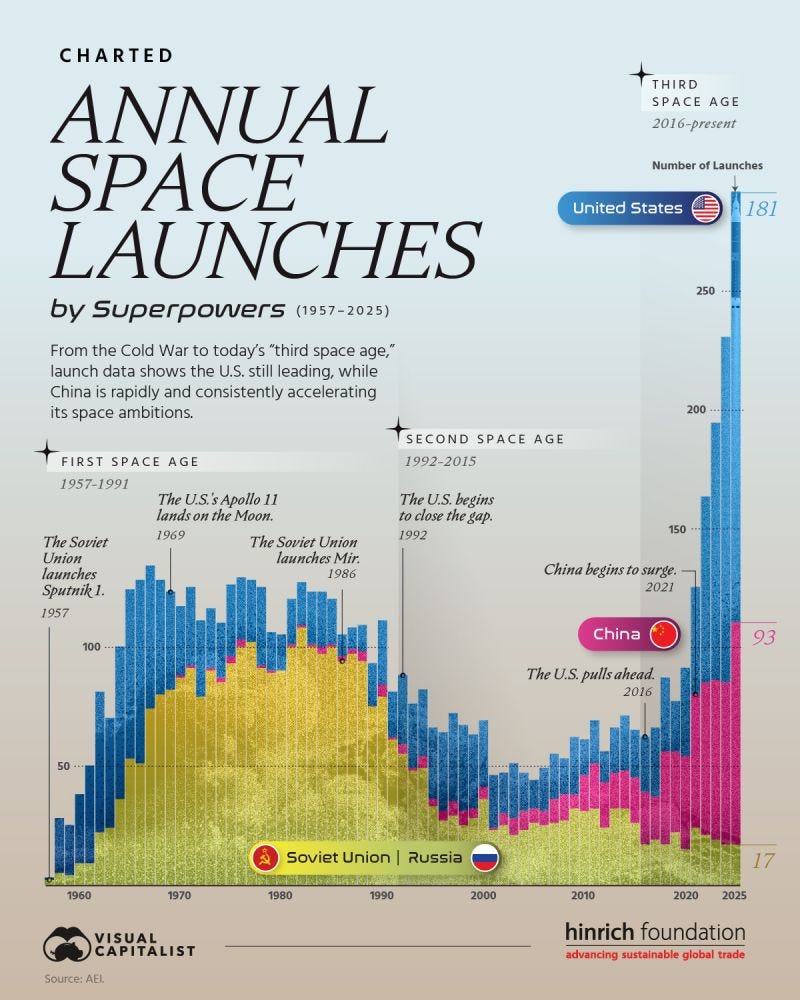
Pure-play space companies are carving out a growing share of the commercial space industry
If you’ve got battlefield intel, classified tips, or just want to call in an airstrike on our typos, hit “reply” and sound off. Whether it’s a new tech sighting, a rumour from the mess hall, or feedback on our comms, we want your SITREP.