

🎯 Three-Shot Burst
Default analogue. Hackers reprogrammed freezers holding blood samples for France’s national blood service from -30 C to 110 C, and in the same month took over refrigeration controls at roughly 700 supermarkets and held them at 50 C for about six hours. France says Iran is responsible for the latter attack.
Canada’s grid could be next on the list, and a grid failure in February is far more dangerous than a warm freezer. One scan found roughly 128,000 Canadian industrial network ports reachable online. A foreign actor got into Nova Scotia Power through one bad click and exposed data on more than 900,000 customers. More than 75% of US power distribution transformers are past their 50-year life, and knocking out nine key substations could black out the US for up to 18 months, on a grid tightly integrated with ours.
The WSJ’s Feliz Solomon maps Iran’s new cyber playbook: rural water operators locked out of control panels across the Midwest and networks breached on two Texas-bound energy tankers entering the Atlantic, in addition to the sabotage of European grocery fridges.
China is automating the work: Palo Alto’s Unit 42 tracked a Chinese crew running the open-source Cairn framework on Zhipu GLM and DeepSeek models through 25 operations against at least 19 organizations, breaking into 10, lifting more than one million records at one and overwriting a live ballot at another.
Reality check: the biggest infrastructure failure of the week needed no attacker at all. The WSJ traces the US air-traffic halt to a single router in southern Arkansas, a Juniper box L3Harris installed at an FAA radio site in El Dorado during copper-to-fibre work. It began flooding the network with about 1,000 connection attempts every four to five seconds, 17 of the FAA’s 22 high-altitude centres lost stable communications, and the result was the biggest halt to US departures since 9/11. The same L3Harris closed a $1 billion Department of War investment in its missile business in April, with solid rocket motor plants in Camden, Arkansas, about 40 miles up the road. One router did by accident what Tehran is trying to do on purpose.
Ottawa drone bake-off. Canada will run live “gauntlets” to pick drone suppliers under the $2.3 billion Defence Drone Initiative: week-long field trials where CAF members fly the kit, rank it on a leaderboard and award contracts off the results, starting with ISR and FPV strike. The US model it copies held two gauntlets, and at least the top 10 companies in each walked away with orders for thousands of drones.
NATO launched a counter-drone marketplace where Allies buy 16 solutions from five companies straight off a catalogue with no further tender, backed by €3.1 million for testing and a Drone Edge pledge of more than US$40 billion over five years. Separately, DIANA picked seven companies for DRONE SHIELD 2026 in Czechia.
Reality check: The Atlantic’s Simon Shuster reports the Pentagon ignored Army warnings about Iran’s Shaheds, including a Ukrainian report on interceptors circulated two months before the war. A Shahed then killed six US service members in Kuwait. When 13,000 Merops interceptors were finally flown in, they shot down one Iranian drone, because nobody brought Ukraine’s acoustic sensor network. The US has since burned through nearly three-quarters of its Patriots.
Retired LGen Curtis Buzzard, who made more than 30 trips to Ukraine running SAG-U, calls learning velocity a form of combat power in a new CSIS report: Ukraine iterates in weeks, its DELTA system serves more than 200,000 users, and Russia’s drone force is doubling to over 160,000 people. “Quite frankly, data is the currency of war, and Ukraine is fighting with ‘live data.’”
“Capital is arriving. Understanding must follow”. That’s the opening line of Eva Sula’s new series, Investing in Defence: Beyond the Hype, which starts from NATO’s estimate that European Allies and Canada spent more than $500 billion on defence in 2024 and the EU’s push for up to €800 billion more by 2030. Her section headers do the work: “A Growing Defence Budget Is Not a Business Model” and “Military Interest Is Not Customer Commitment.”
CCI and Vimy Forge published a blueprint to route ITB obligations into Canadian scale-ups now that the Defence Investment Agency owns the policy: a professionally managed ITB Innovation Fund, a venture multiplier raised from 5-to-1 to 9-to-1, verified five-year Canadian IP retention, and a one-time credit for every new Canadian startup a prime brings into its supply chain.

ADVERTISEMENT

Barrack Hill: Navigating Canada’s defence and procurement landscape with precision.
🤝 Deal Corner
🍁 Arcanus closes $38M+ after setting out to raise $17M. The Toronto drone and counter-drone company more than doubled its Series A target.
🍁 Roshel buys Stellantis’ idle Brampton plant. The Canadian Press reports the armoured-vehicle maker is taking over the assembly plant for an undisclosed sum, closing by year-end, after buying France’s Centigon in October, signing a Daimler MOU in June and forming Roshel Algoma Defence for ballistic steel in April. Roman Shimonov: “With the demand that is growing all around the world, we need more space, we need more capacity.”

🍁 Marconi Technologies funds a research centre at ÉTS. The Montréal tactical radio maker, formerly Ultra I&C’s communications division, is putting $500,000 a year for five years into the Centre de recherche Marconi-ÉTS, more than $1.5 million a year counting its own staff, with all commercial IP staying with Marconi. It has 200 employees in Québec and earns 90% of revenue abroad, from the US military to Poland and Sweden. First idea on the board: 5G for the Far North.
🍁 UFORCE, led by Canadian CEO Oleg Rogynskyy, raised $700 million at a $6 billion valuation, with the UK National Wealth Fund putting in $150 million, its largest defence investment ever, alongside Valor Equity Partners. Sifted confirms its August scoop on the Series A, and Rogynskyy told CNBC bookings more than doubled in a year.
Tiberius Aerospace became defence’s newest unicorn on an $85 million Series A led by Lakestar, licensing its Sceptre ramjet 155 mm shell for an upfront fee, an annual subscription and a 25% royalty on every round, after $500 million in allied orders. Until recently its only contract was a $5 million UK MoD grant. Plural closed a €1 billion Fund III, nearly four times its first fund, with a third reserved for follow-ons after its companies raised €3 billion in 12 months. Poland’s WB Electronics, maker of the Warmate loitering munition, asked banks to pitch for a €7 billion Warsaw IPO next year.

🍁 Maritime Launch is profitable, and DND is the customer. SpaceQ’s Marc Boucher breaks down Q3: revenue of $5.6 million, net income up 9% to $3.5 million and cash up 30% to $29.4 million, with about 99% of revenue from DND’s $20 million-a-year pad lease. Isar’s Spectrum flies from Canso in 2028, MLS is designing pads for medium-class rockets, and it moved to the TSX on November 3 with a share consolidation coming in Q1 2027.
Hadrian buys a 150-year-old foundry and commits $300M. Hadrian acquired Pennsylvania’s Kutztown Foundry & Machine to build “Factory 6” for Virginia- and Columbia-class steel castings, taking a 49-worker shop to hundreds of jobs, months after raising $1.37 billion at an $8 billion valuation. Chris Power: “Reindustrializing America isn’t just building new factories. It’s also about investing in the ones that made it through the years of offshoring.”
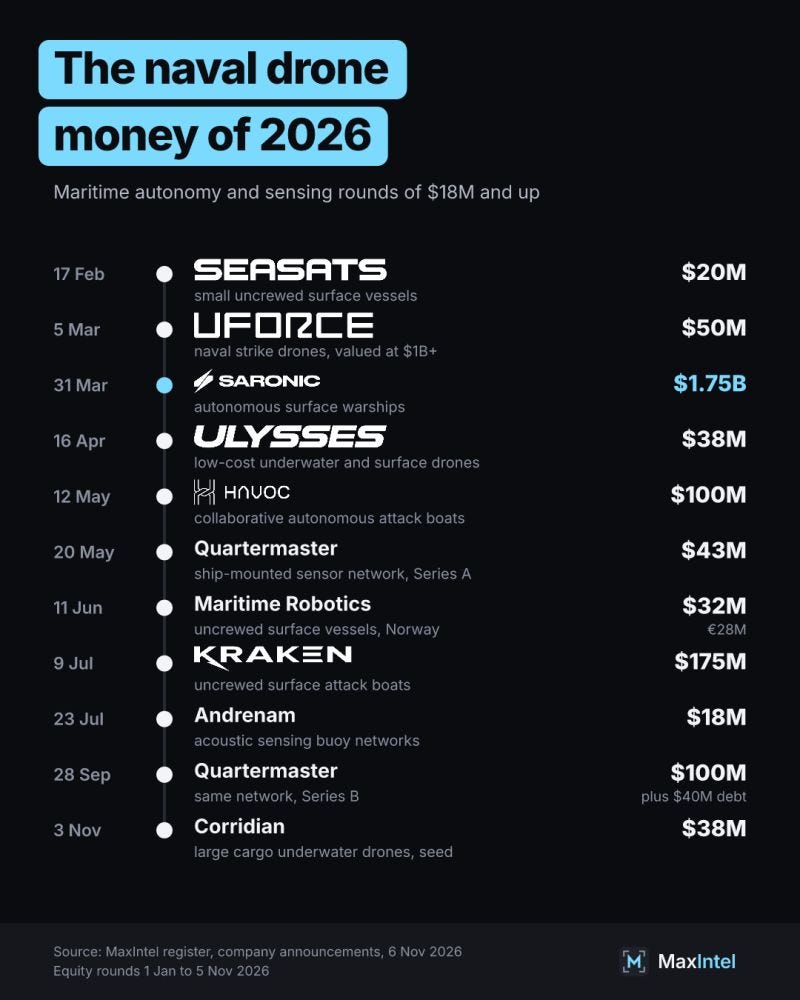
Arondite wins £6M with the Royal Marines and opens in Oslo. The UK startup will put its Cobalt command-and-control software across the UK Commando Force, which just received £100 million for Arctic amphibious capability, and plans £35 million in Norway over the next few years. Cobalt has more than 50 integrations. Will Blyth: “Norway is a natural first step for us. It is on the front line of Europe and NATO’s Northern Flank.” A three-year-old British software company is now building in the High North faster than most Canadian primes.

Early-stage Europe keeps writing cheques. Munich’s SE3 raised a $30 million Series A led by Accel, with Keen, Seedcamp and Lakestar, for spatial AI that lets drones navigate, and says it is working on contracts with Germany and Ukraine. London’s Mistt raised £5 million to build the “next GPS”, a 4D data map for autonomous systems, in a pre-seed led by Expeditions with Seedcamp and the UK’s NSSIF. In Israel, Fusion and Stratos Ventures launched a defence track writing $500,000 to $2 million SAFEs, with introductions to DIANA, the Pentagon, Rafael, Elbit and IAI. Guy Katsovich: “We see a significant gap between the potential of founders in this sector and their access to early-stage capital.”
Related: ArsenalIndex maps the emerging defence and dual-use market by capability, with tile size set by recorded equity financing, and Andrew Glenn counts 568 companies on it so far and is asking for the gaps.

ADVERTISEMENT

Up to $1M in funding — with technical services available for selected projects. Advisory support accessible now. Learn more.
⚔️ Combat Readiness
🍁 Kit for Canada. Resilience Media’s John Biggs goes inside Dominion Dynamics’ Arctic program: an 18-month-old Ottawa company with about 100 staff and $135 million raised, building Scout, an autonomous collaborative combat aircraft for short, rough runways at -60, where batteries die, fuel thickens and the sun disappears for the winter.
🍁 Space. 3 Canadian Space Division commander BGen Christopher Horner lays out how the division is growing: about 100 space professionals a year, a new space mission operator trade and a “space warfare officer” career field, a $2.3 billion proliferated LEO constellation for SATCOM, about $500 million to secure two East Coast spaceports, and light lift under Launch the North by 2028 at the latest.

The launch gap. ULA’s Vulcan failed minutes after liftoff on Sunday and took 40 Amazon Leo satellites down with it, on the first of 38 Amazon launches. Vulcan is contracted for roughly half of the US national security space manifest over the next few years and now faces an indefinite grounding after booster problems on two of its four previous flights. Reuters notes it is ULA’s first mission failure in a 20-year history. The US just lost its main alternative to SpaceX.


Infrastructure of dependence. In Small Wars Journal, Yilma Makonnen explains how a Starshield speed cap changed the war: in October a restriction cut connectivity for drones moving faster than about 100 mph, forcing Ukrainian operators to alter or abandon missions until it was lifted. Ukraine owned the drones. Someone else set the parameters. His answer is “greater sovereign control over the infrastructure through which that knowledge becomes accessible and actionable,” which is why Stetman and GomSpace are planning a $1.1 billion, 360-satellite Ukrainian constellation. Moscow drew the same lesson. SatNews reports Russia filed for a 374-satellite Rassvet-4 constellation after two of its 32 Rassvet-3 satellites burned up and the other 30 stalled short of their 800 km orbit.
ADVERTISEMENT

Learn more.
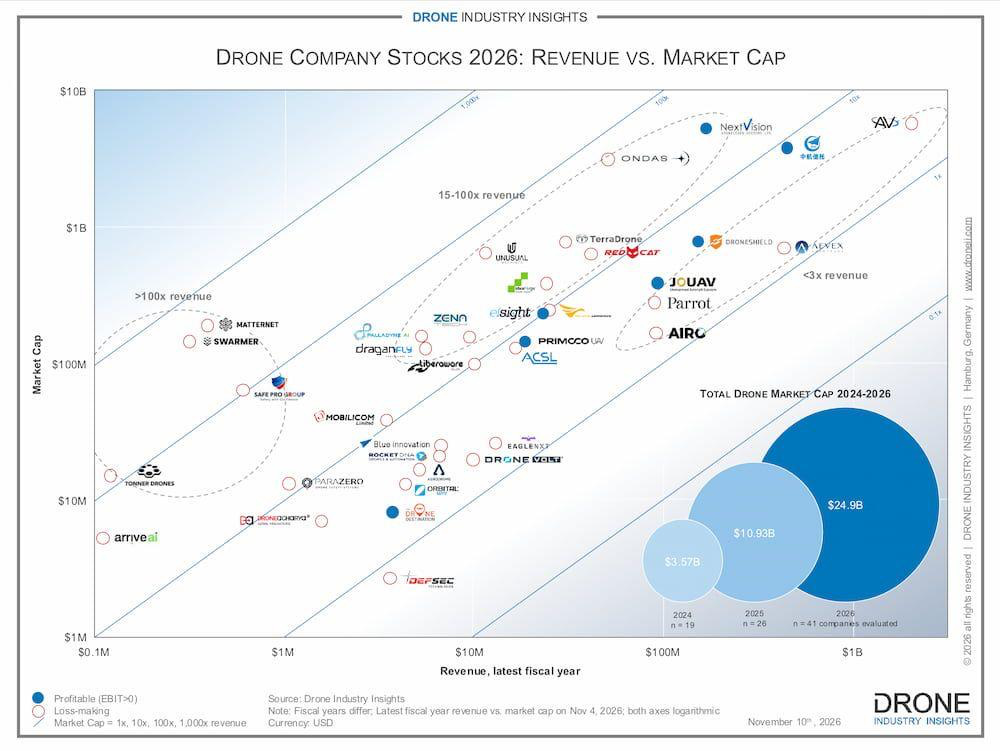
Software sovereignty. Helsing launched Clarity, its answer to Palantir’s Maven: an agentic intelligence platform that ingests satellite, sensor and drone data and helps direct strikes, including long-range missiles, built on a modular open-systems approach. NATO chose Maven, and Palantir has nearly $1.5 billion in Maven contracts from European governments.
Tanks get an air force. Writing in The Telegraph, Col Hamish de Bretton-Gordon profiles Ukraine’s CODE 9.2 regiment under Col Oleksandr “Flint” Nastenko, where every tank has Starlink and a tablet showing a live drone feed of itself from above. Escort drones scout, clear mines and hunt FPVs, Flint claims his tanks have survived 10 to 15 FPV strikes, and drones deliver 40 kg of supplies to each assault soldier every day. The regiment designed its own 16-tonne, 500-horsepower assault vehicle in four months. “The tank is not dead. But the tank without its drones may soon be.”
Counter-drone. TWZ’s Thomas Newdick looks at Beretta’s LIVET turret: eight Benelli M4 Drone Guardian 12-gauge shotguns firing programmable airburst rounds, AI that tracks up to five targets, and a human who makes the final call, just demonstrated for the Danish Armed Forces. The French Army puts the optimal shotgun engagement at about 160 feet and the maximum at 330. It’s a last-ditch layer, and cheap at scale.
Your phone is a targeting packet. US planners say Iran used social media, fitness apps and Russian satellite imagery to target US bases, mapping shift changes and meal times. It hit 26 US sites in the war’s first six months, and damage to regional bases, not counting aircraft, will cost an estimated $9 billion to repair.
Hellscape. The Economist asks whether drone swarms can protect Taiwan, as American and Taiwanese officials plan to turn the Strait into a “hellscape” of aerial, naval and underwater drones. Cheap mass is now the deterrent in the Pacific too.
🍁 Big think. For The National, CBC’s Jennifer Yoon asks whether Canada should join the autonomous arms race in a six-minute segment on AI weapons, international humanitarian law and where Canada fits.
ADVERTISEMENT

Access a network of defence specialists that provide sector expertise, structured financing and strategic connections to help navigate the industry and grow. Click to connect.
🔫 Hot Shots
🍁 Dual-use, from problem to market. Glenn Cowan and Michael Smith of ONE9 are running a free one-hour workshop at Area X.O at Bayview Yards in Ottawa, with a virtual option, for TRL 6 to 9 companies deciding between commercial-first and defence-first, with one-on-one time with the ONE9 team afterward.
🍁 TACTIQL is No. 2 on Deloitte’s Companies-to-Watch. The veteran-owned Ottawa defence software company celebrated its place on the Technology Fast 50 list this week, and SpaceQ puts its three-year growth at 4,395 per cent building ISR data-fusion software as a founding partner in Calian’s Northstar Defence Lab. Michael Nelson gave the credit to the team: “Still a lot of work to do. Let’s build.” He also congratulated H2 Analytics, back on the list for a second year. Congratulations from all of us.
🍁 Volatus is hiring. Volatus Aerospace is recruiting across Canada and the UK for an OCC RPAS pilot in Vaughan, an AME M1 near Edmonton, a supply-chain specialist in Mirabel, and GIS, thermal imaging and UAS instructors in the UK.
Ontario Tech University announces new Defence Tech Lab.

🍁 A UUV from a Waterloo garage. Carleton grads Samuel Scrivens and Shrey Naphade built Pelagos’ backpack-portable Vantage AUV in Naphade’s parents’ garage, ran it for about an hour untethered in saltwater, and signed US ocean-tech company Tekmara as their first customer.

The Pentagon’s lost unit. One more detail from Shuster’s Atlantic piece: the Army stood up a 600-soldier Unmanned Assault Battalion in Italy to learn drone warfare from Ukrainian advisers, then dismantled it in August as part of a “back to basics” push.
Shotguns vs. drones, the scoreboard. Turkey’s Drone Kalkanı mounts two 12-gauge weapons, Estonia’s Edge Group has a quad shotgun on a Ukrainian UGV, and Beretta just went to eight. TWZ has the full lineup.
The Icebreaker is written for the people building Canada’s defence technology base. Forward it to someone who needs it.