

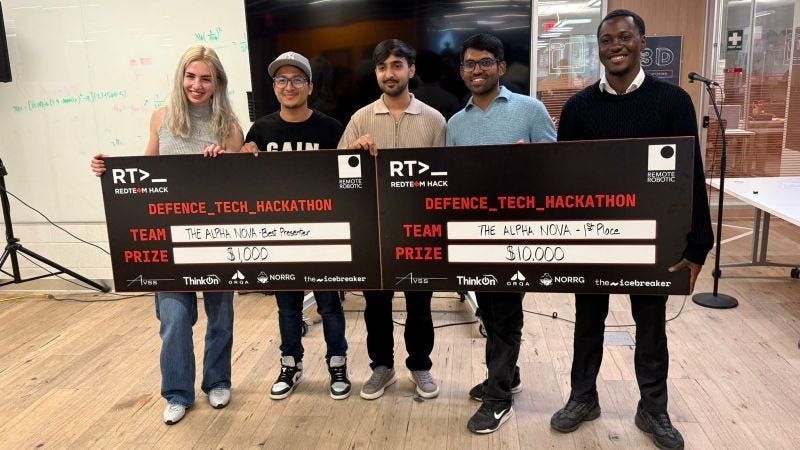
Editor’s Note: Congratulations to Greypoint Industries — the team that took home top prize at Canada’s first-ever Defence Tech Hackathon last year, which we were proud to host here at The Icebreaker. Jordan and the rest of the crew have now earned a spot in Y Combinator. From an Arctic-sovereignty idea built in a single weekend to one of the most competitive accelerators in the world — that’s exactly the kind of ambition we started The Icebreaker to champion. We couldn’t be prouder, and we’ll be watching what comes next.
🎯 Three-Shot Burst
Canada’s electronic spy agency doesn’t usually brag. But buried in CSE’s 2025–2026 annual report — released this week — is a first: CSE publicly confirmed it conducted an active cyberoperation against foreign criminals brokering fentanyl precursor chemicals, disrupting and “diminishing their ability to operate.” It also disclosed it took concurrent action against 10 of the most significant ransomware groups harming Canada and allies simultaneously. Not one at a time. Ten!
The numbers behind the year: 3,216 cyber incidents responded to. 97,000+ threat notifications sent. 67 pre-ransomware alerts pushed to Canadian organizations before attackers could pull the trigger. A 25% increase in alerts and 28% increase in advisories over 2023–24. CSE now has 4,178 employees — up 337 in a single year — and is entering what the report calls “sustained expansion and transformation.”
Reality check: This is not your father’s signals intelligence agency. CSE is deploying staff to Latvia and Lithuania through its Deployed Cyber Security Officer program. It co-chaired the G7 Cybersecurity Working Group during Canada’s 2025 presidency. It led the Arctic Intelligence Coordination Group. It coordinated cyber defence for the 45th federal election, the G7 in Kananaskis, and is embedded in FIFA World Cup 2026 planning across North America. It’s also leading Canada’s post-quantum cryptography migration — publishing the government-wide roadmap while simultaneously chairing the interdepartmental working group.
Bottom Line: CSE’s overt disclosure of an offensive cyberoperation against fentanyl networks is not an accident. It is a signal — about what Canada is now willing to do, and willing to say it did.
Related:


🏆100k Pitch Contest in Montreal next week:
DMZ Ventures is launching the $100K Dual-Use and Sovereign Tech Investment Prize at Startupfest, investing in startups driving Canada’s resilience and national security. The Icebreaker is aboard to help judge.
ADVERTISEMENT

Barrack Hill: Navigating Canada’s defence and procurement landscape with precision.
🤝 Deal Corner
🍁 Canada’s $100B submarine decision is now a bidding war. A South Korean attack submarine docked in Victoria in late May. Germany’s defence minister stood beside Canada’s in Ottawa and made the case for European alignment. Both Hanwha and TKMS meet Canada’s operational requirements — PM Carney has said it “ultimately comes down to the broader benefits being offered.” The industrial lobbying campaign is unprecedented in Canadian procurement history. Decision imminent.
🍁 GlobalEye: Saab chosen, L3Harris blindsided. Ottawa bypassed the standard RFI process and opened sole-source talks with Saab for Canada’s NORAD-linked surveillance aircraft. L3Harris Canada — which had readied its Aeris X (built on a Bombardier 650 airframe) — said it was “quite surprised.” The political catch: fully integrating GlobalEye with NORAD requires US stealth communication technology that has never been shared with a non-US aircraft. Bill C-31 would expand procurement exceptions from 4 to 14 — and may retroactively justify the decision. L3Harris says it can still deliver by 2032.
🍁 Griffon upgrade suspended. The federal government put the $800M CH-146 Griffon Limited Life Extension program on hold over technical complexity — specifically, problems with the mission system computer. Bell Textron (Mirabel) was notified. It’s unclear whether all 82 helicopters will be upgraded or only a select number. The program aimed to keep the fleet flying until 2039; the revised scope will now only target the mid-2030s. Replacement program: ~$18B, deliveries starting ~2033.
STARK raises €500M at €3.5B valuation. The two-year-old Berlin drone company — Virtus loitering munitions (130km range, GNSS-denied), Cascade (100km, tube-launched), Gambit (ISR quadcopter), Vanta (maritime USV), and Minerva (C2 software) — just quadrupled its valuation from earlier this year. Founders Fund and Sequoia led; NATO Innovation Fund participated. STARK holds a €2.8B German military framework contract for Virtus. More than 80% of the new capital goes directly to R&D and manufacturing. CEO: “The challenge facing Europe is no longer whether we can innovate, it’s whether we can scale.”

Booz Allen buys Ultra I&C Mission Solutions for $720M. Ultra’s flagship product ADSI is the Army’s most widely used tactical data fusion and situational awareness tool — it’s already on a $86.8M Guam IBCS contract and a $39M Marine Corps aviation C2 contract. The acquisition also brings Knox (ruggedized AI edge compute, runs on MQ-9), Rain, ACTS, Apex, and CyberFence into Booz Allen’s portfolio. Deal closes by end of September. ~220 people, $720M — a pointed bet on defence tech over consulting.
Anduril leads Army NGC2 common data baseline. The US Army selected Anduril to integrate 17 fragmented C2 programs of record into a single converged data layer. Partners: Palantir (Foundry), Raft (data registries), plus Govini, Microsoft, Striveworks, Rune, Shift5. Falls under Anduril’s existing $20B 10-year enterprise agreement. At Ivy Mass, Team Anduril took connected devices from 10 to 2,500+ and added 17 new applications in a single demonstration. NGC2 is the Army’s answer to JADC2.
Mach Industries closes $300M Series C at $1.8B. The Merge’s breakdown is essential reading on the most polarizing company in defence tech. Ethan Thornton (Thiel Fellow, founded Mach at 19) is running six programs simultaneously: Viper (jet-powered strike), Dart (counter-drone), Glide (standoff), Pike (long-range), Atlas (maritime strike — selected for DIU RIMES in June), and Venom. The factory thesis: 115,000 sq ft in Huntington Beach, 12,000 micro-jet engines annually, Exquadrum solid rocket motors in-house. Roughly half of this year’s revenue comes from B2B component work — other defence companies paying Mach to source scarce inputs they can’t find elsewhere. Public contract obligations: ~$1.76M. Valuation: $1.8B.
Valor Equity raises $2.5B Fund VII. Antonio Gracias’s firm — long allied with Elon Musk — is raising its next fund on the back of SpaceX going public on June 12. A portion already earmarked for SpaceX shares.
🍁 L-SPARK looks to launch defence-tech accelerator. The Kanata-based startup accelerator — backed by Terry Matthews’s Wesley Clover, 160+ alumni, $200M+ in follow-on capital — is in early-stage talks to build a dual-use defence accelerator for Canadian SMEs looking to access the defence establishment through primes. The federal government plans to raise the domestic defence contract share to 70% (from 43%) within a decade, creating 125,000 new jobs.
🍁 DefSec Technologies raises $2.5M. The Kanata-based company (formerly Kwesst Micro Systems) — battlefield laser detection, soldier systems, anti-riot tech, DND software services through Thales Canada — sold 673,006 shares at $3.74 in a registered direct offering. Board member: Ret. Gen. Rick Hillier. Revenue Q1: $2.1M (up from $1.3M). Stock is down ~80% over 12 months. The raise buys runway.
🍁 Q-Branch Dual-Use Accelerator — now taking applications. Canada Q-Branch is screening scaleups for its dual-use accelerator, targeting federal markets and Texas expansion. Applications open now.
Related: France drops Palantir for a reason. ChapsVision won DGSI — German intelligence chose the same. The 2026 defence tech landscape is no longer a two-company story: defence-national security VC investment in early 2026 already exceeds $14.6B — surpassing the prior full-year record of $9.6B set in 2025. 2026 is the execution year.
Related:
Defence tech is hot again, but not every startup is real (25:19)
 Rocket Lab@RocketLabRocket Lab is acquiring Iridium Communications Inc – one of the most transformative deals in the space industry. By combining our launch capability and satellite manufacturing with @IridiumComm’s global satellite communications network and rare spectrum, Rocket Lab becomes a
 11:13 AM · Jun 29, 2026 · 338K Views166 Replies · 537 Reposts · 3.28K Likes

⚔️ Combat Readiness
The jellyfish swarm over Iran. When the downed F-15E pilot was debriefed, he described a “minefield of drones” — multiple Iranian systems hovering in formation, moving as one, with smaller drones dangling below like legs. “Real alien shit.” CNN confirmed the intelligence community remains split on how to interpret the account — the pilot had a concussion — but the capability described is “one-to-many meshed networking,” which Russia and China already possess. If Iran has it, with Chinese assistance, the implications for every US air operation in the region are significant.

The Iran war is straining the arsenal. Trump met with Boeing, Lockheed, Raytheon, and Honeywell at the White House to demand faster production of Patriot, THAAD, Tomahawk, and AMRAAM. Hegseth simultaneously held a separate, unannounced meeting at the Pentagon with Anduril, Castelion, Leidos, and CoAspire — the message: if the primes can’t deliver, the new entrants will. Iran launched over 8,000 missiles and drones in the conflict. The US naval base in Bahrain took significant, publicly unacknowledged damage — command headquarters, satellite communication facilities. Most personnel were evacuated. “Two US fatalities” versus 13,500 Iranian targets struck. The math is not symmetrical — but the base is in rubble.
Arsenal of scarcity — the numbers. AlixPartners’ missile supply chain breakdown is the most data-dense read of the week: Iran produces 100+ missiles per month; the US produces 6–7 interceptors. The supplier base has contracted from 5,000 firms to ~1,000. There are 100+ identified single points of failure at the sub-tier level. GMLRS is scaling from 6,000 to 14,000 units annually — and its ammonium perchlorate comes from one domestic facility, its polymer binder from a single supplier (with degrading quality), its spherical aluminum powder from one qualified manufacturer. China controls 91% of rare-earth magnet capacity; the DFARS restriction on Chinese samarium-cobalt and NdFeB magnets kicks in January 2027 with no assured domestic alternative at scale. “Capacity is the new capability.” L3Harris makes this argument directly: it is not sustainable to defeat hundred-dollar drones with million-dollar interceptors.
🍁 Canada’s top soldier names the threat. CDS Gen. Jennie Carignan, in an exclusive interview with CTV: “The threat to our continent is mostly related to the new missile technologies and the new vehicles of delivery that Russia is developing.” North Korea, Iran, cruise missiles — medium and long range. The CAF is reorienting from expeditionary theatres to continental defence, with emphasis on the Arctic: air defence systems, underwater sensors, space.
🍁 Canada–UK drone warfare training, with asterisks. 350 British and Canadian soldiers are training at Suffield, Alberta — replicating Ukraine lessons: one-way attack drones, electronic warfare, constant surveillance, electromagnetic threat. The capability gaps identified: Canada needs more drone fleets, more electronic warfare units, more counter-drone systems — and a dedicated airborne EW/SIGINT aircraft (RCAF currently has none). The Falcon Shield (Leonardo) is adopted; Leonidas (Epirus) neutralized 49 drones in a single pulse during testing. The MC-55A Peregrine (Australia’s advanced EW jet) is the model Canada is being told to pursue.
Kill zone: the front line no longer exists. LRT’s ground-level Ukraine reporting is required context for every procurement conversation: the kill zone now stretches dozens of kilometres from Russian positions, defined by drone range. Even 15km is “extreme danger.” Soldiers operate in scattered positions 1.5km apart. “War used to be louder. Now you get a false sense of security because it’s quiet, but you can be killed very quickly and out of nowhere.” FPVs: 5–6 launched per Russian soldier. One battlefield insight distilled: “90% of what we knew about warfare will no longer help.”
Drones are the problem, not the answer. MWI West Point’s Lt. Gen. Eric Wesley (Ret.) makes the machine gun analogy: drones have raised the cost of maneuver, not made maneuver unnecessary. They cannot seize ground, hold it, or compel a population. The Ukraine front moves in hundreds of meters per month despite the most intensive drone warfare in history. The decisive system will be whatever restores maneuver under drone threat — directed energy, EW, autonomous ground systems, cheap counter-drone that doesn’t require million-dollar interceptors. “The visionaries who understand this will win the next war.”
China’s Arctic 3D build-up. The Diplomat: China’s 15th Arctic expedition sent two deep-sea research vessels as motherships for manned submersibles Fendouzhe and Jiaolong — conducting joint under-ice operations for the first time, 40+ dives over 56 days, reaching 5,277m at the Gakkel Ridge. The Wukong 6000 AUV hit 3,800m in its first Arctic tests in 2024. The 14th Five-Year Plan explicitly tasked a “three-dimensional space-ground-sea monitoring capability” in the polar regions. The PLA frames the Arctic as a “strategic commanding height” from which the entire northern hemisphere can be reached. No evidence of Chinese submarines in Arctic waters yet — but the data collection infrastructure for that capability is being built.
Russia’s nuclear icebreaker myth. MacDonald Laurier unpacks the gap between Russia’s Arctic narrative and reality: 8 nuclear icebreakers in service (no other country has any), 4 under construction, but the Rossiya program was scaled back from 3 ships to 1, older ships retire in 5–10 years, sanctions are inflating costs and slipping delivery timelines, and the Transarctic Transport Corridor is “mostly propaganda for domestic consumption.” Canadian and US polar icebreakers are expected by 2040 — using Finnish shipyards that formerly built for Russia.
MQ-28 Ghost Bat debuts in the Pacific. Australia’s MQ-28 flew in Exercise Valiant Shield — its first large-force combat exercise — marking the first operational appearance of a loyal wingman alongside F-35s and F/A-18s in the Indo-Pacific. Significant: this is allied, not just Australian hardware.
China studied US stealth — and got it wrong. USAF China Aerospace Studies Institute fellow Maj. Derek Ecklebe: China treats stealth as a technology problem; the US treats it as a system — technology integrated with tactics. China’s J-35 replicates F-35 features but “prioritizes hardware metrics over software-defined adaptability.” Chinese air defences are formidable not because of any single radar but because of unified IADS integration. The strategic risk: if Beijing believes it has neutralized American stealth, it may feel emboldened on Taiwan.
Space acquisition: the next war starts here. Former USAF No. 2 Gen. Jim Slife, in his first op-ed since leaving service: current “exquisite” space systems are massive, multi-billion-dollar soft targets. If one gets jammed or destroyed, replacement takes years. The answer: proliferated, commercially-developed, agile orbital systems that can maneuver, service, and “fire back.” The procurement path: Commercial Solutions Openings and Other Transaction Authorities as the norm, not the exception. Congress has already given acquisition leaders the authority — the barrier is institutional will.
The post-quantum clock is running. The Department of War’s PQC Strategy sets two hard deadlines: all DoW systems must support PQC by December 31, 2030; all must exclusively use PQC by December 31, 2031. A Cryptographically Relevant Quantum Computer would give an adversary the ability to decrypt classified data, forge software signatures, access C2 systems, and gain unauthorized control of warfighting platforms. QKD and quantum networking are explicitly prohibited as substitutes.
Sea drones sink ships. Bloomberg: in an unannounced exercise in the Philippines, US special forces guided Magura-class uncrewed surface vessels — the same Ukrainian-developed drones that ravaged Russia’s Black Sea fleet — into a decommissioned target ship. It sank within seconds. First Indo-Pacific trial. The Pentagon is now studying this capability as a China counter.
USCYBERCOM: talent problem, structural fix. Line of Departure proposes treating cyber operators like special forces and doctors: centralize under one command (model: Space Force), tie mission directly to NDS, and pay retention bonuses akin to jump pay or medical school debt relief. Author: COL Charles McGrue, 35 years of service.
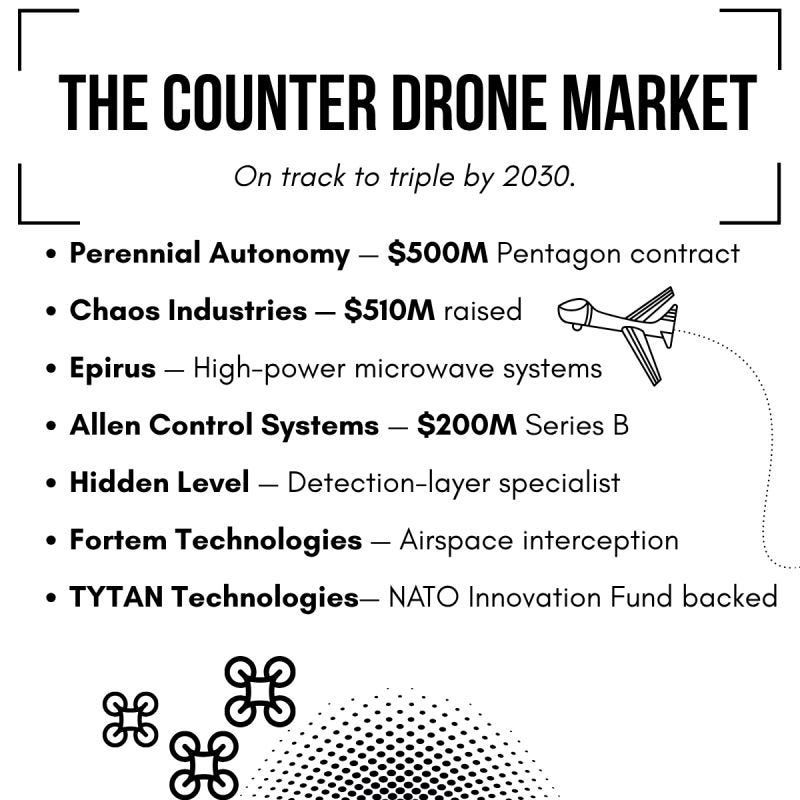
Related: SE3 Labs raises €5.5M (Lakestar, Sequoia Scouts) for spatial AI — helps operators command autonomous swarms in contested environments. In continuous use by the Bundeswehr, in Ukraine, and multiple allied forces. Askari raises $9M seed for a hand-launched, fully autonomous, computer-vision-guided interceptor (Rift Alpha: 2km range, ~60 m/s, hits Group 1–2 drones) — “mega oversubscribed,” turned away $4–6M, ~90% intercept rate in Tier One testing.

🔫 Hot Shots
War by other means. Palladium Magazine’s piece is the most important long-form of the week. The argument: as drones, robotics, and AI reduce the dependency on human soldiers, political power shifts from citizens to the private firms that build and operate the systems. When Ukraine’s 13th Khartiia Brigade overran Russian positions near Lyptsi in December 2024 with zero Ukrainian personnel physically present, it demonstrated both the potential and the political implication. SpaceX reportedly negotiated subscription tiers for drone control with the Pentagon mid-conflict. Anthropic’s Claude was used in Iran strikes while the company and DoW were in a legal dispute over autonomous weapons use. “War is and will forever remain the continuation of politics by other means. It would do us good to remember that politics is, and continues to remain, our domain.”
China has matched Anthropic on cybersecurity. WSJ: Zhipu AI (Z.ai) can now identify security vulnerabilities on par with Anthropic’s Mythos in certain contexts. It still trails in other areas — but the parity on vulnerability discovery is the number that matters. The White House is revising US AI export regulations in direct response.
Iran attack on NSA Bahrain: the damage picture. WSJ satellite analysis reveals the extent of what Iran destroyed at Naval Support Activity Bahrain — strikes from late February through June. Command headquarters and at least a dozen structures severely damaged; two satellite communication facilities hit. Pentagon has not publicly acknowledged the extent. Iran launched 8,000+ missiles and drones total. “No casualties” — but most personnel were evacuated. A small team remains on-site.
Ukraine’s defence tech: investment opportunity of the decade. Business Ukraine makes the case: 4 years battle-tested, 50x production scale-up, ~4 million drones manufactured in 2025 (target: 7 million in 2026), 90% of Russian casualties now caused by Ukraine-made products. Ukrainian howitzer: $2.5M, 2-month delivery. Western equivalent: $4.3M, several years. Interceptor drone: $1,000 vs. $50,000 for a Shahed. Export permits now being issued; 10 export hubs across Europe opening. Saudi Arabia and Qatar have signed framework agreements.
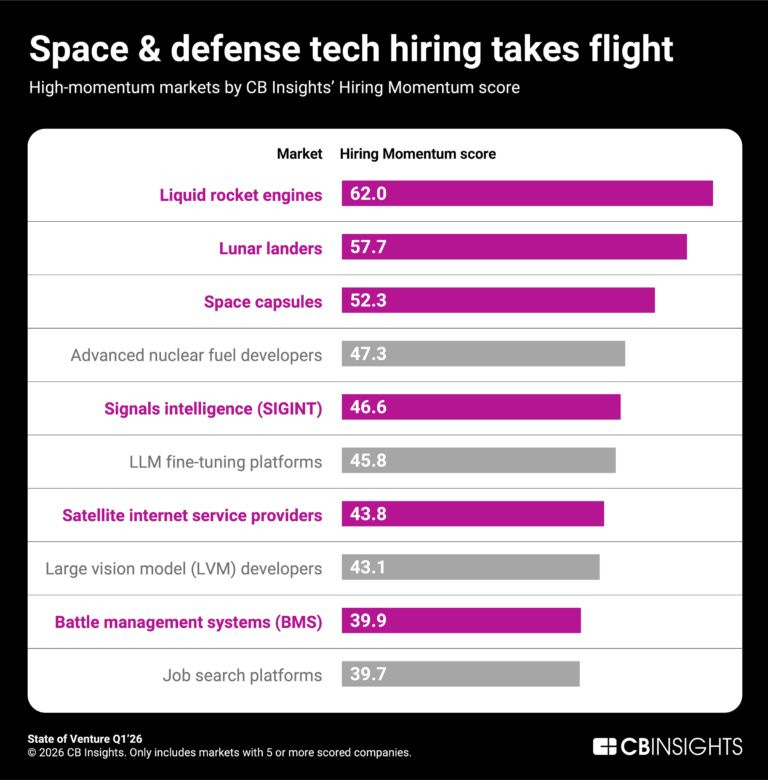
Lithuania went from 5 defence companies to 200. The New Defense Post tracks the boom: Lithuania is spending 5.38% of GDP on defence in 2026 (~€4.8B). Rheinmetall’s €180M 155mm ammunition plant comes online in 2026. KNDS is assembling Leopard 2A8s locally. A state defence holding company is forming. The ecosystem now includes ~110 innovative companies in UAVs, lasers, photonics, ICT, and engineering — and FPV drones are shipping directly to Ukraine from Vilnius.
Frankenburg takes aim at €100M Series B. The 2.5-year-old Estonian missile startup is building the Mark I — a compact, precision-guided interceptor — targeting 200 missiles/day production from facilities in Germany and the UK (via Babcock). Backers include Expeditions, Blossom Capital, Plural (Series A lead). A Series B at this scale would push the company toward unicorn status. CEO Kusti Salm: “The era of scarce air defence is ending.” New MOU with Milrem Robotics to mount Mark I on UGVs — distributed short-range air defence from unmanned ground platforms.
Why VC rules don’t apply to defence tech. Medium/Titus van Heur: defence tech companies don’t have a funding problem — they have an architecture problem. Standard VC fund lifecycles (10 years) create artificial exit pressure misaligned with multi-year sovereign procurement cycles. Capital needs quickly outgrow VC balance sheets; companies need institutional project finance and sovereign debt structures, not dilutive equity rounds.
AGF Capital Partners: the defence opportunity is durable. The investment case: capital is flowing beyond the traditional prime contractor ecosystem into tech firms, industrial suppliers, and emerging businesses. A significant portion of defence spending remains unallocated — creating a multi-year pipeline. The combination of sustained government spending, evolving procurement frameworks, and private capital is driving an investable cycle. AGF: ~C$14B in alternative AUM.
🍁 DND Drone Surge IDEaS challenge is live. DND/CAF are offering: $35K (Round 1), up to $350K (Round 2), and up to $650K (Round 3) for scalable, low-cost, attritable FPV drone systems. Canadian companies only. The goal: accelerate domestic UAS manufacturing capacity.
🍁 Wyvern selected for NASA’s Commercial Satellite Data Acquisition program. The Edmonton hyperspectral imaging company is the first pre-Series A company accepted — among 14 selected globally. Wyvern previously received support under Canada’s Defence Industrial Strategy and has inked partnerships with foreign governments and NordSpace.
🍁 Qubic raises $2.5M USD for quantum signal amplifiers. The Sherbrooke-based spin-off of Institut quantique and University of Waterloo — cryogenic amplifiers that read superconducting qubits without overheating — raised from Two Small Fish (lead), UC Investments, Quantacet, and UCeed. First customer: US-based Quantum Machines. Defence demand is growing. Total raised: ~$10M CAD. Target: 30 employees by end of 2027.
ISC Challenge: quantum laser for CBRNE detection. NRC is offering up to $1.5M CAD (Phase 2, up to 18 months) for a field-deployable quantum cascade laser system that can detect hazardous chemicals at safe standoff distances for defence/security applications. Deadline: July 21, 2026.
European Sky Shield Initiative primer. Defence Post’s guide: ESSI is not a system — it’s a coordinated architecture of Patriot, IRIS-T, SAMP/T, and future directed-energy capabilities across Germany, Poland, Czechia, Romania, and others. It runs alongside NATO’s integrated air defence structures, pools costs, and aims to cover ballistic missiles, cruise missiles, drones, swarms, hypersonics, and electronic jamming simultaneously.
Orqa: Croatia’s drone champion. L’Express: founded in 2018 in Osijek, Orqa builds dual-use drones with a European value chain — breaking dependence on Chinese components that dominate the market. The military drone market hit $18.2B in 2025 and is expected to exceed $30B by 2034.
The Pentagon rethinks how it does R&D — The Office of the Under Secretary of War for Research and Engineering has finalized its Defense Research Enterprise Review, a blueprint to modernize the department’s sprawling lab network, cut bureaucratic friction, and push combat-ready technology out the door faster. A signal worth watching for anyone tracking how the U.S. wants to maintain its technological edge
The money is rotating “to atoms” — PitchBook’s Q1 2026 data shows roughly $16 billion poured into robotics and physical-AI startups across nearly 500 deals — an all-time high on both counts, and about 4.5x the deal value and 2x the deal count of a typical quarter from 2021–2025. Robotics has now leapfrogged fintech to become the second-largest private-market category, fueled by megadeals for the likes of Shield AI and Saronic.
Canada’s defence strategy has a workforce problem — Mark Norman argues that the real Achilles’ heel of Canada’s $180-billion Defence Industrial Strategy isn’t procurement — it’s people. With a structural shortfall of 20,000+ skilled trades workers a year and a 125,000-job pledge that lacks a credible plan, he warns the strategy could quietly default back to buying from foreign suppliers. His prescribed fix: an independent annual labour assessment, a dedicated defence-trades pipeline, and a tilt toward dual-use firms.
Where the drone money might go — Barron’s makes the case for drone stocks as the Pentagon leans harder into unmanned systems, with names like Kratos Defense among those drawing analyst attention across the sector.
China’s seabed push blurs mining and war — A CNN/Mongabay investigation tracked China’s deep-sea mining fleet and found the vessels spent just 6% of their time in designated mining zones — raising questions about dual-use missions like seabed mapping and submarine tracking, as Beijing holds more International Seabed Authority licenses than any other nation
Following the defence dollars — The Department of War launched a public Investment Intelligence Center, an interactive dashboard tracking over $6.7 billion in Defense Production Act and industrial-base investments since 2015 — searchable by sector, year, location, and funding mechanism. It’s pitched as a demand signal to industry and private capital.
Drones are the problem, not the future — In a sharp counter to the prevailing hype, retired Major General Eric Wesley argues at West Point’s Modern War Institute that drones are the machine gun of our era — a lethal tool that has made maneuver more costly, but not less necessary. Drones can destroy tanks and strike deep, yet in Ukraine the front still moves only hundreds of meters a month, because no drone can seize ground, hold it, or “knock on a door and secure a city block.” His warning: the next war will be won not by whoever builds the most drones, but by whoever solves the drone problem and restores ground maneuver — through electronic warfare, directed energy, cheap counter-drone tech, and autonomous ground systems.
The $20,000 drone that should wake up the Pentagon — On June 8, a U.S. Army AH-64 Apache — a roughly $30 million aircraft — went down over the Strait of Hormuz, with early indications pointing to an Iranian loitering munition costing about $20,000. Both pilots survived, pulled from the water within two hours by an uncrewed Navy surface vessel in the first sea-drone rescue in U.S. military history. The episode crystallizes the cost-asymmetry problem now reshaping air defense: cheap, mass-produced drones against exquisite, expensive platforms and interceptors.
Related:
Anduril: Why we choose to ‘fight unfair’
Cybersecurity coding bootcamp aims to help Canadian veterans transition to tech jobs
Charted: How Many Years of Supply Life Are Left for Commodities?
From Five Companies to Two Hundred: Lithuania’s Defence Boom
The Right Way for Europe to Spend More on Defence
SAFE bids run in pairs, so go find your European partner before a tender shows up, not after:

The US Navy is shifting its munitions strategy by investing in Project Blackbeard
The Canadian Space Agency has disclosed $5.05 billion in contracts since 1999, and about 80% of it is one company
RAND documents the US defence ecosystem
Will Canada Lose Its Nerve? Canada Has Defence Momentum. Now Comes the Hard Part
The real defence cluster — Huntsville, Alabama
A housekeeping note. We’ve been slowly moving off Substack and onto a new distribution list manager. Nothing about the newsletter changes except how it reaches your inbox — same time, same place: 0600 EST. If your next issue doesn’t land at 0600 EST as expected, please reply and let us know so we can make sure you don’t miss a beat during the switch.
If you’ve got battlefield intel, classified tips, or just want to call in an airstrike on our typos, hit “reply” and sound off. Whether it’s a new tech sighting, a rumour from the mess hall, or feedback on our comms, we want your SITREP.
Thanks for another great article. I did manage to follow your link to the CSIS “NORAD Modernization” article which led to the Arctic Security discussion in the same format.