

This week, The Icebreaker will attend the True Patriot Love Annual Tribute Dinner in Toronto, Canada’s largest celebration in support of military members, Veterans and their families. In recognition, here is a recent profile of TACTIQL CEO Mike Nelson, who successfully transitioned from military service to running one of Canada’s most prominent defence tech companies.
🎯 Three-Shot Burst
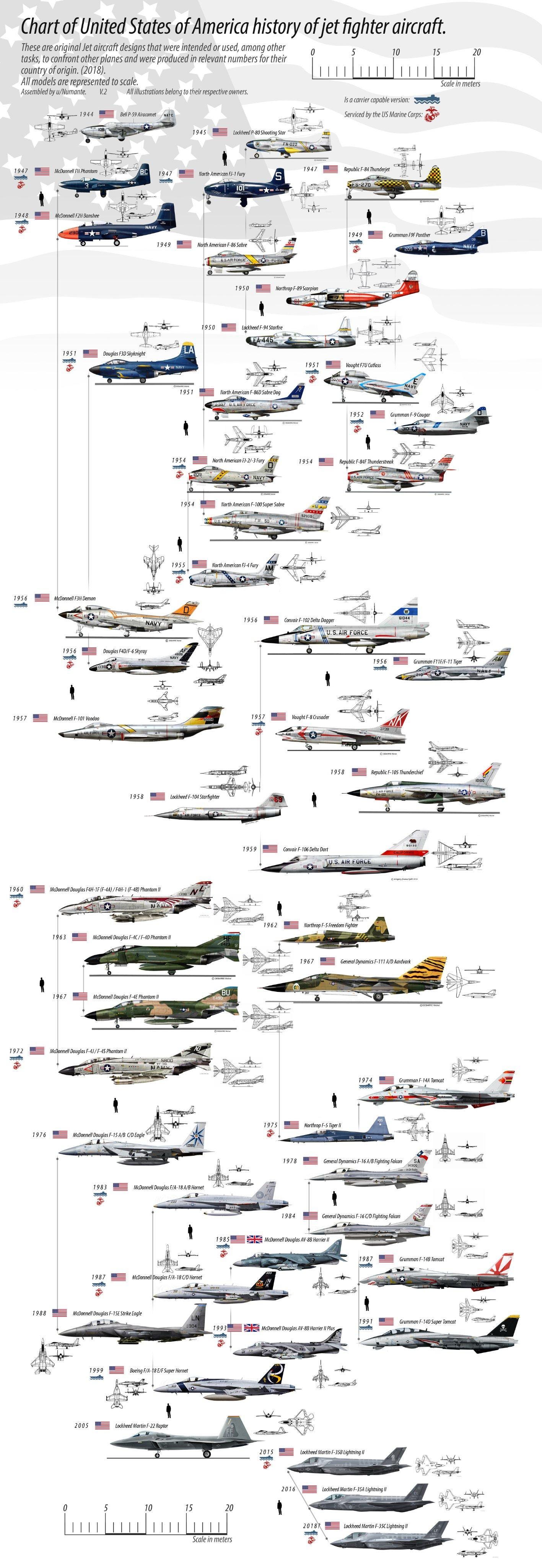
No crewed jet, however advanced, can solve the structural challenges facing the Royal Canadian Air Force. We are a country with the second-largest land mass on Earth, a yawning awareness gap in the Arctic, and a chronic shortage of pilots. If we are serious about defence, we must look beyond the F-35 — to the next frontier of air power: unmanned and autonomous systems.
Here and there: NATO allies are already moving fast. Experts suggest drones could replace large US Army units in Europe.
The US, through Anduril Industries and General Atomics, is developing Collaborative Combat Aircraft — loyal-wingman drones designed to accompany every F-35 into contested airspace. Britain aims to deploy a hybrid carrier air wing within five years. Turkey, the U.K., and even China are testing drones launched from ships. As The Economist recently noted, drones are cheaper to lose, easier to sustain, and faster to upgrade. They extend the range of crewed fighters, absorb risk, and can be built in the numbers modern warfare demands.
If we act decisively — harnessing Bombardier’s factories, De Havilland’s production lines, and Canada’s dormant automotive might — we can ignite a new era of air power built for Canadian realities.
On the ground: The Americans are already trying to sell those Collaborative Combat Aircraft to NATO allies, but the companies leading that charge — Anduril, ShieldAI — are not natural hardware manufacturers. It will take years before it reaches full-rate production. Canada, by contrast, already has one of the largest aerospace Original Equipment Manufacturers (OEMs) in the world. Bombardier, De Havilland, and the broader Montréal ecosystem already possess what these new entrants are scrambling to create: certified factories, tooling, and a workforce capable of delivering aircraft today. Montréal is one of three cities in the world that can build an aircraft from tip to tail — a sovereign industrial advantage hiding in plain sight.
Bottom line: Canadian defence companies are cautiously optimistic about today’s budget. With a clear signal from Ottawa — a line item in today’s budget — those companies could pivot rapidly from civil to unmanned production. The supply chains, engineers, and hangars exist. What’s missing is commitment. Canada can reallocate part of the F-35 procurement envelope to jump-start a sovereign unmanned program.
Related:
Two new players (one a 15 month old company) get a $300M contract each as Germany to deploy 12,000 kamikaze drones near its eastern border with Russia
From Latin America to Europe, the pattern is the same: agile adversaries are weaponizing commercial drones for ISR, IED delivery, and swarming tactics—compressing the time between innovation and impact
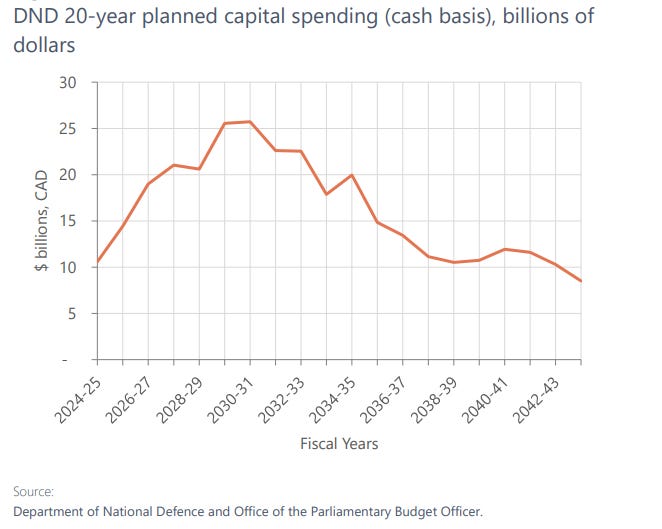
Planned Capital Spending under Canada’s Defence Policy: 2025 Update… Canada’s Defence Dollar: Reading Between the Lines of PM Carney’s 70-Cent Claim… Canada’s military to be primary focus in Ottawa’s fall budget
Can the new Defence Investment Agency fix Canada’s procurement problems—or will politics slow that down too?… Ontario’s Procurement Restriction Policy and the federal Buy Canadian framework are reshaping public-sector purchasing and creating new opportunities for Canadian businesses

ADVERTISEMENT

Dominion Dynamics is building Canada’s next generation of sovereign defence technology, with a focus on Arctic sovereignty.
💾 Drone Detection Hackathon: 20k in prize money
November 15, 2025 | Ottawa, ON
Modern battlefields are swarming with small, low-cost drones (Class 1 UAS)—systems too elusive for radar and tricky for traditional detection.
Your mission: Build “Shazam for Drones”—a smart, audio-based system that listens, detects, and pinpoints airborne threats in real time.
Sign up closes this Friday:
Related:
Ottawa-Gatineau looks to become Canada’s ‘Defence Innovation Hub’… Special shoutout to Sonya Shorey and the Invest Ottawa team on their strategy launch, which does name check The Icebreaker 😊
DND Request for Information “to assess the availability within the industry of aerial drones capable of supporting a self-contained RF equipment payload for use as a receiver system”
How Canada Lost the Drone Race (And How We Can Win It Back)
No permanent advantages: Drone interception is quietly becoming Europe’s next big defence market
Rheinmetall, MBDA tout German shipborne laser gun for zapping drones
🤝 Sovereign Capability
Ottawa wants big defence industry champions. That’s a costly mistake
Canada is in the midst of developing its first comprehensive defence industrial strategy. It will arrive at a critical moment as many countries retool for an era of geopolitical tension defined by speed, software and supply chain resilience. Yet as early signals of the strategy emerge, Canada risks repeating a familiar mistake: equating industrial strength with protecting industrial incumbency.
So what?: Ottawa’s definition of a champion remains anchored in supersizing the incumbents rather than cultivating the next generation. Missing from the conversation were the startups that serve as the commercial incubation labs of strategic technology.
Canada already possesses the ingredients for this transformation. A recent company mapping exercise by Canadian defence innovation network The Icebreaker identified more than 400 Canadian companies with dual-use products – technologies that have both civilian and defence applications.
The sobering reality is that nearly 90 per cent of those companies said government procurement was critical to their success, and half cited access to customers, including federal buyers, as their biggest barrier to scale. When the Defence Investment Agency signals that only large projects count, it entrenches that obstacle.
Bottom line: In a 21st-century warship, nearly 60 per cent of total acquisition costs reside not in steel but in software, sensors and networks. If Canada neglects its technology startups, we will be left assembling exquisite hardware systems that risk becoming floating targets. The core of sovereign capability today lies in code, artificial intelligence and distributed manufacturing; areas where small, fast-moving companies excel.
Related:
Define sovereignty:
Sovereignty is the ‘mot du jour’, but everyone is playing fast and loose with the definition… Bruce Flatt, CEO of Brookfield, explains how Japanese investment dollars will be used by the U.S. government to finance AP1000 builds in exchange for future profit sharing or even an ownership stake in Westinghouse Electric Company. The AP1000 is an American reactor technology engineered at its Pittsburgh headquarters, supported by a U.S.–Japanese supply chain for forgings, components & fuel. Westinghouse is owned by a partnership between two Canadian companies:
Cameco Corporation (a nuclear fuel and services company) with a 49% interest, and Brookfield (specifically, Brookfield Renewable Partners and its institutional partners) with a 51% interest
Meanwhile: Canadian firm Cohere and French rival Mistral AI are surprise beneficiaries of U.S. attempts to dominate AI, as companies and countries seek alternatives to Silicon Valley technology
SHIELD score: A framework to ensure that Canada retains control over the systems and platforms that shape our economy
Dual-Use Technologies in the Age of Intangibles… Canada’s Accidental Innovation Strategy: Why Defence Spending Might Solve Canada’s IP Crisis
How VCs are fueling innovation in defence tech… 15 defence startup operators to watch… Apollo and 8VC Partner to Accelerate the Next Wave of American Industrial Innovation
Naval power will no longer be measured primarily by the number of ships or their tonnage, but by the superiority of a fleet’s sensor network, the sophistication of its AI and the security of its data links
With Spire Global’s sale of ExactEarth to Belgian firm Kpler, a Canadian wildfire-monitoring mission – WildFireSat – is now fully in foreign hands
Saab considers Canada as site for Gripen jet assembly to meet demand from Ukraine… Value-added does not necessarily lie in final assembly. In fact it’s more likely to lie in the midstream (high-value components, chemicals, and specialty metals)
Arctic corner: After decades of stalling, projects in Canada’s North gain momentum as part of defence push… Support for communications infrastructure is key to Arctic development… The Department of National Defence has a requirement to establish a Standing Offer for the provision of Arctic Mobility Amphibious Vehicles
Funding roundup: L3Harris Technologies has made a $5.24M strategic investment in ESL Labs, a Halifax based defence innovator… MDA Space Makes $10 Million Investment in Maritime Launch becoming an Equity Owner and a Strategic Partner… Xanadu to go public on Nasdaq and TSX in $3.6-billion USD SPAC deal… NordSpace announces the establishment of its new Advanced Manufacturing for Aerospace Lab… Canadian Spaceport Gets $7M For Orbital Launch… Atlantic Spaceport Complex (ASX) has officially joined the Global Spaceport Alliance (GSA)
ADVERTISEMENT

⚔️ Combat Readiness
European defence valuations have surged. Are investors heading for disappointment?
This year Europe will spend some $180bn on military kit, more than double its outlays in 2021 and greater even than the amount spent by America. That figure is set to rise further still, after NATO members agreed in June to increase defence spending from a current target of 2% of GDP to 3.5% in a decade’s time, with another 1.5% for adjacent spending on things like infrastructure.
In the process, European leaders envisage revitalising the continent’s arms industry, which has suffered from decades of underinvestment. Europe relies on American military gear; between February 2022 and September 2024 American weapons accounted for a third of European procurement spending, according to the International Institute for Strategic Studies, a British think-tank.
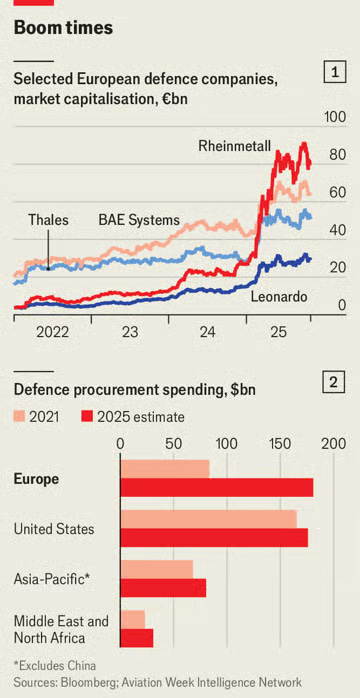
Bottom line: Can Europe’s defence industry rise to the challenge? “Readiness 2030”, a white paper published by the European Commission in March, concluded that the continent’s companies are “not able to produce defence systems and equipment in the quantities and speed that member states need”, and called for a “massive ramp-up of European defence industrial production”. “Preserving Peace”, a follow-up plan published on October 16th, laid out the bloc’s defence priorities for the next five years. But scaling up to meet these will be a struggle for an industry held back by fragmentation, glacial procurement processes and too few innovative newcomers. If it stumbles, far more than investors’ money will be at risk.
Related:
Germany’s new €377B military wish list… Defence startups ‘getting their foot’ in the door with Italian primes — but the ecosystem still lags
US Military Advances Cost-Effective Hypersonic Missile Initiative… X-59 Supersonic Test Jet Takes To The Air… Northrop Grumman inks deal with tech startup for accelerated, AI-enabled spacecraft design… Lockheed Martin Invests $50M in Saildrone to Advance Unmanned Surface Vehicle Capabilities for US Navy… The Return of the Energy Weapon
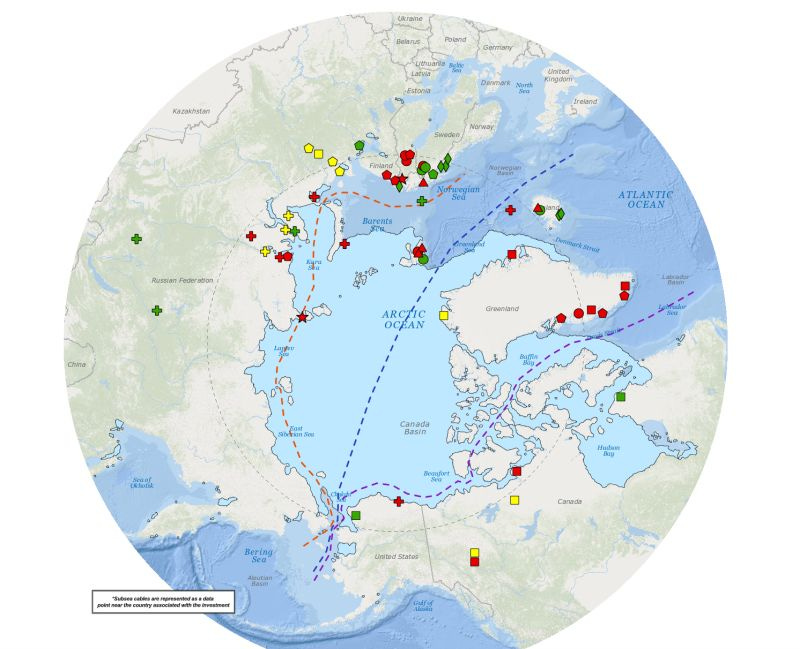
Hong Kong companies funnel Canadian tech to Russian army… Canadian manufactured sniper rifles are finding their way into the hands of Russian soldiers and mercenaries… An interactive map of Chinese investments in the Artic:
The U.S. Is on Track to Lose a War With China: Modern warfare is decided by production capacity and technological mastery… America Doesn’t Have Enough Weapons for a Major Conflict. These Workers Know Why… Trump promises executive order to revert Navy to steam power
Silicon Valley–backed startup Oklo Inc is pursuing an ambitious plan to revive nuclear power in the U.S. through compact, next-generation reactors… Stark Defence Fails All Four Strikes In Military Trials… Peter Thiel-Backed Startup Secures $100 Million to Make Chips in US… Shyam Sankar, Palantir’s C.T.O., on surveillance, A.I. and the future of war
The U.S., once a world leader in drone technology, is now falling behind the likes of China, Russia, and even Ukraine… Ukraine Gamifies the War: 40 Points to Destroy a Tank, 12 to Kill a Soldier… Dispatches from the front already report that drones are more effective when accompanied by artillery barrages to disrupt electronic warfare
Ukraine isn’t just hurling attack drones; they’re waging real robot warfare… Brave1’s NEXT special unit to procure innovative weapons without tenders
Beyond Minerals: A National Electronics Strategy to Power Defence
How to address critical supply chain challenges that directly impact the CAF’s operational effectiveness… G7 critical minerals pact will take aim at China market manipulation… 60 MINUTES visited the California mine where rare earths were first identified and learned how China became the dominant producer… How the U.S. Plans to Leapfrog the Rare Earths Race
Be the navy: a16z argues that Britain didn’t rule the seas by remaining a nation of pirates
ADVERTISEMENT

Barrack Hill: Navigating Canada’s defence and procurement landscape with precision
🔫 Hot Shots
Grey war: In recent weeks, the Cyber Centre and the Royal Canadian Mounted Police have received multiple reports of incidents involving internet-accessible ICS. One incident affected a water facility, tampering with water pressure values and resulting in degraded service for its community. Another involved a Canadian oil and gas company, where an Automated Tank Gauge (ATG) was manipulated, triggering false alarms. A third one involved a grain drying silo on a Canadian farm, where temperature and humidity levels were manipulated, resulting in potentially unsafe conditions if not caught on time… Overcoming Canada’s Disorganized and Ineffective Approach to Cyber Security Standards… Ensuring Canada is cyber-resilient in the face of converging threats is a nation-building mission
Here and there: $2.5B surge for operational technology (OT) cyber defence in the 2025 US National Defense Strategy. For the first time, the U.S. treats control systems — not just networks — as the true frontline. The message is clear: trillion-dollar shields like the Golden Dome are worthless if $1,000 malware can bring them down… China uses its ability to track cars produced in China for military intelligence purposes
Bad kids table: Putin says Russia tested Poseidon nuclear-capable super torpedo… From the theft of maritime and autonomy research at elite universities to months-long cyber incursions inside a Massachusetts utility
Between friends: NATO Support and Procurement Agency (NSPA) launches its Catalogue of Capabilities, a new digital platform, providing Nations, customers and industry with a single source of accurate, up-to-date information on all NSPA’s support and services… Tech firms launch new group to help feds fix procurement woes… Getting the Victoria-class Submarine Replacement Right… Navy commander says he’s ‘not looking’ to have new sub fleet built in Canada… Canada bolsters Indo-Pacific presence with new defence pact with the Philippines… DRDC memo on a mixed fighter fleet
If you’ve got battlefield intel, classified tips, or just want to call in an airstrike on our typos, hit “reply” and sound off. Whether it’s a new tech sighting, a rumour from the mess hall, or feedback on our comms, we want your SITREP.
"Canada’s Moment to Lead the Drone Age" and no mention of Draganfly? Volatus has an advertisement in your article, but not mention of them? Cellula? Kraken?
It would be great to see an article about the actual Canadian drone segment!