

Editor’s Notes: Thanks to the team at Reaction Dynamics for a tour of the factory floor last week in Montreal, and to LGen Molstad and the VCAA for hosting a terrific roundtable on defence capital in Calgary; big congrats to COVE’s Robyn Warrier; hiring: North Vector Dynamics, CSMC, and AEDC.
The Icebreaker is on summer break for the next two weeks. Back in your inbox on August 4!
🎯 Three-Shot Burst
In 1965, Canada spent 2.6% of GDP on defence and had 107,000 people in uniform. Today we sit 28th on the Global Firepower index - one spot below Algeria - with roughly 71,000 troops, one of four submarines operational, and the distinction of being the only G7 country that can’t launch a rocket. Stephen Maher’s Maclean’s feature is the definitive anatomy of the half-trillion-dollar rebuild: missiles for Latvia announced in 2022 that arrived in May 2025, a Nanisivik naval facility that took 18 years to become a summer-only gas station, and an F-35 program where Canada has committed $27.7B for 88 jets but paid for just 16. Retired general Wayne Eyre says he grew frustrated with the lack of “U” in the Urgent Operational Requirement process. Defence analyst Philippe Sauvé is blunter: “Institutionally, we avoid risk completely.”
The companion piece profiles the founders and CEOs cashing in on the rebuild - and it’s a who’s-who: Dominion Dynamics testing its Arctic “digital fence” across 5,200 km on Op Nanook, Sapper Labs at ~$25M/yr in federal contracts, IMT Group’s $305M munitions deal, Calian booking $200M in a single quarter, and LeafStar’s $100M private small-arms plant bringing ~300 jobs to Ontario. Founder Fady Mansour: “70 cents of every dollar went to the U.S. - that’s changing fast.”

The Canadian company arming Ukraine with drones
Watch this one. CBC’s Jennifer Yoon has an exclusive video look at the Canadian company supplying drones to Ukraine - a battlefield where Kyiv needs more drones than it can produce, even with domestic industry running flat out. A Canadian firm stepped into that gap. The real story: what its front-line experience teaches Canada about its own modernization. Combat-proven beats brochure-ready. Ottawa should be studying this playbook, not just applauding it.
The next defence fight is over trust, not money
Britain’s government imploded over an unfunded £25B-a-year defence gap. Murray Brewster argues Canada is next unless Ottawa shows its math: $81.8B budgeted, a $540B decade pledge - and no published five-year projections. Carney promises transparency in the fall budget, with 4% by the 2029 NATO review. Eric Reguly warns the submarine program alone could hit $100B all-in, and IMF data shows defence sprees widen deficits by ~2.6 points of GDP. Reality check: at the Ankara summit, where Kerry Buck warned “the cost of drama is too high,” Rutte admitted the old 2% target was “a bit plucked from the air.”
Bottom Line: Canada is rebuilding from 28th place with real money and real companies finally moving. But the UK just showed what happens when ambition outruns fiscal credibility. The fall budget is now the most important defence document of the decade.
ADVERTISEMENT

Up to $1M in funding and additional technical services available for technologies with defence and civilian applications. Advisory support is available now.
🤝 Deal Corner
🍁 3DBioFibR wins the inaugural DMZ Ventures $100K Dual-Use & Sovereign Tech Investment Prize — judged by The Icebreaker and BDC. DMZ Ventures awarded the prize at Startupfest to the Halifax company producing collagen and spider-silk biofibres at scale — US Navy contracts already in hand, applications spanning defence textiles and surgical materials. Over 100 companies competed. The Icebreaker sat on the judging panel: “Canada cannot afford to outsource the technologies that underpin our security, resilience and strategic autonomy… What stood out about 3DBioFibR is that they’re building a capability that matters for both commercial markets and national strength. We need more founders tackling hard, strategic problems like this — and more investors willing to back them early.” At the same festival, Moncton’s AgroGene Solutions took the $100K Best of the Fest from 275 pitches, part of $825K in total prizes.
🍁 Nord Quantique posts another error-correction breakthrough — the Sherbrooke company (last valued at US$1.4B) pushed bookend errors below 0.1% on its grid-state qubit, another step toward fault-tolerant machines. Timely context: only six companies worldwide build quantum cryogenics — one is Canadian — and quantum sovereignty is defence sovereignty.
🍁 Canada Rocket Company raises $22.5M in under six months — incorporated November 2025, with 22 hires including seven Canadians repatriated from SpaceX, Blue Origin, Rocket Lab and ArianeGroup now building the methalox medium-lift R-2, with an Etobicoke test site and hot fire targeted by year-end.
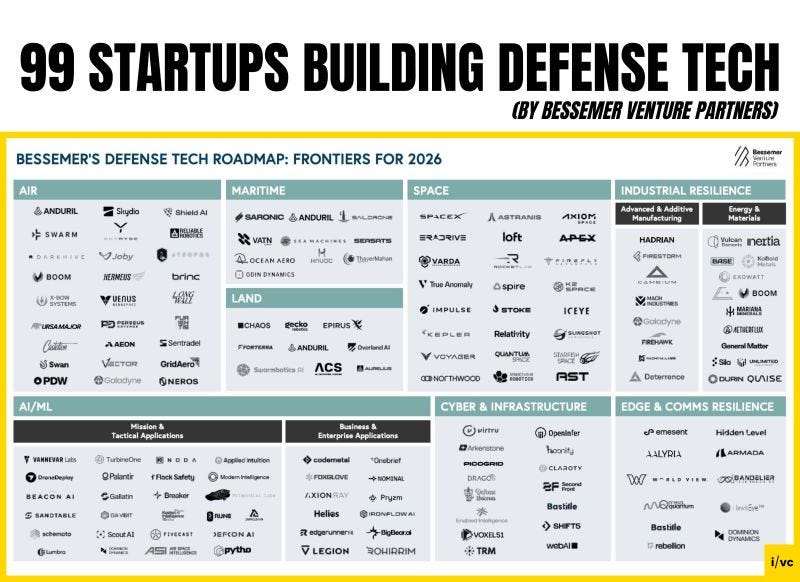
🍁 Maritime Launch lands Isar Aerospace on a 10-year deal — signed at the NATO summit: US$3.75M per quarter plus ~$100M in pad build-out at Canso, with Spectrum launches from 2028 and up to 40 per year by 2029.
🍁 Larus books $10M+ in defence AI awards — $8.3M from IDEaS for Army tactical intelligence plus $2.5M for RCN maritime domain awareness, extending a CAF relationship dating to 1999.
🍁 Canada’s NATO Innovation Fund entry inches forward — the $107M-over-20-years commitment still needs sign-off from 24 LP nations, possibly not until fall.
Auterion and Skyfall ink a 50,000-drone deal — 50,000 Shrike FPVs with Skynode S AI autonomy are headed to Ukraine, worth $100M to Auterion and funded by a European NATO nation. More than double Auterion’s prior largest order, with a swarming update coming.
Ukraine’s defense tech sector is starting to look less like battlefield improvisation and more like the early stages of a real industrial base; updates to Brave1

Kraken Technology raises $175M at a $1B valuation — the UK maritime-autonomy firm (not St. John’s Kraken Robotics) closed a Series B led by DTCP with the NATO Innovation Fund and Rheinmetall aboard, and holds a Davie partnership for Canadian production of its 55-knot K3 Scout USVs.
Forterra wins a $114M Army contract for Ukraine — the Sandhills Project puts 105 Lancer autonomous ground vehicles into the fight, delivered in under six months.
Skapion raises a $36M seed for counter-swarm defence — UP Partners and Khosla co-led the round for founders including the ex-Rafael GM behind Iron Dome and David’s Sling.
Surtr raises $4.8M for c-UAS sensor fusion — the YC-backed startup founded by Shield AI and Anduril alumni is already testing with Brave1 in Kyiv at sub-100ms latency.
Aurelius Systems: $0.10 per shootdown — the ~$12M-funded startup’s Archimedes laser turret killed 20+ quadcopters at T-REX in June. Only 19 directed-energy systems have been fielded in 60 years — Aurelius is betting on Detroit manufacturing to change that.

Related: Reaction Dynamics’ CEO wants Canadian LPs to back moonshots — top-5 VC fundraising is down 50% since 2021 — while AGF Capital Partners argues the defence capital cycle is durable and moving well beyond the primes.
⚔️ Combat Readiness
Ground robots: The first American autonomous ground vehicles are fighting in Ukraine — 100+ Forterra Lancers have run 1,100+ missions, hauled 777,440 lbs and completed 88 casualty evacuations in nine months. One soldier: “the most important UGV in Ukraine… we are dying to get more.”
Do regular tanks still matter?
No infantry, no losses: Ukraine captured a Russian position using only ground robots and drones — Zelensky called it a first. Machine-gun UGVs and multi-swarm operations are now doctrine, not demo.
Breaching goes autonomous: The US Army picked Caterpillar, Forterra, IDV USA and Overland AI for its new autonomous minefield-breaching program — the deadliest job in land warfare, handed to machines.

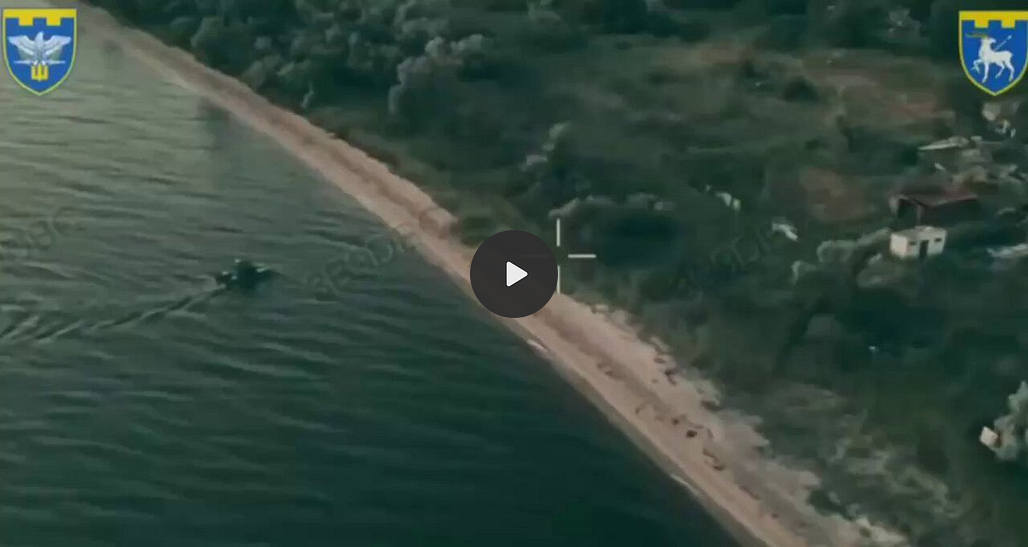
Saronic Corsairs, a 24ft ASV:

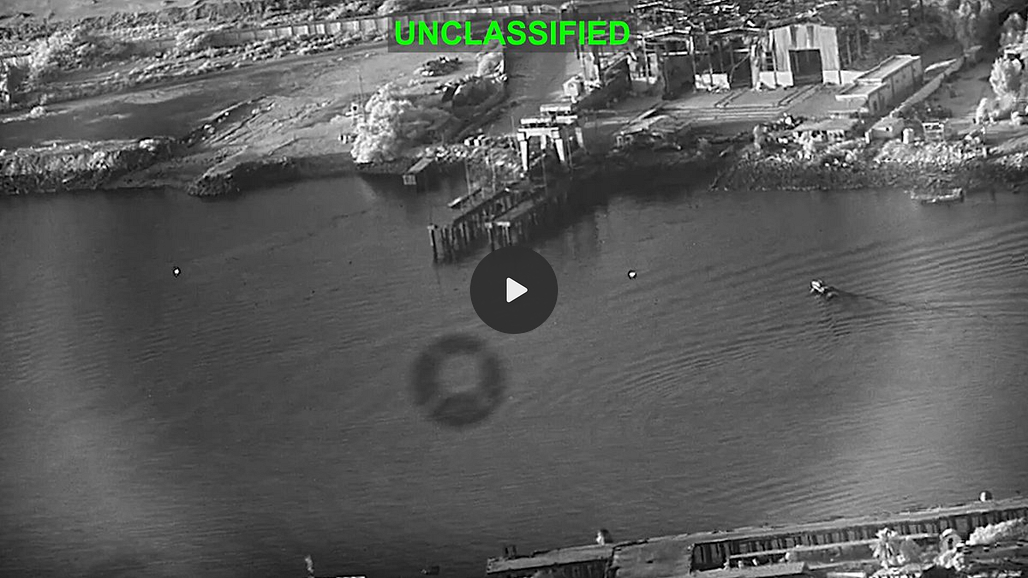
The Pentagon’s drone bible: JIATF 401’s “Small Drones, Big Problems” paper lays out a first-principles counter-UAS framework built on five Ds: Detect, Deny, Disrupt, Defeat, Discipline. The data: FPVs account for 60–70% of destroyed Russian systems and 70–80% of casualties, and Shaheds made up 66% of Iran’s counterattack. Its warning — drones’ “happy time” ends when defenders adapt.
Ukraine opens the arms store: Kyiv approved its first transparent weapons-export mechanism for partner countries — with ~800 producers making 4M+ drones a year and capacity to double, combat-proven Ukrainian kit is now for sale.
Interceptors, printed: SkyDefense’s 3D-printed CobraJet VTOL interceptor hits 350 mph in hybrid form, launches from a mothership, and fires Mach-1 VIPER rounds produced by the thousands each month.
Axis watch: A joint investigation by The Insider, Der Spiegel and Le Monde exposed secret Russia-China military forums: a three-level plan to defeat Starlink up to physical destruction, a 2023 Almaz-Antey protocol for joint hypersonic-intercept air defence by ~2030, and 200+ Russian operators trained on Chinese drones at six sites in China. Beijing trades tech for combat data.

AI export walls rise on both sides: Beijing is weighing curbs on overseas access to Qwen, Doubao and GLM-5.2 — the mirror image of Washington’s Mythos directive. 🍁 Michael Geist’s warning: Canada must fight for frontier-AI access in the USMCA talks or settle into “the second tier of AI.”
Europe’s conversion problem: NATO fixed its cash flow — now it must turn money into munitions, as Rutte puts it. The Economist finds the gap on the factory floor: BAE’s Hägglunds plant went from $211M revenue in 2018 to $1.1B in 2025 and is expanding capacity five- or six-fold — demand still outruns supply. The backdrop: WSJ’s inside account of Europe’s rupture with America, where Macron told nearly 30 leaders “There is no going back” during a five-hour midnight session in Brussels.
ICYMI: NATO's new web portal for industry is now live
🍁 Kit for Canada — strike: Norway’s Joint Strike Missile could give Canada a common precision-strike architecture across air and undersea domains — two internally on each F-35A, canister-launched from Type 212CD torpedo tubes.
🍁 Kit for Canada — sensing: CDR makes the case for a “pocket AWACS” built on Saab’s LoyalEye AEW package riding the MQ-9B SkyGuardian — 11 of which Canada is already buying — with 40+ hours of endurance per orbit.
🍁 Kit for Canada — space: Canada joined seven NATO allies to build HALO, a layered satellite mega-constellation for comms, ISR and missile tracking — stacking on top of its Starlift membership.

Big think — evolution or revolution? Yaroslav Trofimov asks whether today’s hundreds of billions in conventional platforms will look like investing in horses and arrows just before the machine gun arrived. The US-Israel failure to decisively defeat Iran despite massive precision-weapon expenditure broke the old assumptions.
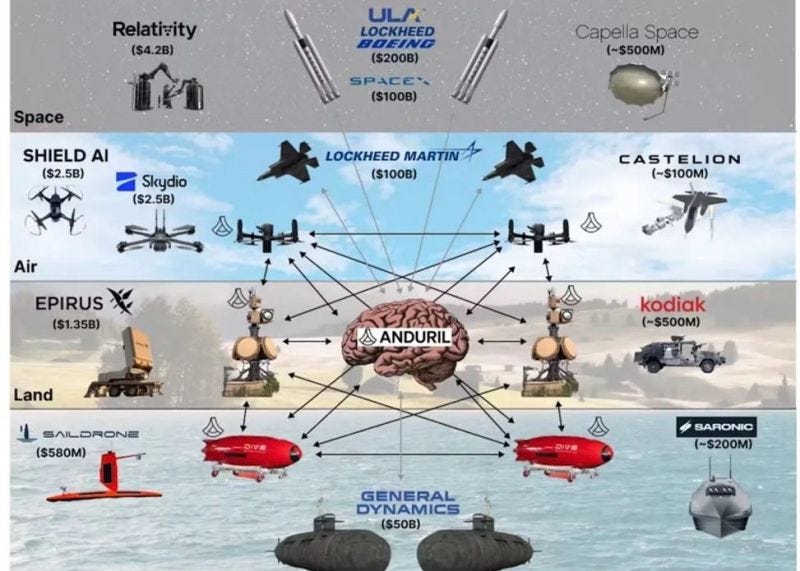
Big think — the empty arsenal: Anduril chairman Trae Stephens tells Arena the US burned ~1,000 Tomahawks in the first weeks of the Iran war against production of a few hundred a year — resupply timelines stretch to 2030. His prescription with Katherine Boyle in the Washington Post: “just war” theory doesn’t forbid terrifying new weapons — but America must get there first.
Big think — the counterpoint: A US Air Force veteran and defence investor warns against “vibe patriotism” — founders and VCs marching with rucksacks and calling equity “service.” Building for the mission is honourable. It is not sacrifice, and conflating the two lowers the moral barriers to war.
🔫 Hot Shots
🍁 Mitacs opens a Defence & Security call — and forgot the munitions. The program offers $20K–$25K internship units, up to 30 per project, with applications due August 17 across eleven priority areas spanning AI, quantum, sensors, space and Arctic sovereignty. Munitions and energetics — explicitly named in the Defence Industrial Strategy — appear nowhere. Canada’s most acute industrial gap didn’t make the list.
🍁 Ottawa scraps the open LUV competition — phase 2 of the $4.9B light utility vehicle program is dead, with only Canadian firms — Roshel, GM Defense Canada, Armatec, Terradyne — invited to the restructured process. AM General and Oshkosh are out.
🍁 Innovative Solutions Canada rebuilt — the program returns with $79.9M over five years under Buy Canadian phase 2 and a supplier registry by end-2026. As one founder put it: “a contract is better than a grant.”

🍁 Built here, bought there — Raymond Luk’s Impact Group interviewed 31 founders of foreign-acquired Canadian firms and found that in 93% of cases, strategic control moved abroad. “Canada should stop acting like the waiting room for Delaware.” Same issue notes Telesat won the Defence Investment Agency’s first-ever procurement and MDA’s ~$920M bid for 70% of France’s CLS.
🍁 DND is now Canada’s biggest buyer — federal defence postings jumped 62% in June, with DND at 583 postings in Q2, while Alberta’s sovereign-compute pre-qualification drew 298 plan takers.
🍁 Markham wants to build the defence tech Ottawa is buying — the city is positioning its 1,500+ tech firms and 35,400 knowledge workers against a DIS worth ~$180B in procurement and $290B in infrastructure over the decade.
🍁 Trucking software finds a defence lane — Vancouver’s Switchboard is pivoting fleet software into defence logistics via UBC Sauder’s Scale Up program. “Trust is table stakes.”
🍁 AVSS passes 2,000 systems built this year — the Fredericton drone maker’s record pace runs on ~75% international revenue across 20+ countries, plus its new Flying Beehive air-launched FPV line.


🍁 Canada angles for the Moon Base — with Gateway cancelled, Canadensys (17 systems already on the lunar surface), Mission Control and MDA are vying for NASA’s lunar utility vehicle, and CSMC won $1M from CSA for a lunar nuclear reactor with Arctic dual-use potential.
🍁 Procurement school is in session — Carleton’s NPSIA launches a Practical Certificate in Canadian Defence Procurement December 10–11 at $800, taught by Philippe Lagassé and former ADMs.
The Ugly American meets the Ugly Ally — Stephen Nagy argues allied free-riding and condescension helped create Trump: Canada “cannot publicly denigrate the U.S… then request expedited trade deals, security guarantees.” Meanwhile Politico finds Canadians turning into genuine defence hawks at exactly the right moment.
DIANA picks 10 for Decision Superiority — zero Canadians. NATO’s accelerator awarded €100K each to its latest cohort in the Decision Superiority challenge. Canada’s absence from the list speaks for itself.
Odds & Ends:
America should rebuild its manufacturing base; the new generation of American industry according to Reid Hoffman
The defence tech Valley of Death
The Big Search mapped 600+ 𝐜𝐮𝐫𝐫𝐞𝐧𝐭 𝐚𝐧𝐝 𝐟𝐨𝐫𝐦𝐞𝐫 Anduril Industries 𝐥𝐞𝐚𝐝𝐞𝐫𝐬. Two core insights from the data
How EIF is helping defence innovators
Ukraine’s Operation Auchan: How one operation halted the enemy’s mechanized offensive for six months
Renting Our Future: U.S. Tech Hegemony, Canada’s Sovereignty Race, and the Coming Realignment
Drones are machine guns
Top 100 defence innovators
Keeping our defence supply chain sovereign
How to Make Hardware Venture-Shaped; Robotics is having a software moment
BRiley Securities Q2 A&D report; has the defence market peaked?
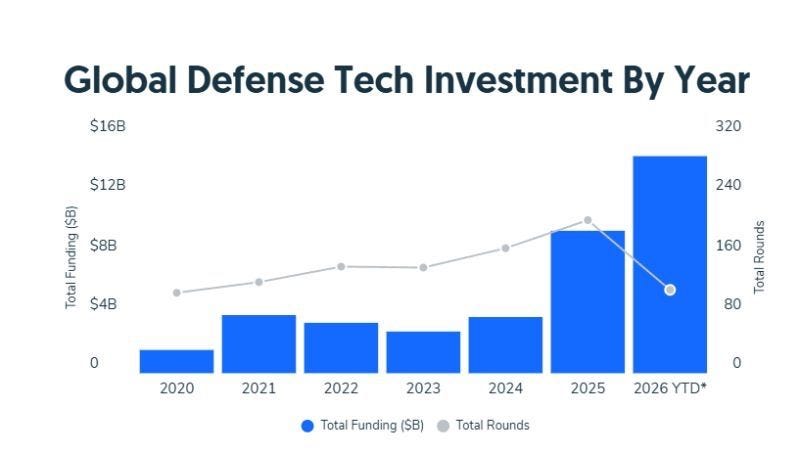
Photos from the front
PQC is not a 2030 problem. It is a today problem with a 2030 deadline
Hybrid threats target democratic institutions, critical infrastructure and societal cohesion in the EU


If you’ve got battlefield intel, classified tips, or just want to call in an airstrike on our typos, hit “reply” and sound off. Whether it’s a new tech sighting, a rumour from the mess hall, or feedback on our comms, we want your SITREP.
Thank you for an excellent article and associated links. The link to Canada’s CEO’s regarding defence matters was particularly appreciated.