

Editor’s Note: The Icebreaker will be at DEFSEC Atlantic this week. Make sure to say hello!
🎯 Three-Shot Burst
Spending is no longer the constraint. Capture is. The Canadian Chamber of Commerce’s Business Data Lab put the decade on one page in its latest report. Core defence spending climbs from $64 billion in 2025 to $160 billion by 2035, a full 5% commitment means roughly $228 billion a year, and defence rises from about 11% of federal spending to nearly 30%.
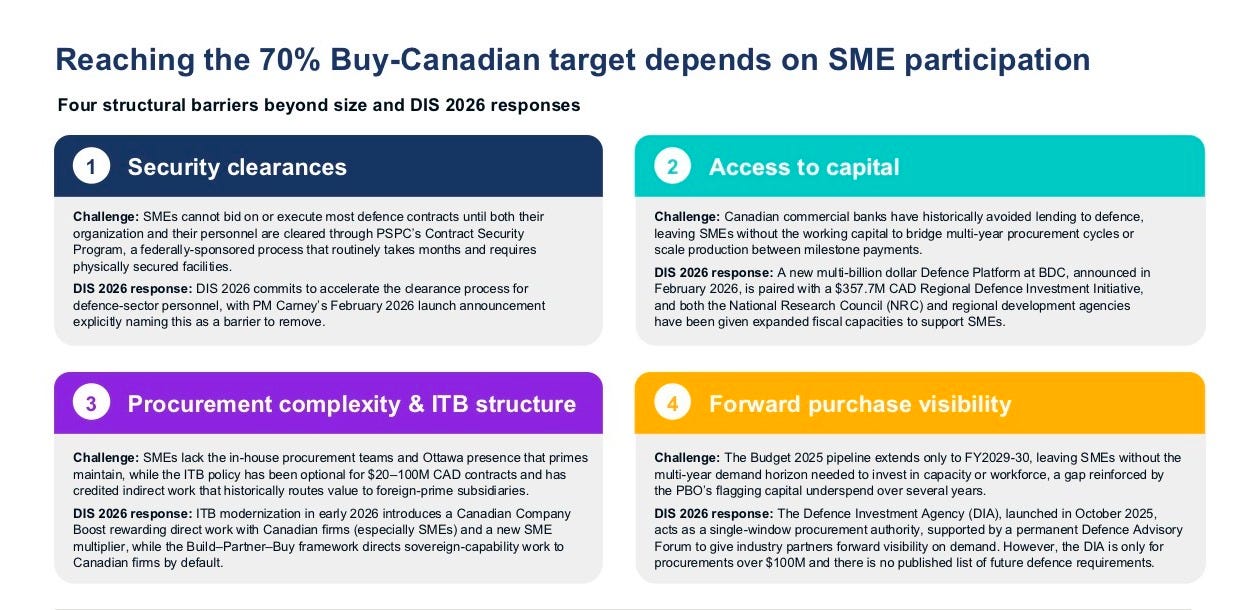
Where the money leaks: Canada’s 538 core defence firms booked $17.3 billion in 2024 sales, the top 50 take roughly 80%, Canadian-controlled firms capture just 18% of sales, or $3.1 billion, and the industry imports 47% of what it buys. Of 802 innovative Canadian firms U15 identified, only 88, or one in nine, had won a related federal contract since 2015, and the new Defence Investment Agency only handles buys above $100 million with no public list of future needs.
Poland is the warning label: it doubled defence spending to about 4.5% of GDP between 2021 and 2025 and sourced an estimated 80% abroad. U15 Canada’s Robert Asselin told the Globe that about 75% of Canadian-linked patent families relevant to the industrial strategy had a foreign-controlled firm as the applicant, then summed up the file: “The intent is there, but the execution right now is not.”
The Toronto Star ran the numbers: Of $25 billion in federal contracts since Carney took office, an estimated $7.8 billion went to American-controlled corporations against $14.9 billion for Canadian-controlled ones, the share heading south rose from one-fifth to nearly a third, and the Buy Canadian Policy has steered 34 contracts worth $1.5 billion since December.
Washington has a different problem: AIA and Bain found the US gap is not “an overall shortage of capital, but a shortage of investable opportunities”, with defence venture capital up tenfold since 2019, the top 100 venture and PE-backed defence companies holding $118 billion against $16 billion in federal production commitments, and primes trading at utility multiples.
Reality check: St. John’s Avalon Holographics just banked $11.7 million from Lockheed Martin Canada, a $5.6 million contract on top of a $6.1 million Phase 1, for a 40-inch glasses-free holographic table now installed at Lockheed’s Lighthouse centre in Suffolk, Virginia. Founder Wally Haas: “even though it’s being developed in Canada, honestly, the primary beneficiary right now is probably the U.S. defense forces.” Hamilton’s Sentinel R&D is the same story pointed east. CEO Kath Intson says the company is now “selling directly to the Ukrainians,” in a deal separate from its Airlogix joint venture, while Ukraine’s digital procurement platform has already split $50 million among six Canadian companies. Dominion Dynamics’ Eliot Pence writes the fix: “Our grandparents built bombers faster than we award drone contracts today.” Victory Aircraft went from Lancaster blueprints to first flight in 16 months and built one bomber a day at peak in Malton, so give Canadian-owned autonomy firms 90 days from proposal to contract and 12 months to a field-testable prototype, then scale what works.
Ottawa to turn defence procurement agency into Crown corporation, sources say



Canada wants its own rockets. The US still holds the keys to orbit. Toronto’s Canada Rocket Co. will put $30 million over three years into an engine test site on 50 acres beside London International Airport, fully operational by 2028, with a medium-lift orbital launch targeted for 2032. The company has 32 employees, $22 million raised, an $8.3 million DND grant, plans for a 500,000-square-foot factory, and is scouting lakefront land so it can ship 150-foot rockets to the pad by boat. CEO Hugh Kolias puts the cost of reaching orbit near $1 billion, half of it hoped from government, and sees “a once-in-a-lifetime opportunity to have this as Canadian as possible.” Ars Technica explains the bet. Tariffs and 51st-state talk pushed Ottawa to fund NordSpace, Reaction Dynamics and CRC through Launch the North, and CRC skipped the small-rocket phase entirely after interviewing about 150 engineers, up to the director of Starship engineering: “you’re not going to be able de-risk a rocket development program by building a smaller rocket.”


The window is real: Kolias says SpaceX plans to retire Falcon 9 within a few years, and FT Alphaville’s Sinead O’Sullivan argues SpaceX itself is pivoting away from space, almost a quarter century after it set out to make humanity multi-planetary. Canada has been here before. Alouette I made Canada the first nation after the two superpowers to design and build its own satellite in 1962, a 145-kg ionosphere probe that stretched a one-year design life into a ten-year mission, and it still rode an American Thor-Agena to orbit.
Now look at what Canada actually owns. Wes O’Donnell’s essay in The Walrus walks the chain: a $2.3 billion military satellite contract, potentially $2.7 billion, grows Telesat Lightspeed from 156 to 225 satellites, all built by MDA in Montreal, yet Telesat has booked more than a dozen launches on SpaceX Falcon 9, Canada has no missile-warning constellation, and he found no evidence of access to Galileo’s hardened PRS signal. His audit of military satcom: “Wideband: American. Protected: American. Tactical narrowband: American.” And the line that should headline the next space policy: “A satellite sitting in a clean room in Montreal isn’t a space capability yet.” Britain is already a step past that. The RAF just stood up No. III Space Effects Squadron to disrupt, degrade and deny hostile activity in orbit, using electronic warfare and backed by £880 million for space ISR and space control through 2029/30.


Beijing doesn’t need to steal it. It can buy the board. Italy’s Ferretti Group builds luxury yachts and has supplied patrol and fast-attack craft to the Italian Navy, Coast Guard and Carabinieri since 2016, and the FSD195 interceptor rides a Pershing yacht hull. State-owned Weichai, founded to arm the PLA and now a maker of engines for Chinese rocket launchers, holds 39.5% yet took eight of nine board seats at the May meeting, backed by a bloc of Chinese shareholders each sitting just under the 3% disclosure line. Weichai’s chairman named moving Ferretti production technology to a Qingdao hub for “public service vessels,” Beijing’s phrase for its coast guard fleet, a priority back in 2023. Former Italian defence chief Gen. Vincenzo Camporini: “There’s no need for espionage scenarios: the product’s standard digital architecture is sufficient.” Robbins: “Instead, they arrive with a shareholder vote, a below-threshold stake, and a factory turning out yachts for spying.”
The espionage track is running too: MI5 says more than 100 UK-linked academics unwittingly fed projects in AI, cyber, covert communications and steganography through CGTRI, a front with “very strong ties” to the Ministry of State Security, and security minister Dan Jarvis has written to every vice-chancellor to cut ties. Jamestown’s Sze-Fung Lee argues the approved embassy at Royal Mint Court, 5.5 acres and ten times the current footprint, could run as a hybrid-warfare hub beyond the reach of UK police, and notes former MP Paul Chiang’s 2025 suggestion that a Hong Kong activist carrying a HK$1 million bounty be handed to the PRC consulate in Toronto. The physical layer is exposed as well. FBI and Coast Guard investigators found hackers reached the propulsion system of a fully laden supertanker, the VL Prosperity, on approach to Galveston this summer, and US agencies were tracking cyber threats against nearly 20 vessels by September.
Washington is answering with export controls: Commerce has slowed licences for jet parts bound for COMAC and is weighing new rules on landing gear and aviation hydraulic fluid, while gallium, germanium and tungsten stay tight on the other side of the ledger.
ADVERTISEMENT

Barrack Hill: Navigating Canada’s defence and procurement landscape with precision.
🤝 Deal Corner
🍁 Quantum eMotion buys Plurilock for nearly $34M. Montréal’s QeM will pay 30% cash and 70% stock for Victoria’s Plurilock, pairing quantum-secure cryptography with an existing government customer base and public-sector procurement channels, with a shareholder vote due in November.

🍁 Draganfly takes US$10M from Trump Jr.-backed Unusual Machines. The Saskatoon drone maker sold 1,869,159 shares at US$5.35, with US$5 million each from Unusual Machines and an unnamed US fund, weeks after landing a Canadian Armed Forces drone contract for up to 5,000 drones, only 100 of them firm. The company says “no board seats or special rights” are attached.
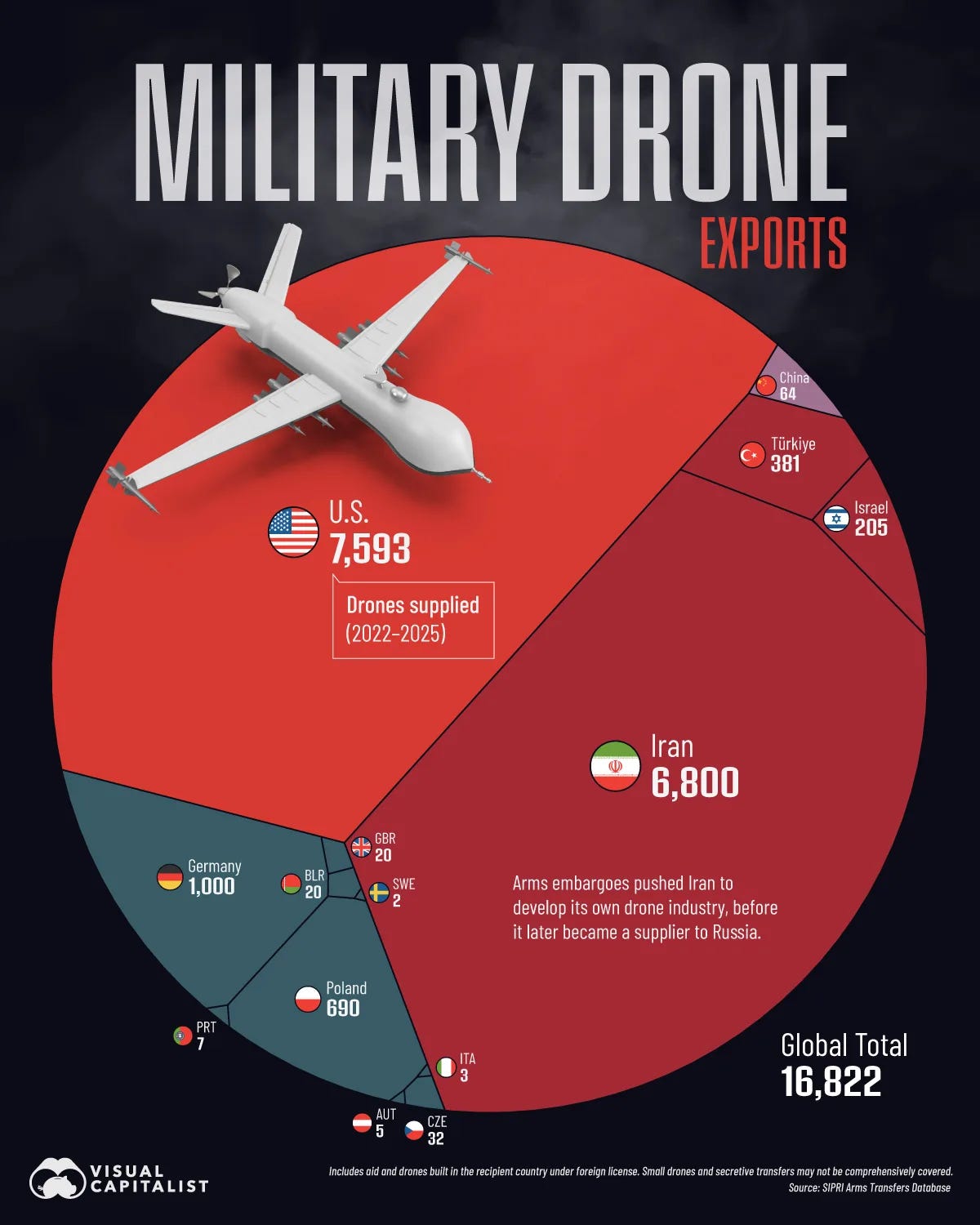
European defence VC heads for $10.5B. Dealroom's State of Defence Tech 2026 says European defence startups have raised $7.4 billion so far this year, already a record, with defence now 11.1% of European VC. Resilience Media's write-up projects the total will quadruple 2025's $2.6 billion to $10.5 billion by year-end, while US startups took $19.6 billion, 75% of NATO and allied defence VC. Bessemer's Alex Ferrara names the catch: "in defense tech there are only a small number of strategic acquirers."
🍁 Hanwha keeps “Project Arrow” alive after losing the subs. The Korean group lost the submarine program to TKMS in July but is still exploring a military-vehicle joint venture with Canadian auto parts makers such as Linamar and Martinrea, potentially in Ontario plants idled by 25% US tariffs, building K9 Thunder howitzers, Redback IFVs and Chunmoo launchers.

🍁 H2 Analytics lands $800K from FedDev Ontario. The repayable contribution backs a $4.2 million upgrade of the EASE military exercise-design platform with new AI features, plus expansion into Europe, the Middle East, Australia and New Zealand. The Ottawa firm is still bootstrapped, posted 552% three-year growth and added 22 staff in six months.
🍁 OSCP raises US$6M to navigate without GPS. Montréal's One Silicon Chip Photonics closed an all-equity Series A led by New Science Ventures to shrink a fibre-optic gyroscope onto a chip within two to three years, and plans to grow from 18 to 30 staff in a year. Founder Kazem Zandi is a Defence R&D Canada alumnus, and COO Alex Lintott says Canada's lighter export controls on the tech, compared with the US, help it sell into Europe. Lintott: "We're going to be the preeminent IMU provider out of Canada." GPS denial is now the default on every modern front.
US Navy orders 30 drone ships for $1.2B. Galliano (Edison Chouest), HII and Saronic each get 10 Medium Unmanned Surface Vessels at an average of $40 million per hull, with production starting immediately in Louisiana and deliveries as early as Q4 FY2027. The qualifying test ran roughly 26 hours and 360-plus nautical miles on a single command-and-control input, and Birdon did not finish testing.


Army picks five shooters for PrSM Increment 4. Anduril, Castelion, Lockheed Martin, Mach Industries and RTX will prototype HIMARS-launched missiles that hit moving land and sea targets beyond 621 miles, with a fly-off and down-select in FY2027 and a final fly-off in FY2028. A week earlier Lockheed took $1.2 billion for Increment 2 production. Canada is buying HIMARS, so these are the rounds that will fill Canadian launchers.
Anduril buys underwater-comms specialist Popoto Modem. Terms are undisclosed, but the Massachusetts acoustics firm folds entirely into Anduril’s autonomous undersea fleet, which includes Copperhead and the Dive-based Ghost Shark, a $1.7 billion program of record. Maritime chief Andrew Nuss calls subsea communications “the wicked problem.”
Pentagon’s Critical Technologies office signs up In-Q-Tel. IQT will scout and diligence startups across all six Critical Technology Areas, from applied AI to scaled hypersonics, with joint pilots starting within weeks. Assistant Secretary Michael Dodd sets a 12-month benchmark of moving validated prototypes into field evaluations, because superiority goes to “who delivers it to the warfighter fastest.”


Japan builds a state defence investment fund and its own FMS. Tokyo plans a new agency run jointly by the Ministry of Defense and METI that would back defence startups through competitively selected domestic VCs, buy Japanese kit for resale abroad and manage government-owned, contractor-operated munitions plants, as early as fiscal 2027. Officials admit there are “almost no” Japanese startups living off Self-Defense Forces business.
Aventra raises $17.5M for balloon-dropped glide bombs. Konvoy Ventures led the round for the Virginia startup, whose Piranha rides a balloon to 60,000 feet and glides a 5 kg bomb about 100 miles to within three metres of a target, with a new factory taking output from 35 to about 500 a month. CEO Michael Weigand: "Short-range air defense systems really don't reach that high, so the mere act of the enemy shooting at you is mission accomplished." Cheap mass, courtesy of the stratosphere.
Airlogix and Auterion want a Canadian production line. The Ukrainian drone maker and the autonomy firm are taking their German joint venture model to Canada and the UK next, after a German JV building AI-guided strike drones under a contract Resilience Media pegs at $300 million. Auterion expects 100,000 drones to ship through partners this year.
Related: Resilience Media’s Jamie Burnham warns that a boom for European defence startups in 2025 brings a cap-table risk most funds cannot see, quoting an Estonian VC who knows one Russian LP would end his next raise… A Sanity Check on Defence Tech… From Innovation to Operational Capability: Canada’s Next Defence Challenge… Since July, European governments have taken two concrete steps toward buying defence capability together.
ADVERTISEMENT

Learn more here.
⚔️ Combat Readiness
Middle strike. The Kyiv Independent rode with the 422nd Unmanned Systems Regiment, which works the band between the end of FPV range at about 35 km and deep strike at 300 km. Its $5,000 Starlink-equipped Hornets from Eric Schmidt’s Perennial Autonomy hunt fuel trucks on highway E58, and commander “Tyson” says they are now “the main weapon for controlling the highway from Russia to Crimea,” with “any serious movement” stopped. Warbirds’ Zozulia carries 50 kg over 300 km: four launched at a substation feeding radars and Starlink jammers, two got through, two direct hits. Russia answers with Rubicon interceptors and the Peresvet-M jammer, which can blank Starlink across about 20 square kilometres. Tectonic’s week in Kyiv shows why the middle matters. Small drones cause an estimated 60% to 70% of deaths in the 30 to 40 km kill zone, Vyriy’s Oleksii Babenko says “We cannot destroy 15,000 or 50,000 FPV drones on the front line” so you hit the vehicles that carry them forward, and Geran 4s and 5s at 500 kph are outrunning $1,000 to $2,000 propeller interceptors while turbojets run short.
The Kyiv Independent puts numbers on that gap: the Geran-5 flies 150 km/h faster than the Geran-4, costs about $115,000 against roughly $1.5 million for an Iskander-K, and Ukraine is downing only 57% of jet-powered drones while Russia builds about 3,000 Geran-4s and 5s a month. Drone adviser Serhiy Sternenko: “there is currently no mass produced effective product among interceptors.”


🍁 Kit for Canada. Justin Massie and Philippe Lagassé’s roadmap for the Strategic Analysis Network defines strategic autonomy as fighting with the US when possible and without it when necessary, framed as “risk mitigation rather than decoupling,” against a CAF where only 61.3% of force elements are operationally ready and 16,000 people are missing. The shopping list is specific: 88 F-35s by 2034, then about 50 non-US next-generation fighters from 2035, eight to ten GlobalEyes, AUVs alongside 12 Type 212CD submarines, and R&D at 3% of the defence budget. Their timeline is the sobering part: command autonomy within a decade, deep-strike autonomy beyond 2040. Meanwhile DND invited 22 companies from six countries to an October 6 drone sandbox at CFB Suffield and left Sentinel Advanced Military Solutions off the list, even though its containerized StarForge factory carries enough material for 300 to 400 drones, has flown with the US Marine Corps and is backed by $10 million in Lockheed HIMARS ITB money.
CTV Montreal toured the bigger Forge X unit in Châteauguay, which deploys from a shipping container in about 30 minutes with four 3D printers, and is going out for testing primarily with US groups while DND talks continue.
🍁 Choosin’ Texas. The Radiocommunication Act bars anyone outside the military, its existing suppliers, the RCMP and prisons from even possessing a jammer, so Hamilton's Sentinel R&D ran its electronic-warfare tests in Texas, and ISED's fix, a class-based exemption, is targeted for before the end of 2028. Remote Robotic Systems' Kevin Toderel on why that matters: of the first four US-backed drone models sent to Ukraine, "Zero. Zero platforms worked." Volatus' Glen Lynch: "The ideal scenario is that we put it in a lake." Latvia, smaller and denser, has an EW range. Meanwhile, documents tabled in Parliament show Ottawa flies at least 1,600 Chinese-made drones across more than a dozen departments, led by the RCMP's 1,027, with Environment Canada admitting no formal security assessment on its 76.
🍁 Home front. The BBC asks why Canada is preparing for “a (long shot) US invasion” after more than 30% of Canadians told Leger an invasion was likely following the Maduro capture.
Former CDS Gen. Wayne Eyre: serviceability sat near 50% and Canada could burn through much of its ammunition in days while industry needed years to replace it.


🍁 Software sovereignty. Canadian Defence Review’s James Careless polls the builders behind the DND/CAF AI strategy, which targets AI-enabled defence by 2030, and the verdict from industry is consistent. Contextere’s Gabe Batstone says procurement traps firms in “pilot purgatory.” Sapper Labs’ Allen Dillon, who ran an $11.3 million IDEaS contract: “Cyber-power now doubles roughly every ten months… Yet Canada’s cyber procurement cycles often take decades.” Zighra’s Deepak Dutt: “The strongest signal the government can send to talent is confidence in adoption.”
The kill zone. The Telegraph reports Ukraine got its tanks back into the fight this summer by hunting drone crews, radars and EW first: strikes 10 miles back on drone supplies, 20 to 25 miles on artillery, 60 miles on fixed-wing scouts and more than 200 hits on logistics vehicles in May, some 100 miles deep, before the Oleksandrivka push retook 288 square miles. Units reportedly read Russian messenger apps to adjust fire. Dr Thomas Withington: “The minute you switch your cell phone on, you have to assume you’re lighting up like a Christmas tree.” A Military Review team led by Maj. Gen. Thomas Feltey puts the doctrine around it: a 15 to 25 km contested zone, breakthroughs that must run 25 to 75 km, and drone-enabled defences that “excel at denial, not decision,” which is why Ukraine’s 2024 Kursk surprise stalled for lack of armoured mass.
Ukraine rolls out drone-stopping razor fence to thwart attacks

Ground robots. Mykhailo Fedorov, the 35-year-old who built the Army of Drones, launched an “Army of Robots” at IT Arena, promising a first confirmed battlefield result from a humanoid-like robot within six months and a robot-led assault with no infantry alongside within a year. His new company counts Palantir’s Alex Karp as first investor, and Ukrainian troops already ran more than 25,000 ground-robot logistics and evacuation missions in August, 3.3 times January. Fedorov: “We want to eventually substitute our infantry with these robots.” The US Army is moving at prize-money speed by comparison. Its xTechHumanoid challenge picked five winners from a $1.25 million pool, including IHMC’s hybrid robot “Alex” and Ras Labs’ fingertip force sensors, with breaching, resupply and casevac competitions to follow.
Pentagon reform watch. At Quantico, Pete Hegseth announced six initiatives, led by an Autonomous Warfare Command meant to stand up as a four-star functional combatant command by October 1, 2027, with DIU director Owen West and SEAL Senior Chief Max Strasiser running Project Agincourt as a CEO-COO pair, plus FORTRESS America, a new Corps of Cadets and an Office of Religious Affairs. TWZ fills in the fine print: the command still needs Congress to approve it, Project Meridian names Elon Musk, Palmer Luckey and Newt Gingrich to a future-war study due January 28, 2027.
Big think. Former Army Secretary Dan Driscoll argues in Foreign Affairs that Operation Spider’s Web made mass the new currency, and describes watching an allied air defender at Grafenwoehr swivel between screens, manually copying data from one proprietary system to another while Ukrainians ran the whole fight from one. His prescription is an allied, open-architecture industrial base, because “a smartphone that cannot exchange data, after all, is simply an expensive paperweight.” Matthew Ford of the Swedish Defence University pushes the other way, arguing that innovation has become a strategic dead end that substitutes for judgement, that “identifying 1000 targets a day is the easy part,” and that NATO’s 2025 purchase of Palantir’s Maven Smart System raises sovereignty questions no one has answered.


A RealClearDefense paper argues drones have gone from tactical tool to strategic weapon, citing a Russian Black Sea Fleet that “now has nowhere to hide,” Spider Web’s box-truck swarms and a jet-powered Geran-5 that blurs into cruise-missile territory, which together add up to the “democratization” of deep precision strike. Its sharpest warning is about home soil: it doubts stadium and venue owners “have grasped the true depth and breadth of this potential threat.”
Stockpile paradox. The Atlantic traces how the UAE became THAAD’s first foreign buyer and how the system has worked exactly as designed against Iran, just not as promised: the US held no more than 534 interceptors in 2024, burned a stockpile that took about nine years to build in ten months, and nearly 80% is gone by CNN’s estimate. Batteries have been pulled from South Korea, the production race finishes in 2030 at best, and CSIS says Tomahawk stocks need four more years.


At Lakestar’s Resilience Summit outside London, one military attendee priced the same problem on land: the UK spends £15 billion on 100-plus tanks for a division, while in Ukraine an identified tank lasts about an hour against five or six £4,000 fibre-optic drones with 35 km of reach. The room’s summary: “We have been throwing Ferraris at Frisbees.” A Lakestar partner added a rule every Canadian founder knows: “Your right to exist starts with the first contract of your home military.”
European defence funds are raising quickly:
▪️DTCP reached a €455 million first close for its inaugural defence fund
▪️Lakestar closed its $300 million Resilience I fund for defence and dual-use technologies
▪️Expeditions closed a €197 million fund for defence and dual-use startups
▪️Final Frontier and Myriad are targeting €100 million for early-stage defence tech
▪️Resist.UA launched a new fund targeting up to €50 million
▪️Primo Capital is targeting €120 million for space and dual-use technologies

Nuclear microreactor companies in Europe
🍁 Arctic traffic. The Financial Times reports that Northern Sea Route transits quadrupled as the Gulf war and melting ice pushed ships north, and the same story is also reachable through this Google link for readers without a subscription. Lloyd’s List counted 133 voyages in September, four times 2022 and 46% above August, almost half under the Russian flag, and the Chinese box ship Dubai Tower ran Qingdao to Felixstowe in 24 days against 40-plus via Suez.
Europe rearms. The Atlantic spent a month in the Baltics and found societies ready to commit their whole populations to the fight: Lithuania’s Riflemen’s Union doubled after 2022 to about 20,000, Lithuania spends more of its GDP on defence than any other ally, and some officials fear the US munitions burn in Iran raises Moscow’s appetite for a fait accompli across the 40-mile Suwałki Gap.
Washington’s contribution is modest: about 50 Marines from Camp Lejeune are heading to the Baltic with small drones and coastal sensors for NATO’s Baltic Sentry mission, as Moscow threatens nuclear use over any Kaliningrad blockade.

ADVERTISEMENT

We combine funding, sector expertise and strategic connections to help Canadian businesses scale, compete globally and seize the opportunities ahead. Connect with our experts today.
🔫 Hot Shots
🍁 The Army wants to see your breaching kit. The Canadian Army and IDEaS are running a MINERVA field demonstration on breaching at 2nd Canadian Division Support Base Valcartier on October 28, and Canadian industry must register by October 16.
🍁 Kingston Police lost 100,000 real documents to a hacker. An intruder on a compromised account copied and encrypted about 160 GB across 345,000 files starting January 1, 2025, touching records on tens of thousands of people back to 1998, then “agreed” to delete it all. The force now plans nearly $4 million over three years for cyber.
Is the AI Revolution Ready for War? No.
🍁 Calian opens Northstar, its first defence integration lab. With Invest Ottawa at Area X.O's Greenbelt site, Calian will run a vendor-neutral lab on its ATHORA platform for eight founding partners including Cohere, Anvil, TACTIQL and Tessellate Robotics, the first facility under a $100 million push for sovereign C5ISRT.
🍁 Spy capacity. CSIS is rewriting its hiring playbook after internal documents showed 85% of appointments were internal as of March and onboarding under enhanced top secret clearance takes 12 to 18 months. The service is adding an external recruitment team and weighing outsourced screening to clear "structural bottlenecks." Former CSIS analyst Stephanie Carvin: staff shortages mean people "burn out, they get tired and that is a risk for the organization." Meanwhile, former intelligence officials Alan Barnes and Geoff St. John warn that a Canadian foreign espionage service would yield perhaps several hundred reports a year and should start from a requirement only espionage can meet, because "Bond films are not documentaries."
🍁 Juno Industries shows its first two products. Harjit Sajjan and Hunter Scharfe’s Vancouver company unveiled Guardian, a sensor-and-compute kit that runs without external connectivity or GPS, and Logan, a common operating picture built to plug into existing C2, after a $12 million raise in May and entry into the Defence Drone Initiative.
🍁 Volatus opens 53,000 square feet in Mirabel. The plant already builds drone docking stations and V-Series aircraft, and CEO Glen Lynch says sovereignty requires the ability “to manufacture, integrate, test and support that technology here in Canada” and not just design it.
Drone Dominance is recruiting FPV pilots. The Pentagon program wants service members with FPV experience to fly future Gauntlets, with follow-up surveys going only to valid .mil addresses.
Ukraine’s Mavic replacement still needs China. Vyriy’s new Slavic recon drone doubles the Mavic’s range to 30 km, plugs into Delta and Kropyva, and retrains Mavic pilots in under a day after testing with seven units, but ships with no price, no production target and some Chinese components.
DARPA wants a hypersonic cruise missile that’s cheap to build. The new RFI covers four classes, from fighter-carried to ground-launched, demands a “revolutionary leap” in range, speed or altitude plus high-rate manufacturability, and explicitly invites non-traditional firms, with responses now due November 6.
Traysar wants to put sovereign AI underground. The Austin startup’s truck-mounted Terminus borer, paired with Armada’s modular data centres, aims to bury air-gapped compute next to the mission so it survives attacks like those on Middle East data centres. CEO Yadin Soffer: “The future of infrastructure is not only distributed, it is underground.”
USNI wants the Navy to draw maps again. Proceedings traces US sea power’s high points from Mahan to the 1980s Maritime Strategy to map-driven strategic thinking and calls for a Naval War College “Geography Center,” with the Arctic among the candidate priorities.
The US Fed economist, the dating site and the spy. CNBC’s Eamon Javers reconstructs how a Chinese handler cultivated Fed official John Rogers for years, brokering his travel, his marriage and even his prenup, until FBI agents arrested him.
Rinse and Repeat: Canada Has the Talent to Build for Its Own Military. It Needs the Nerve to Use It.
Britain brings back the horse. Household Cavalry troopers patrolled in pairs on horseback at Sandhurst’s Barossa training area on September 23, tracking simulated enemy positions through SA80 sights. The MOD calls it a niche capability for ground vehicles can’t handle, not a return to the charge. The last British cavalry charge was in 1917. In a kill zone full of drones, a horse is hard to jam.


The Icebreaker is written for the people building Canada’s defence technology base. Forward it to someone who needs it.