

Editor’s Note: Big congrats to the team at Greypoint Industries (YC S26). Keen Icebreaker community members will remember them as the winners of Canada’s first ever defence tech hackathon (hosted by us, and proudly backed by NordSpace, SkyWatch, DMZ and Build Canada) back in September.
🎯 Three-Shot Burst
🍁 Six months of “Buy Canadian” receipts are in
The Logic pulled the contracts and found that more than 70% of Buy Canadian awards went to foreign-owned subsidiaries in the policy’s first six months. Just 4 of 14 deals, worth $726M combined, went to Canadian-headquartered firms, against a $37B annual procurement budget.
An independent analyst went deeper into the Treasury Board data and found DND awarded $7.94B in goods contracts in 2023 but only $1.96B reached Canadian-domiciled vendors, and that’s an upper bound, since subsidiaries of foreign firms count as “Canadian.”
Total DND awards grew 4.4x between 2021 and 2024. The Canadian share of goods awards fell from 56% to 12%. His manufacturing check is the kicker: shipments of navigational, control and radar instruments, the category closest to defence sensing hardware, grew just 2.5% since 2023 while communications equipment grew 18.8%. Canada quadrupled its contracting. Canadian factories never felt it.
The carve-outs have already started. CSE quietly exempted its entire $2B budget from Buy Canadian by declaring every purchase a “sensitive operation.” The Globe’s editorial board says procurement must stop doubling as regional economic development, pointing out our artillery buildout hits 12,000 shells a month only in 2029, “enough to cover a weekend of fighting.” A sharp Vanguard op-ed argues Ottawa fixed the buyer’s four problems but the SME’s four problems remain: visibility, selection, runway, and no lane from pilot to production.
Now what? The ecosystem is responding anyway. Source Canada returns October 22 with dedicated defence and deep-tech tracks, expanding to 350+ attendees with the defence track co-developed by The Icebreaker.
Ottawa’s Anvil and Vancouver’s Caseway are pitching homegrown alternatives to Palantir for military software, with Anvil’s CEO putting it bluntly: “There’s one customer in Canada in defence. You either win that customer or you lose everything.”
Bottom Line: The Canadian Shield Institute argues knowing what you’re doing is half the battle on a PBO-projected $230B defence ramp, and its research director’s companion essay traces Canada’s dual-use history from the Avro Arrow to quantum. The lesson: we captured Canadarm’s value, we gave AI’s away, quantum is the next test.

🍁 Washington calls Canada’s Plan B a waste of time.
Despite the procurement figures above… Elbridge Colby, the Pentagon’s policy chief, took to X to dismiss the “middle powers” strategy as a distraction that wastes allies’ “time, money, and political capital,” insisting “no alternative country or countries can compete with the U.S. defense industrial base.” The Globe confirmed the 3.9M-view thread was aimed squarely at Mark Carney’s doctrine, with Colby adding that access to the US industrial base “is a privilege, not a right.” Carleton’s Fen Hampson called it American “bipolar disorder”: you can’t tell NATO allies they’re on their own, then complain when they go out on their own.

Canada’s response has been to keep signing. CBC reports Canada is joining the UK-Japan-Italy sixth-generation fighter program as an observer while the 88-jet F-35 order stays under review, and the US ambassador flew two F-35s over his July 4 party to make his feelings known. The Economist says the old laggard is turning to Europe for its security, with 80%+ of Canadians backing much higher defence spending. Evan Dyer breaks down why Canada picked Germany’s TKMS 212CD for up to 12 submarines at a reported $24B, passing on a Korean boat that launches ballistic missiles. The Carney-championed Defence, Security and Resilience Bank is lining up $135B with nine founding nations and a Canadian HQ, backed by JPMorgan, Deutsche Bank and Canada’s biggest banks. Even James Stavridis, NATO’s former supreme commander, is urging Canada to diversify away from US primes toward Airbus, Saab, Pilatus and Asian shipbuilders as it commits nearly $30B to the North. And Trump just ordered 11 polar icebreakers after a golf game with Finland’s president, triggering billions in no-bid contracts. The Arctic race is on whether we show up or not.

🤝 Deal Corner
The primes just became VCs.
Defence primes have joined a record US$4.1B in venture rounds for military startups this year, per FT and Dealroom data, and the full FT analysis shows Lockheed Martin and BAE Systems leading the charge: Lockheed’s venture fund grew from $400M to $1B with a new London office, BAE put €50M into two funds, and Airbus anchored a €500M dual-use vehicle. City AM counts 42 defence M&A deals in H1 alone, up 56% year over year. Klaus Hommels closed Europe’s largest dedicated defence VC fund at €262.2M, completing the Spotify investor’s full pivot from consumer tech to strike systems.
Stateside, Vanity Fair profiled Harpoon Ventures, the SEAL-heavy San Diego firm riding a market where VCs deployed US$19.8B into defence tech in Q1 2026 alone, up from US$5.7B in Q1 2024, and Harpoon just closed an oversubscribed US$155M Fund IV on the strength of it. Even the banks are in: Jamie Dimon put US$24M into a submarine plant at the Philadelphia Navy Yard under JPMorgan’s US$1.5T security initiative, declaring “the arsenal of democracy has been reignited.” The Pentagon itself is dangling $400K salaries to poach Wall Street bankers for its Office of Strategic Capital, which lends up to $150M per deal across 31 tech categories and plans to deploy US$200B+ over three years.

🍁 Davie launches Davie Autonomous in Ontario, partnering with newly minted unicorn Kraken Technology Group after its US$175M Series B at a US$1B valuation to build uncrewed maritime vehicles, with multiple Ontario production sites in talks.
🍁 Ottawa commits nearly $2B for 190 armoured combat support vehicles from General Dynamics Land Systems-Canada, a deal CBC reports will sustain 6,000+ Canadian jobs a year for eight years across a supply chain from B.C. to Nova Scotia.
🍁 NordSpace backs North Vector Dynamics, an undisclosed strategic investment pairing Markham rockets with Calgary missiles inside a DND-backed hypersonics network.

🍁 Airbus invests in Medicine Hat’s Landing Zones Canada, taking a board seat in the drone threat-emulation firm announced at Farnborough, and banking Canadian industrial-benefit credit against its military transport contract.
🍁 CSMC lands $4.5M from FedDev Ontario to push its micro-nuclear reactor toward a fueled Arctic demonstration, framed by Minister Evan Solomon as defence industrial base building.
🍁 Quebec gets a $29.6M drone hub: the BOREALIS uncrewed-systems hub in Mirabel pools 30 organizations under Espace Aéro, with CBC noting the nearly $30M flows over just two years under Canadian Joint Forces Command sponsorship.
🍁 Magellan Aerospace will build the M-72 anti-tank weapon in Canada under the Munitions Supply Program, a sovereign manufacturing win for one of the most fielded shoulder-launched weapons on earth that gives the CAF a resilient domestic source.

🍁 Calian and six Atlantic partners form CAMSC, Canada’s first integrated Arctic maritime security consortium, built on a region with 200+ defence companies and 34% of Canada’s marine workforce.
Helsing picks West Virginia for its first US plant, a $50M facility targeting 2,000 HX-2 strike drones a month after a $1.8B raise at an $18B valuation. A rare German-press look inside its secret Bavarian factory run by the ex-Tesla executive who scaled Model 3 production reveals a plant designed to relocate by container in an emergency.
Helsing’s ‘crazy’ valuation raises defence tech bubble concerns
Anduril talks a $100B valuation just two months after doubling to $61B, per Reuters reporting on the two-stage structure under discussion. Bloomberg meanwhile reports its year-old Rheinmetall partnership has been significantly scaled back, even as Anduril signs with Poland’s PGZ for 3,000 Barracuda missiles.

Neros wins up to US$500M from the US Army for FPV drones, with the WSJ noting the former teenage drone racers now build 1,200 units a week at ~$2,000 each, targeting a million a year by 2028.

Cambridge Aerospace nears $300M at a $3.4B valuation, less than two years after founding, with its Skyhammer interceptor priced to match the Shaheds it kills and a claimed $5B pipeline.
A SpaceX vet raised $65M to pull wire harnesses out of the Cold War era. Senra Systems had just closed a $65 million Series B.
Counter-drone money is pouring: Hidden Level won a US$100M Pentagon-wide OTA for passive drone detection, Allen Control Systems raised US$200M at a multi-billion valuation for its Bullfrog robotic gun, Brinc pulled in another US$125M to replace DJI in American policing, and former acting US defence secretary Chris Miller’s FPF raised US$10M for a $30K interceptor that he pitches bluntly: “$3M a pop to kill a drone that costs $50,000. Nuts.”

The picks-and-shovels round: Arkenstone emerged from stealth with US$35M to build defence tech’s compliance back office, and AI cyberwarfare startup Twenty hit a US$1.2B valuation on Khosla’s US$30M cheque to “industrialize cyber warfare.”

Ukraine’s Magura drone boats go American: UForce signed with Oregon’s ReconCraft to produce the battle-tested USVs in the US for the first time, targeting eventually thousands of units a year.
Related: a new investor map shows who actually funds Ukrainian defence tech, with $35B in production capacity chasing just ~$57M in disclosed 2025 VC. If you want in, there’s a closed-door investor day on the eve of Defense Tech Valley 2026 in Lviv this September; The 20-Somethings Running Ukraine’s War Machine; War in Ukraine: has the tide really turned?
⚔️ Combat Readiness
🍁 Kit for Canada: Ottawa launched the Defence Drone Initiative, a supplier marketplace across five streams with applications open to August 14, covering six priority areas from ISR drones to counter-drone interceptors, no prior defence experience required. The formal RFSA is live on CanadaBuys now. DND also stood up the Canadian Deep Precision Strike Capability program with closed industry sessions this month. Long-range fires, made in Canada.
🍁 Division math: Derek Dobson’s essay on fielding a division, not just declaring one argues the C5ISRT digital backbone, not tanks, is the pacing item for Canada’s new Manoeuvre Division, with roughly half the Army’s vehicle fleet unavailable at any given time.


Ground robots: The NYT documents how a robot army is remaking ground warfare in Ukraine, with UGVs running thousands of monthly supply, evacuation and assault missions. The Washington Post profiles Foundation’s Phantom humanoid loading a mortar as armed robots edge toward weapon of choice. Ukraine’s Ark Robotics prices ground robots at $20,000 or less because a $200,000 UGV is a dead UGV.
The kill zone: Reuters’ interactive reconstruction of Ukraine’s 30km-deep drone kill zone includes a soldier who spent 300+ days in a single foxhole. The CIA director says AI drones give Russian recruits 20 to 30 minutes of battlefield life expectancy. Eric Schmidt calls it the biggest revolution in the history of warfare, with 96% of Russian casualties in March coming from drone units.
Deep strike: Joshua Yaffa charts how Ukraine brought the war a thousand miles into Russia, with Fire Point now producing in ten days what took all of 2024. Russia is hitting back at the industrial base itself: a ballistic missile destroyed a US-owned drone factory in Kyiv, apparently the first direct Russian strike on a US defence company in this war.
Counter-drone: Ukraine’s Tryzub laser burns holes in Shaheds from 5km away and is nearing mass production. Russian lorries now wear zebra stripes designed to fool machine vision, not human eyes. The Marines picked the Bullfrog AI gun with a claimed cost-per-kill as low as $10, and a new British firm called Agon will train arms companies against enemy drone swarms with practice, practice, practice.
Big think: Phillips Payson O’Brien argues fighter jets are passé and Western brass are the new cavalry officers. West Point’s Modern War Institute counters that the drone revolution isn’t one, since 9,000 drones a day still need industry, logistics and EW cover. The Dispatch asks whether US military culture can adapt to autonomous weapons faster than China’s. And a Marine planner contends the first waves of amphibious assault will be unmanned, after Ukraine’s July uncrewed amphibious landing.
Pentagon reform watch: Hegseth created an autonomy czar as single joint integrator for unmanned systems and is steering billions toward startups while calling traditional vendors slow and bloated. The department also froze its CMMC cyber rules after realizing compliance could cost small firms $7B a year. Pete Newell’s verdict on all of it: the Pentagon built a faster engine, nobody built the steering. An Army acquisition officer adds ammunition, having built for $1,700 in AI tokens a tool traditional contracting would price at $840K+ and 6,000 hours. The make-or-buy line has moved.
Cheap at scale: APFIT crossed US$2B in cumulative awards with a final FY26 round of $592M across 30 selections, and the next cohort will prioritize tech “made cheaply at scale”. The program’s own stats show $10M–$50M awards cutting fielding time by two years. The $1B Drone Dominance Program is buying kamikaze drones in four phases, and its newest solicitation wants 1,200 bomber drones at no more than $20,000 each, responses due August 5. Canadian drone makers, read the fine print: Blue List rules apply.
Maritime autonomy: A Navy officer warns that without overseas repair frameworks the fleet gets broken drones far from home and hangar queens. Splash Industries ran unmanned resupply to two amphibious ships at RIMPAC on a $4.2M seed round. IQT’s CEO describes a Saronic vessel pulling off the first combat troop rescue by a maritime drone near the Strait of Hormuz. 🍁 And Aeryon Labs co-founder Mike Peasgood says we need to talk about the killer robots as he builds autonomous hydrofoils at Waterloo’s ENVGO.
Software sovereignty: France and Germany signed a declaration to build a European Palantir rival on France’s Arcadia platform, after both countries’ security services dropped Palantir. Alex Karp says the German snub involved “conversations about witchcraft.”
Europe rearms, unevenly: The UK’s Defence Investment Plan puts £5B into drones, the largest such investment in British military history, though startups call it too slow. Economists propose mandatory SME procurement shares to fix a continent where top-10 contractors take up to 90% of spending. Rheinmetall broke ground on a €350M gunpowder plant as investors cool on old-style primes. BCG says the real fix is multiyear demand commitments so contractors will actually build capacity, while its aviation team projects exquisite systems still holding 80% of the market through 2033 even as attritable segments grow 15-40% a year.
Stockpile paradox: NATO officials warn against stockpiling millions of drones that will be obsolete before the war starts, with Ukraine’s Frontline Robotics updating products 20 times a month. The Atlantic tallies why the US is running so low on weapons: two-thirds of Patriot interceptors gone since February. CSIS’s progress report counts 10,000 new firms entering the US defence industrial base in two years, and flags the Canada-Finland-US ICE Pact on icebreakers moving to implementation. Ukraine’s Brave1 keeps the demand signal honest, funding exoskeletons, dugout-busters, lasers and combat humanoids across 53 new priorities. Airbus just joined its prime alliance.
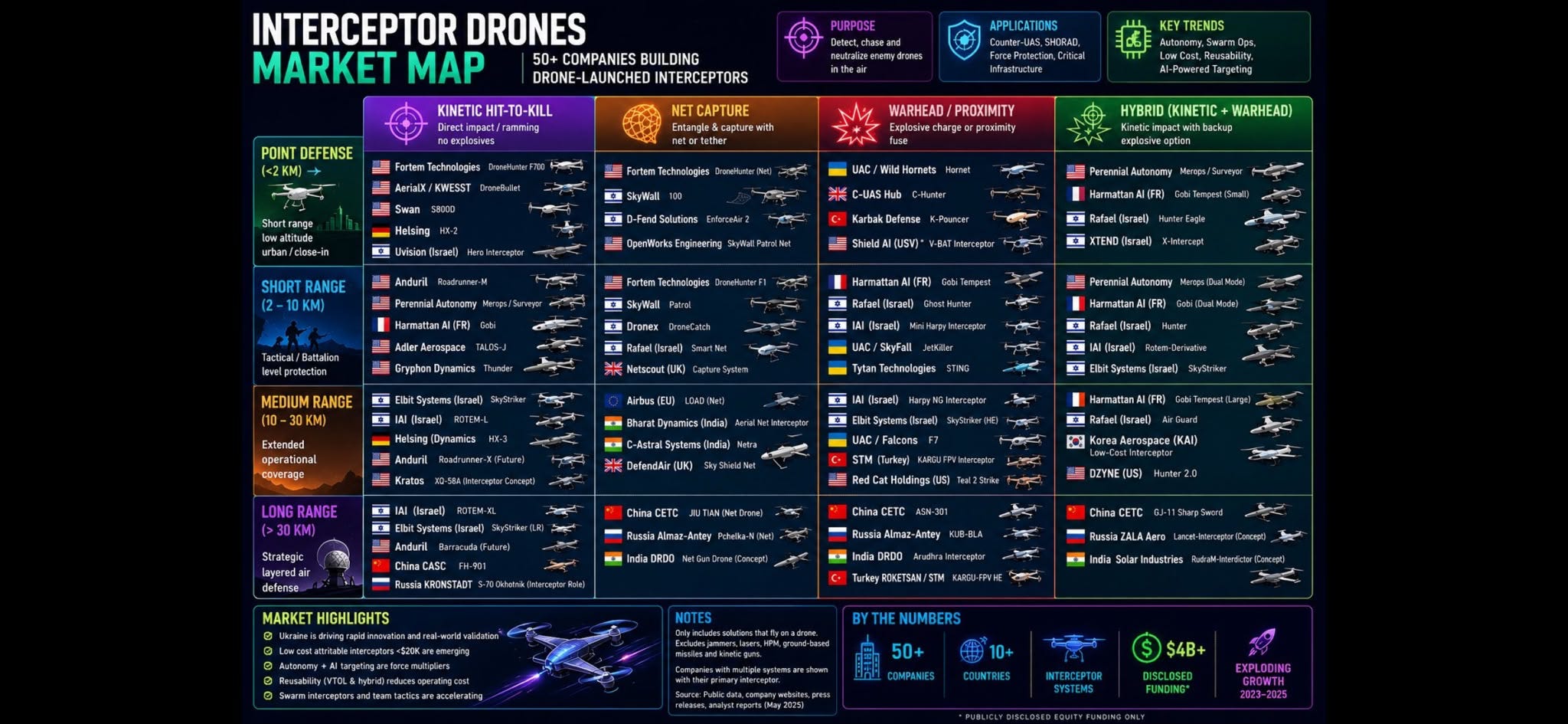
Autonomous air: A NYT opinion documents fully autonomous AI drones firing missiles over the Mojave as the Pentagon requests US$54.6B for its new autonomous warfare group. Archer and Anduril unveiled Thunder, an autonomous attack rotorcraft aimed at Apache operators, first flight 2027.
Space: The Mitchell Institute’s workshop report maps space superiority through the spectrum of conflict in seven recommendations. Slingshot Aerospace won a US$69.2M Space Force contract for its MENTAT training environment, its largest ever. 🍁 Canada is in the game too: a new tender seeks system definition for the Surveillance of Space 2 optical capability, Canada’s own eye on orbit.
Axis watch: The Economist tracks China’s maritime militia massing 1,000+ vessels in 450km swarms near Taiwan. CNN finds Chinese deep-sea research ships spent only 6% of their time actually researching their mining zones, going dark near submarine routes instead. A leaked police database shows China tracking 12,000 foreigners, with Canadians filed under a “Five Eyes Alliance” label. Beijing banned rare-earth shipments to 14 European defence-linked firms. Evan Osnos’s New Yorker dispatch on the future being made in China notes 70%+ of global drones are built there, and Moonshot’s new 2.8-trillion-parameter open-source model now rivals top US systems. The tech race and the drone race are the same race.
Nathan Mintz: “The Submarine and PAC-3 contracts exceed the combined value of all OTAs awarded in the last two years. They dwarf by a factor of 8.5X the total lifetime federal obligations of the NatSec100 companies ($16B) and exceed the total private capital raised for those companies ($118.2B)”
🍁 Home front: A hostile intelligence service cloned the Macdonald-Laurier Institute’s website to phish for classified information. Ex-CSIS director David Vigneault warns Canada’s openness is now its biggest vulnerability, citing a downed Shahed carrying Canadian-made antennas. Sweden’s answer to the same threat environment: a brand-new foreign spy agency comparable to MI6. Iran shows where this goes, pinging Middle East mobile networks to hunt US personnel and, per the NYT, attacking water systems in at least seven US states, with HuffPost reporting 30+ Minnesota water systems hit in one coordinated wave. Critical infrastructure is the front line. Canada’s is not exempt.
🔫 Hot Shots
🍁 Greypoint Industries, founded by Canadian infantry veterans and winners of Canada’s first defence hackathon, Icebreaker, made Newsweek’s case for why defence innovation is moving beyond traditional contractors. Their counter-swarm thesis: neutralize the operator, not the drones.
🍁 North Vector Dynamics CEO Paul Ziade went on The Techne Connect to talk leaving tenure for hypersonics.
🍁 Canadian kit is protecting Ukrainian women in combat: NP Aerospace’s curved plates and Logistik Unicorp’s carriers anchor the first body armour designed for the 75,000 women serving, with 48% more protection than flat plates. “Women are not just small men.”
🍁 Middle East turmoil upended global helium supplies, and Canada holds a fifth of world reserves while producing 2% of output. Helium is the only one of 34 critical minerals without the tax treatment. Fix that.
🍁 Canada’s aerospace sector put up $33.1B in GDP and 218,700 jobs in 2025, with R&D intensity 4.5x the manufacturing average. AIAC wants a national industrial aerospace strategy to match.


🍁 Vancouver’s QSE was selected for Canada’s quantum trade mission to the Netherlands this September. Post-quantum encryption is becoming an export product.
🍁 Breaking in: Alacrity Canada published a defence literacy field guide for Canadian SMEs, and Carleton launched a two-day practical certificate in Canadian defence procurement taught by former ADMs. Cheaper than learning by losing bids.
🍁 Jobs desk: Dominion Dynamics is hiring a Director of Operations to run the factory floor in Ottawa or Toronto, and BDC’s StrongNorth Fund wants an associate with a STEM brain and a Secret clearance in Toronto or Vancouver. CSMC needs a corp dev team in Toronto, and North Vector Dynamics needs a head of growth

🍁 Ticker watch: a markets piece on the counter-drone billions puts Volatus Aerospace’s Mirabel expansion and CAD 9M NATO contract next to DroneShield and Kratos, with analysts’ targets at double the current price.
Nuclear is quietly having its defence moment: BloombergNEF sees global capacity jumping 44% to 535GW by 2036, with China holding nearly half the reactors under construction.
Ottawa working on ‘Maple List’ to help validate Canadian drones for the Armed Forces

If you’ve got battlefield intel, classified tips, or just want to call in an airstrike on our typos, hit “reply” and sound off. Whether it’s a new tech sighting, a rumour from the mess hall, or feedback on our comms, we want your SITREP.