

🎯 Three-Shot Burst
Special guest post by Philippe Letarte, Canadian Venture Capital & Private Equity Association (CVCA)
Amending a single regulatory provision could unlock millions in private capital for Canada’s innovation ecosystem.
The gap: Canada’s chronic shortage of growth capital is one of the most pressing problems facing its innovation agenda, as the CVCA has stressed in recent months. The Defence Investment Agency (DIA) now holds the pen on the next iteration of the Defence Industrial Strategy (DIS), and part of the solution may already sit in the Industrial and Technological Benefits (ITB) Model Terms and Conditions. The Venture Capital Fund (VCF) Transaction provision under section 7.9 lets defence primes meet part of their ITB obligations by investing in Canadian venture capital.
The CVCA’s ask: The government is about to launch the Venture and Growth Capital Catalyst Initiative (Growth VCCI), a $1B fund-of-funds program announced in Budget 2025 and managed by BDC. That launch is an opportunity to put currently unallocated ITB capital to work for Canada’s innovation ecosystem.
Reality check: Innovation, Science and Economic Development Canada’s Fall 2025 ITB annual report counted ~$84B in live ITB obligations across 117 contracts. Of that, $23.4B has yet to be assigned to any industrial activity. The VCF category carries a 5x multiplier, yet in the decade since it was created, not one dollar of VCF credit has been publicly reported. The Parliamentary Budget Officer found that multipliers of every kind (R&D, VCF and technology transfer combined) made up just 0.8% of ITB transaction value from 2015 to 2019. It is a mechanism on paper only.
The fix: CVCA’s submission asks that limited partner (LP) commitments to Growth VCCI-approved funds-of-funds count as eligible VCF Transactions under section 7.9. The rest of the ask:
Treat the LP’s cash commitment as the eligible investment.
Accept Growth VCCI’s existing Canadian-content compliance reporting submitted to BDC as ITB evidence, subject to DIA audit rights. The program already requires at least 60% of allocations to go to Canadian VC funds and at least 90% of direct investments to go to Canadian companies.
Use look-through attribution against paid-in LP commitments.
Keep the existing 50/50 staged-credit structure.
Raise the multiplier from 5x to 9x, still subject to the aggregate VCF cap.
Bottom Line: This needs no new appropriation, no new bureaucracy and no new program. The DIS’s ITB modernization pillar already promises enhanced multipliers and new Strategic Investment Transactions, and the CVCA is handing the DIA a ready-made way to deliver on that commitment. Capital will decide whether Canada’s rebuilt defence industrial base is Canadian-owned when it matters most

ADVERTISEMENT

Barrack Hill: Navigating Canada’s defence and procurement landscape with precision.
🤝 Deal Corner
🍁 ATCO spins out a defence company inside a $72B utility merger. Emera is buying Canadian Utilities and ATCO in what the companies call the largest merger ever between two Canadian firms, and ATCO’s housing, defence and investment arms become New ATCO, a separate Calgary-listed company built around contractor ATCO Frontec, with Nancy Southern as chair and CEO. Frontec turned a Resolute Bay site into a base for 350 CAF personnel in three weeks for Operation NANOOK-NUNAKPUT, holds a two-year, $48.4 million Polar Over-the-Horizon Radar contract with Inuvialuit Development Corporation, and owns 49% of Nasittuq, which runs the North Warning System and supports CFS Alert. Closing is expected in Q3 or Q4 2027, after CFIUS review. Canada’s biggest Arctic defence services shop is about to become a pure play.

To SPAC, or not to SPAC?
Canadian defence procurement system is “genuinely broken”
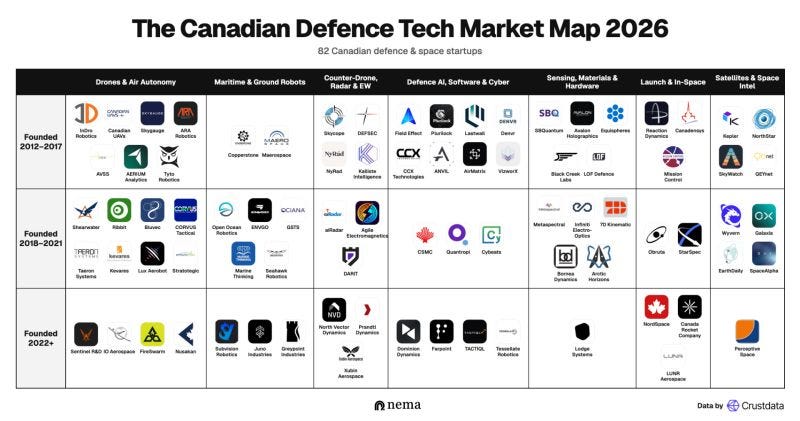
🍁 AirMatrix lands its largest IRAP project (amount undisclosed). The Ottawa company is getting NRC IRAP funding through the Defence Industry Assist initiative to fuse multi-sensor data into one low-altitude airspace picture on Libra, its hardware-agnostic C2 platform, covering automated sensor cueing and AI-assisted visual confirmation with a human in the loop. CEO Bashir Khan: “The next generation of airspace security will not be defined by whoever deploys the most sensors.”

🍁 Q3 A&D M&A: fewer deals, bigger cheques, and a Montreal deSPAC. B. Riley counts 59 announced A&D deals in Q3, 40% below Q2 and well under the 87 quarterly average, but nine $1B-plus deals, the most since 2020. They include GE Aerospace for CPP ($11.8B), Thales for Exail ($4.4B), Lockheed Martin for Ultra Maritime ($3.5B) and Wildcat for Austal ($1.4B) with Hanwha bidding $1.2B. Sponsors now own a record 277 A&D companies, and Big 6 prime dry powder hit $16.4B, the highest since 2Q19. Montreal’s NorthStar Earth & Space closed its deSPAC with Viking Acquisition Corp I on October 1 at a $300 million pre-money EV. The exit window is narrow, but it is open.


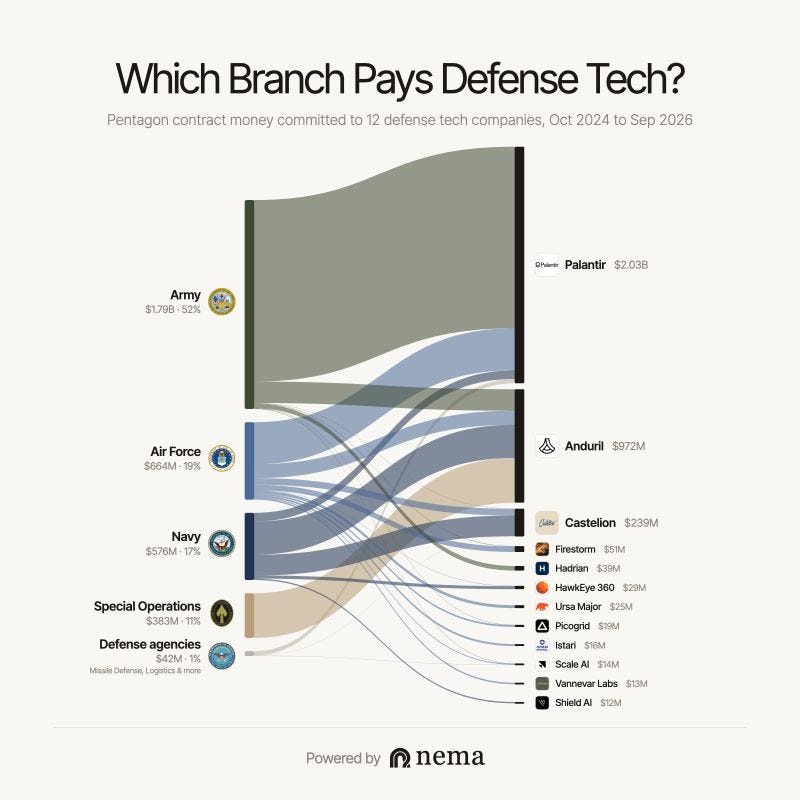
Anduril bets $6.6B on submarines and wins $1.8B for Army C2. The company is putting $3.7 billion of private capital into Arsenal-2, a 187-acre, two-million-square-foot yard in Baltimore County backed by a Navy incentive contract worth up to $2.9 billion that ties payments to production, building Virginia-class modules for Electric Boat and Newport News from 2030. The same week the Army gave it a five-year deal of up to $1.8 billion to field Lattice across I Corps as the NGC2 backbone. Bloomberg reports the Sparrows Point site will employ about 3,100 people at full operation, with full production the year after it opens.



Pentagon puts $350M into quantum computing. PsiQuantum gets a $150 million capital loan commitment for US manufacturing and prototyping, and $200 million moves Atom Computing, Diraq, IBM and IonQ into Stage C of DARPA’s Quantum Benchmarking Initiative, which tests whether each machine can reach utility scale by 2033. PsiQuantum is valued at $7 billion on $1.66 billion raised. OSC’s Peter Zuckerman: fault-tolerant quantum is “a national security imperative.” Capital loans now sit next to grants in the Pentagon toolkit.
The Pentagon Is Moving Onto the Cap Table
Benchmark makes its first pure defence bet: $25M into Furientis. The one-year-old Los Angeles interceptor maker raised a $25 million seed at a $125 million post-money, on top of a $5 million pre-seed in May, and holds a funded Pentagon contract for mid-range interceptors after 12 successful launches. The goal is 1,000 interceptors a year per facility. Industrial Base Alpha frames the gap: the US Navy receives 300 to 500 interceptors a year, while China can build an estimated 3,000 anti-ship cruise missiles a month. Interceptors are the new drones.
Tiberius signs $500M to license its ramjet shell to the UK. The California company will manufacture, license and distribute Sceptre with unnamed UK partners under an ITAR Technical Assistance Agreement. The 155 mm round claims 150 km, Mach 3.5 and 65,000 feet from unmodified NATO howitzers, after first in-flight ramjet ignition in New Mexico in April.
Balerion closes an oversubscribed $200M Fund II. The Dallas firm has backed 15 companies from Fund II, including Valar Atomics, Vast, Commonwealth Fusion, Relativity and Erebor, on top of earlier bets on SpaceX, Anduril, Impulse and Armada, and hired former NASA Chief Technologist A.C. Charania as managing director.

Voyager wins $22.4M to put more satellites on each launch. The Strategic Capabilities Office signed an Other Transaction Agreement for Voyager to build flight-ready prototype satellite dispensers that let the Space Force fly extra smallsats on spare payload capacity without touching the primary mission.
Related: PitchBook’s new Q3 robotics note goes deep on actuators and motion systems, the component layer under every ground robot, interceptor and drone array in this issue, and the layer most exposed to Chinese supply.
ADVERTISEMENT

Learn more here.
⚔️ Combat Readiness
Spectrum war. The WSJ went inside Ukraine’s electronic warfare fight. Night Watch says its Lima system, with a stated 120-mile reach, diverted two Russian ballistic missiles into the Dnipro River before they hit a government site in Kyiv, and spoofed a hypersonic Kinzhal last November until it broke up. An Unmanned Systems Forces officer says EW suppresses 70% to 95% of radio-controlled drones in his sector. Phantom Defense counts more than 11,500 Russian drones detected and about 7,500 neutralized in a year, and December1 now ships thousands of units a month, up from dozens in 2024. The cycle is brutal: when Russian drones started using Chinese Controlled Reception Pattern Antennas to dodge jammers, Night Watch and Cascade built Lima Quant in three months, and Russia went from four antennas to eight, then 16, then 32. US Air Force Col. Josh Koslov: “If you are not winning in the spectrum, you are going to lose the war.” Canada has a home for this. CAFCYBERCOM leads all CAF cyber, joint EW and SIGINT, with the Canadian Forces Electronic Warfare Centre producing intelligence mission data.

🍁 Kit for Canada. NATO’s Innovation Continuum, run by Allied Command Transformation, held its final in-person working period in Dartmouth, its first time in Canada, with 100 companies and 30% of them Canadian. Finland’s Kelluu flew a surveillance airship over Dartmouth Cove alongside Canadian and Icelandic underwater kit, a war game ran on a map of the GIUK gap, and Kelluu has opened an Ottawa office to chase the Canadian Arctic.
The procurement side is trying to keep up. At Edmonton Startup Week, CFB Edmonton contracts officer Sean Naugle told founders “We want to partner with you: we need suppliers, diversity, more options” to make buying faster, while Grengine’s Connie Stacey compared federal procurement to “telephone tag” and pointed at DIANA’s Rapid Adoption Service, which lets any of 32 allies contract a vetted product directly. Calian’s Chris Pogue, speaking at DEFSEC Atlantic, says 1,700 new companies and 166 venture firms entered Canadian defence in the past year, and warns the foreign platforms bought in the last six to eight months will lock in decades of support contracts unless Ottawa builds vehicles for Canadian firms to add capability: otherwise “we will have purchased obsolescence.”

🍁 Procurement, rewired. Bill C-40, tabled October 6, would turn the Defence Investment Agency into an agent Crown corporation, the Canadian Corporation for Defence Investment, led by a new associate minister of national defence and freed from parts of Treasury Board policy. Eugene Lang calls it “unprecedented and a leap of faith,” and Philippe Lagassé warns “a Crown corporation model comes with big risks.” Siobhan Harty and Jeffrey Collins call it the biggest change to defence procurement in 75 years and point to the last precedent: C.D. Howe’s Department of Defence Production, which ran from 1951 to 1969 while Canada spent about 5% of GDP on defence, the level Canada is targeting now. Their worry is the split: the Defence Production Act stays with the public works minister. The PBO’s new primer supplies the stakes. Core spending reaches $163.6 billion in 2035-36 on a gradual path, DND’s capital spending fell $18.5 billion short of plan from 2017-18 to 2023-24, and a standalone DIA costs $103.8 million over five years plus $22.3 million a year after that.

Ukraine, Inc. Tectonic’s second dispatch from Kyiv tracks an industry whose capacity went from $1 billion in 2022 to about $35 billion in 2025, with roughly $55 billion expected this year. Foreign money into Ukrainian production hit $6.1 billion in 2025, up from $600 million. Brave1 counts 2,500 companies and 5,000-plus products, and brigades with their own budgets have ordered UAH 33 billion and 500,000-plus drones through its marketplace. Consolidation has started: Swarmer bought Ratel for $224 million, Vyriy rolled up five firms, and Ukraine opened controlled exports in July with 20% to 30% of proceeds sent to a state defence fund.
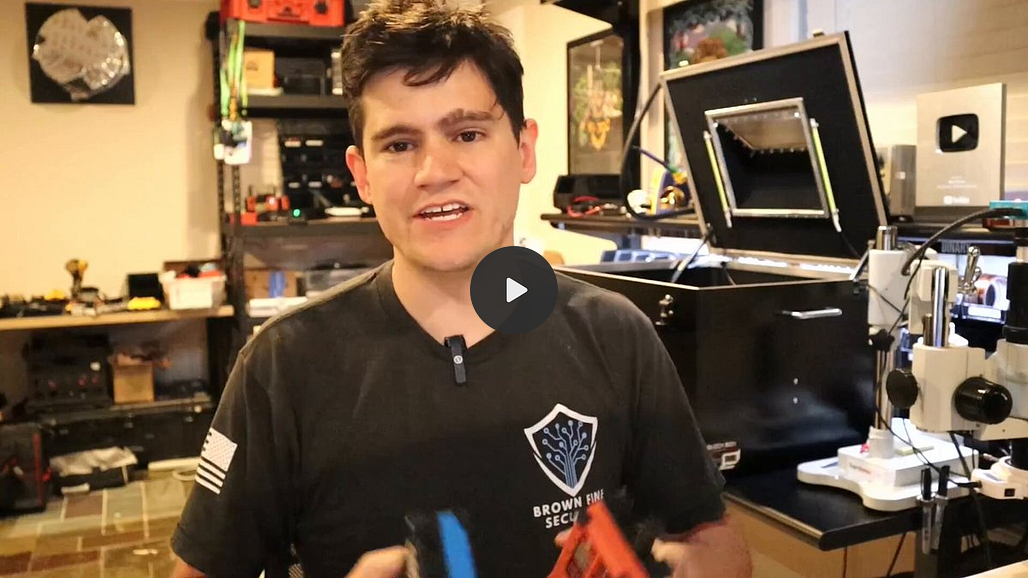
Theseus CEO Ian Laffey, a Université de Montréal alumnus, explains the pull on the Ukraine Military History Podcast. His GPS-free navigation startup came out of a February 2024 hackathon, landed in Kyiv in November 2024, and failed on day one because nobody had told the team drones launch from catapults, so he moved there. His case for the market: brigades buy at unit level and drop what fails, so “you just can’t prove that scale anywhere but here and that efficacy.” The private capital is still small next to the state money. Defense Valley’s open tracker counts €126 million across 65 capital events and 46 companies since 2024, with €87 million in 2026 alone and Uforce’s $50 million the largest round. Saskatoon’s Draganfly shows up once on the investor list.
Dan Herman on partnering with Ukrainian defence tech


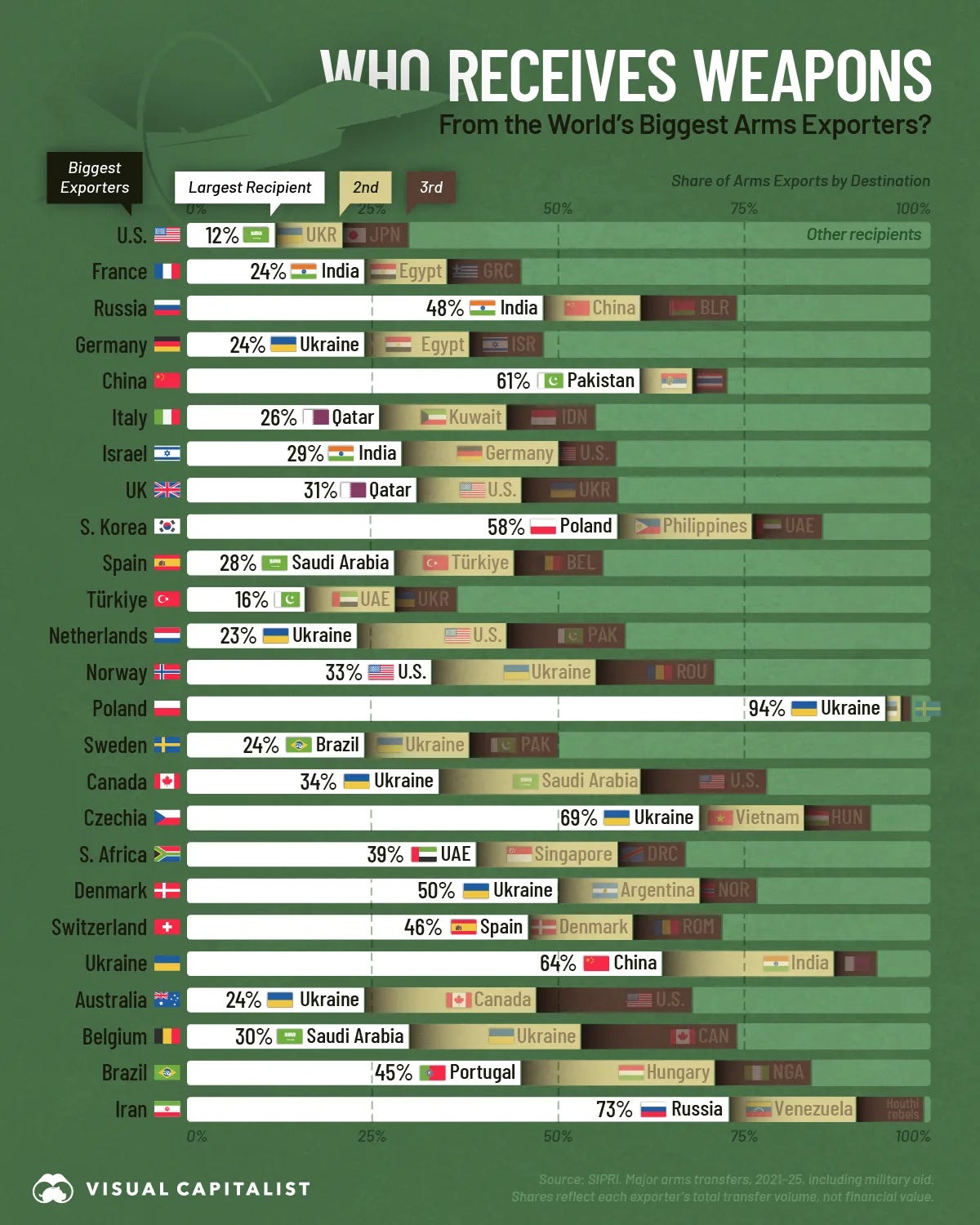
🍁 Export math. SIPRI’s 2021-2025 data puts Canada 16th among arms exporters at 0.7% of the global market, with Ukraine taking 34% of Canadian exports, Saudi Arabia 27% and the US 17%. The US holds 42% and France 9.8%. The Defence Industrial Strategy wants exports up 50%. The opening is in Brussels and Washington at once. France’s new ambassador, Hélène Farnaud-Defromont, says France already gets 65% European content in what it buys and the ideal is “100 per cent European content,” yet only one SAFE contract has gone to Canada since it became the first non-European partner in February.
US Ambassador to NATO Matthew Whitaker told Europe that with $1 trillion to $1.5 trillion in US defence spending this year, American industrial capacity “is largely going to be used to provide those requirements for the US military,” and that “the United States needs friends with manufacturing capacity.” The EDA expects missile defence capacity to grow more than 800% by 2030, mostly at the short-range end. Washington can’t fill Europe’s orders and Europe wants European content.
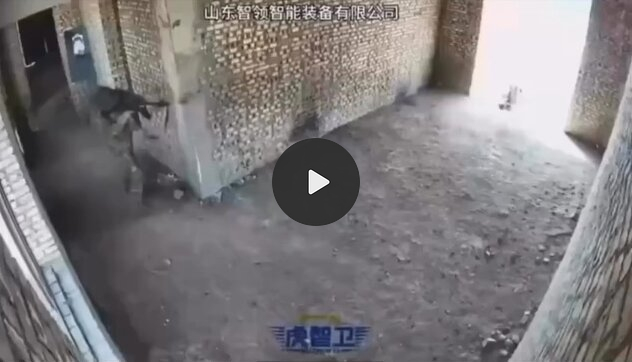
Big think: breaking robotic mass. Retired Air Force Col. George Dougherty argues mass drone fires alone won’t restore manoeuvre. His answer is to treat the low “air littoral” as terrain for ground vehicles that don’t touch the ground: arrays of up to tens of armed drones under one operator acting as the forward striking element, with crewed forces following. A 50 kg payload carries a light machine gun with fire control plus four light anti-tank missiles. Twenty drones replacing a $5 million to $10 million Stryker implies $250,000 to $500,000 each, under the Army’s $650,000 target for a new robotic combat vehicle. He wants a prototype unit modelled on the 11th Air Assault Division (Test). Beijing is studying the same problem without paying for it. CSIS reviewed 90-plus Chinese sources and found PLA analysis lands about four months after a technique appears in Ukraine, with fielding a year or more later. Within four and a half months of Spider’s Web, a Chinese brigade drilled against 20-plus drone operators with detection kit cataloguing 800-plus commercial models.

Spend more, build more. Harpoon Ventures founder Larsen Jensen, a former SEAL and two-time Olympic medallist, makes the money case. China installed 295,000 industrial robots in 2024 against 34,200 in the US, or 54% of the world total, the DIA estimates real Chinese military spending at $325 billion to $400 billion, and GAO says major programs average more than 12 years to deliver initial capability, which he blames on budgets that refuse to fund both today’s force and tomorrow’s. His two lines: “Calling the refusal to pay ‘discipline’ does not make it so,” and “We cannot assume American ingenuity will make up for factories that do not exist.” CNAS puts numbers on the cheap end. Operation Epic Fury drained US high-end missile stocks, and the $35,000 LUCAS made its combat debut there. Against a Renhai-class cruiser, 47 HERONs cost $9.4 million versus $19.2 million for six LRASMs, but a lower unit cost “does not translate into a cheaper salvo” when far more rounds are needed, roughly half of 2,000-plus Chinese targets sit deep inland, and hardened targets still need exquisite weapons. The Pentagon wants more than 10,000 low-cost munitions in three years.
🍁 Nuclear: learned, unlearned, outsourced. Works in Progress shows how Britain built 26 reactors from 1956 to 1971 in four to five years apiece, and by 1965 had more nuclear stations than the US, USSR and France combined. Now Hinkley Point C will take at least 13 years and run £17 billion over budget after 7,000 UK-specific design changes. The government’s taskforce found “a culture of resignation among dutyholders and regulators who simply accept that nuclear projects must be slow and expensive.” Canada is losing capability a different way. The Logic reports that Canadian Nuclear Laboratories, run by an all-American consortium of BWX Technologies, Amentum and Battelle, is helping Chicago’s Clean Core Thorium develop a fuel that a May briefing to Minister Tim Hodgson says India sees as a way to cut imports “from countries like Canada.” India runs 25 reactors, 21 of them Candu-style, and Cameco signed a nine-year, $2.6 billion supply deal there in March. Canada’s national lab, run by Americans, is helping its best uranium customer need less Canadian uranium.

Counter-drone. The Pentagon picked four directed-energy systems for a homeland pilot run by JIATF-401: AeroVironment’s palletized laser, Kord’s Firefly, Boeing’s CLWS and Epirus’ Leonidas, which downed a 49-drone swarm in one burst in testing, across five bases for a year. JIATF-401 also awarded 10 Domestic Shield contracts worth up to $4.15 billion and plans a December shoot-off at Dugway. Brig. Gen. Matt Ross on cost per shot: “If I procure that system and it costs me $6 million and I take one shot a year, you can’t tell me that that shot only costs 8 cents.” Pete Newell, who ran the Army’s Rapid Equipping Force, warns the kit is aimed at the last war. Federal agencies seized more than 700 drones across 11 World Cup host cities, but the next drone navigates without GPS and flies with no radio link, and most counter-drone systems work by detecting and jamming that link ahead of LA 2028. His line: “Drones are IEDs that fly.” The Secret Service agrees. Deputy Director Matthew Quinn told 60 Minutes “I’d love to tell you the swarm problem is solved. It’s not,” even as the agency builds an AI- and radar-guided net-capture “drone hunter” and logs 10,000 threats against protectees this year.

Maritime autonomy. Ukraine’s navy calls September 14’s clash, when a Sargan 300 drone boat sank a Russian USV, the “first naval battle in history between unmanned boats.” In July three US one-way-attack USVs struck an Iranian submarine and naval facility, the first US combat use of USVs, and Taiwan wants 1,200-plus USVs and 200,000-plus one-way-attack drones. Retired Vice Adm. Michael Connor and Yoni Tobin argue destroyer budgets crowd out unmanned spending: “That is subtraction by addition.” China is building the carrier for the deep end. New imagery puts the Hudong-Zhonghua mothership we flagged last month at about 205 by 27 metres, with a bottom-opening well deck, a 12-arm cradle and a hangar for four 35 to 45 metre XXLUUVs with an estimated 10,000-nautical-mile range.
ENVGO and Victoria’s Open Ocean Robotics will bring ENVGO’s 25-knot hydrofoiling XV2 into Open Ocean’s XplorerView C2, pairing a 68 kg sprinter with solar DataXplorers that have logged 13,000-plus hours and 30-day deployments in Sea State 7.
🍁 Cold reality. Internal DND evaluations of Exercise Global Response in Alaska found more than 400 soldiers of 3RCR lacked basic Arctic living and winter soldiering skills, with up to 30 frostbite cases, drones with 10 minutes of battery in the cold, and medics on personal phones.
The new Greenland-Denmark-US deal largely gives Washington rights it already held under the 1951 agreement, adds a ban on control by investors from outside NATO and the EU, and still cannot defend North America alone: “The Americans are going to need Canada.” Trump “has not changed the geography of the continent.” The geography is ours. The cold-weather skills have to be ours too.
Canada’s Air Effects Team recently competed in a Five Eyes military modernization exercise

Mojave reality check. “Under a blistering desert sun, the U.S. Army strained to show it had become a modern, AI-powered fighting force.” That is the WSJ’s Heather Somerville on Project Convergence Capstone 6, ten days in July at Fort Irwin. There, 9,700 soldiers fought around the clock against an Army unit playing the PLA, in heat near 110 degrees. The drones from Anduril and Theiss UAV Solutions overheated and landed, or took as long as ten minutes to get airborne, against under a minute for Ukrainian crews with similar kit. Operators flew them for half their maximum time to save batteries, and lost the signal behind mountains. The augmented-reality headsets, on contracts worth more than $100 million each with three companies, struggled enough that the Army isn’t sure it will keep them. Much of the exercise went to clearing buildings. Starlink connectivity and the AI planning tools did improve. Anduril just won up to $1.8 billion to run the Army’s next command system, and the hard part is the gear at the edge of that network. Put this next to 3RCR’s drones getting 10 minutes of flight in the Alaskan cold. Heat or frost, the battery is the weak point.
🍁 Space. Canada remains the only G7 country without its own launch, and SpaceX launched all 12 Canadian satellites sent up in 2025, while SpaceX is reportedly turning away Falcon 9 bookings after 2028. SpaceQ’s Marc Boucher puts the cost of a light-lift rocket to orbit at $50 million or more, and Kepler’s Mina Mitry says rideshare’s “barrier to entry now has grown significantly.” Longueuil’s Reaction Dynamics is dropping its hybrid engine and cancelling the Aurora-1 test flight from Australia for storable liquid propulsion, after 21 hot-fires above 95% characteristic-velocity efficiency. It will start testing the RE-X orbital engine in November, still targets Q4 2028 from Spaceport Nova Scotia, and will follow with Borealis, a medium-lift rocket.
NordSpace got there another way: its Terra Nova pathfinder, nine months from concept to launch-ready, is operating in orbit and met every mission goal so far, which makes the Markham company the first Canadian launch hopeful flying its own hardware in space. Its Taiga suborbital rocket could fly from St. Lawrence, N.L. within weeks, pending approval. Terra Nova rode up on a Falcon 9 with about 130 other satellites.
🔫 Hot Shots
🍁 The Icebreaker x BDC report keeps showing up in the news. BetaKit’s story on Markham’s CyberWorks Robotics, which won an amended DND contract worth more than $1 million through Innovative Solutions Canada to supply autonomous vehicles to the CAF, with a path to up to $7 million more, cites the recent BDC x Icebreaker report finding that smaller Canadian businesses want to meet defence needs but many struggle to get in. CyberWorks is what getting in looks like.
🍁 Defence Drone Initiative Marketplace, Round 2 is open. The DIA is inviting Canadian suppliers to qualify for the DDI Marketplace, with a mandatory-registration industry day on October 15 and bids due November 6. There are six bid events, each capped at 100 bids, so submit once. The notice already lists 398 related contract awards.
🍁 NRC wants a field-deployable chemical imager. An Innovative Solutions Canada Phase 2 challenge offers up to $1.5 million over 18 months for a quantum cascade laser standoff imaging system that detects CBRNE threats at 0.3 to 10 metres, scaling up a capability NRC has only demonstrated as point spectroscopy in the lab. The window closed August 4.
🍁 Logistik Unicorp’s CEO is out after arrest. La Presse reports Hugues Dorban, 49, was arrested September 30 and faces three charges. The Saint-Jean-sur-Richelieu firm, which holds a 20-year, $3.7 billion DND contract for 1,220 uniform and kit items, says he no longer works there, says the company is not a target of the case, and has named Nicolas Robert interim CEO.
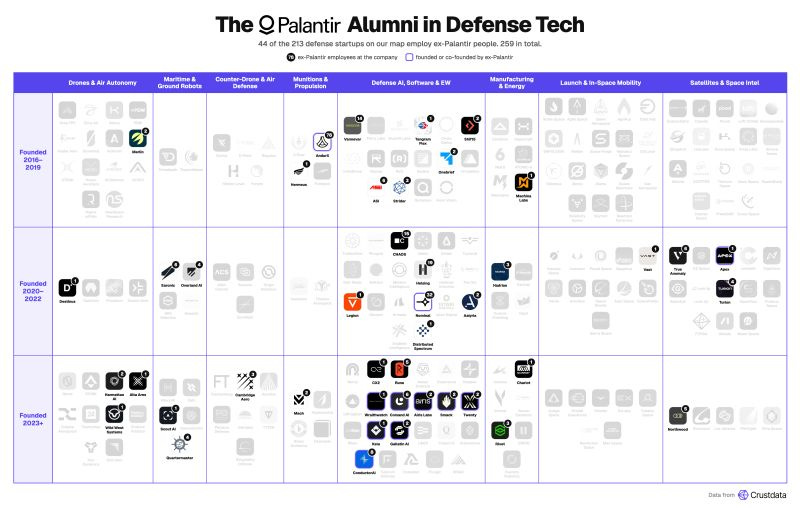
Palmer Luckey’s bank tops $7B. Erebor, the startup bank built to fill the gap Silicon Valley Bank left for tech, defence and manufacturing companies, has taken in more than $7 billion in deposits since launch in February. Defence founders now have a lender of their own in the US.
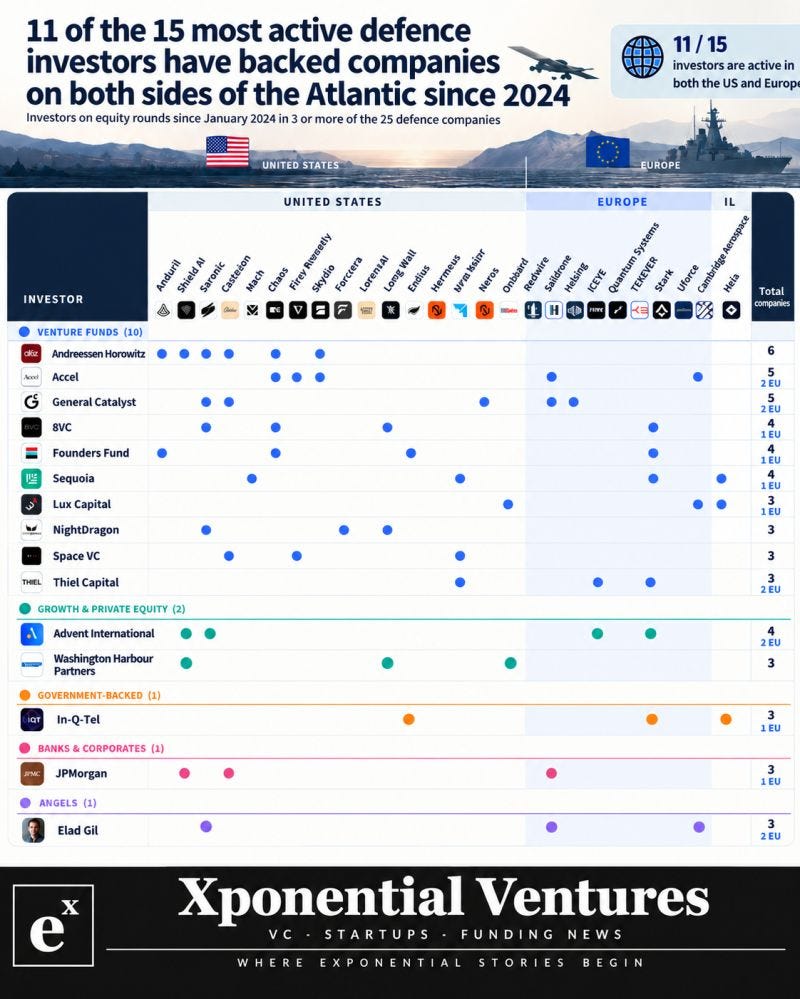
Resilience Media names 100-plus investors to watch. The list leans on Crunchbase data showing $14.6 billion invested in defence in the first half of 2026, up from $9.6 billion in all of 2025, and is built to help newcomers map the field.
War on the Rocks crowns ten wartime technologies for America’s 250th. The Cogs of War winners run from the blood bank to Rickover, Kevlar and the integrated circuit. The editors’ lesson is that government’s leverage “has historically come from committing early to things the market did not yet value,” such as the Army’s 1936 decision to design every Air Corps engine for 100-octane fuel. Buying early is industrial strategy.
Hackers knocked out French supermarket fridges. Cyberattacks on refrigeration systems hit hundreds of supermarkets across several major chains, including Intermarché and Coopérative U, which had to throw out fresh and frozen food. Prime Minister Sébastien Lecornu is “personally monitoring the situation” and has called in ANSSI.
The F-35 parts that shipped because of one missed email. A UPS employee missed a DSV email warning that the shipment must not route through Hong Kong, and China got an F-35 cockpit canopy and weapons-bay door, both coated in radar-absorbing material. ITAR held up on paper. The inbox did not.
The Icebreaker is written for the people building Canada’s defence technology base. Forward it to someone who needs it.
Is BDC keeping the data on Canadian servers or are they planning on storing it in US based servers endangering Canada's security?