

Editor’s Note: Thanks to the NATO Association of Canada and the Canadian International Council for hosting us as part of a lively discussion on AI & Warfare at the Canadian Forces College during Toronto Tech Week!
🎯 Three-Shot Burst
New Scientist reports that a senior figure in Ukraine’s defence industry confirmed a test near Bakhmut approximately two years ago: ten AI-driven quadcopter drones were sent toward the front lines, activated “Terminator mode” — and killed Russian soldiers with no human involvement at the terminal stage. Confirmed casualties: “a couple of soldiers and one truck.” No recordings exist. Responsibility was inferred from the aftermath. There is currently no international ban on fully autonomous lethal weapons. The UN has called for one. Ukraine’s own government prohibits AI in the final stage of target engagement — though it used it anyway, in a test that apparently worked.
The Promise & Peril of Autonomous Weapons: A Primer
This is not a hypothetical. It happened. The question now is what it means:
New Scientist’s reporting is corroborated by BetaKit, which noted the milestone while covering Russia’s threats against Canada. The ICRC’s SIPRI researchers put the policy problem plainly: IHL compliance depends on the system, how it’s used, and the circumstances — and compliance ultimately rests with states, not companies. Almost no major defence AI company — Anduril, Palantir, Helsing, Shield AI, Anthropic — references IHL on their website or in their recruiting. “Responsible” and “ethical” branding is not the same thing as legal compliance.

France is at least trying to build it in from the start. Its Arcadia battlefield AI command system — described by Gen. Patrick Justel as “our response to Maven” — was tested at NATO’s Coalition Warrior Interoperability Exercise (CWIX) in Poland. Built with Mistral AI, Safran.AI, Thales, and Airbus. Highly decentralized, field-deployed server mesh. Open architecture. Built to synthesize information, generate courses of action, and leave decisions to commanders. Britain is moving too — MoD awarded a £227K prototype contract for Project STRONG: a single analytical platform that fuses intelligence, generates courses of action, and supports deployment of effects across cyber, information, and supply-chain domains.
Reality check: US CENTCOM commander Adm. Brad Cooper sent a memo to his commanders on May 26 reminding them: “Our commitment to the law of armed conflict is not a constraint on our lethality — it is the source of our legitimacy.” The memo came as Hegseth called rules of engagement “stupid” and Trump threatened Iranian civilian targets on social media. The gap between what CENTCOM is saying internally and what civilian leadership is saying publicly is not small.
Bottom Line: Autonomous lethal AI is operational. The legal frameworks are not. The companies building the systems don’t mention IHL. The governments deploying them are sending contradictory signals. Canada, which is about to spend $68B/yr on defence and is signing drone production deals with Ukraine, has no public position on autonomous lethal systems. That is a policy vacuum that will not stay empty.
🏆Canada can’t build sovereign capability without backing the startups building it:
That’s why DMZ Ventures is launching the $100K Dual-Use and Sovereign Tech Investment Prize at Startupfest, investing in startups driving Canada’s resilience and national security.
ADVERTISEMENT

Barrack Hill: Navigating Canada’s defence and procurement landscape with precision.
🤝 Deal Corner
🍁 Russia calls Canada a warmonger — and threatens to publish Sentinel’s address — Following the Airlogix + Sentinel R&D drone JV announced at CANSEC, Russian foreign ministry spokesperson Maria Zakharova called Canada a “warmonger” and vowed to publish “the addresses of all Canadian production facilities participating in the drone deal.” Russia’s ambassador said Canada was trying to profit from the conflict. Sentinel CEO Kath Intson: “The Canadian DND and Sentinel deal will proceed as planned.” Defence Minister McGuinty: “We’ve seen this before.” 🍁
McGuinty to lead defence trade mission pitching Japan on Canadian military tech
McGuinty urges businesses to ‘take risks’ as Canada builds defence-tech ecosystem
Are Canadian investors too timid to invest in defence tech?
🍁 Isar Aerospace raises $400M CAD for Spaceport Nova Scotia — German rocket builder Isar Aerospace secured a Series D bringing total funding to ~$1.3B CAD. Maritime Launch Services signed an LoI to pursue orbital launches from Canso, NS — and DND has already signed a $200M sublease for a dedicated pad. Isar’s two-stage Spectrum rocket: 1,000 kg to LEO. Launch window attempt: June 15–21 from Andøya, Norway. If they succeed there, Canada could see its first orbital launch attempt by 2027–28. Mid-to-high inclination orbits from NS are optimal for defence communications and Earth observation. Isar is also cooperating with TKMS on the Canadian Patrol Submarine bid. 🍁
🍁 Geopolitical feature flagging: it’s here — Anthropic abruptly disabled its newest Fable and Mythos models for all foreign nationals — Canada included — following a US government directive. SourceCAN’s Raymond Luk frames this as “geopolitical feature flagging”: access to critical technology switched on or off by nationality. Canada sits in the “foreign national” category alongside Russia and China. The risk isn’t just being cut off — it’s being given a degraded version. Also last week: DND opened its $166M Valcartier research complex (80+ new labs) 🍁
ICEYE raises €1B at €10B valuation — Finnish SAR satellite startup ICEYE — previously valued at €2.5B just six months ago — closes a Series F led by General Atlantic. Revenue: €250M+ in FY25. EBITDA: €100M+. Contracted backlog: €1.5B+. Customers: 7 European nations, NATO, Poland most recently. Used in Ukraine for strike planning. Currently producing 50 satellites/year; targeting 100 by 2028.

Gardar: Norway’s €80M fund backing Ukrainian builders — Sandwater’s new fund invests in Ukrainian defence tech from seed to Series B — tech that is already operational at the front. Backed by Norwegian billionaires including Johan H. Andresen and Gustav Witzøe. Named after the Old Norse word for Ukraine (Gardariki). The thesis: front-line builders are innovating faster than VCs can fund them. Norway supplies hundreds of millions in equipment and is already co-producing NASAMS missiles with Ukraine.
Hermeus hits Mach 1.21 — and raises $350M — The hypersonic startup hit its first supersonic milestone at White Sands on May 26 — Quarterhorse Mk 2.1, third test sortie, less than 90 days after maiden flight. DIU expanded the contract ceiling to $219M — the largest in DIU history. Series C: $350M (Khosla Ventures), including $150M in debt. Total raised: $500M+. Valuation: $1B+. The Chimera engine transitions from turbojet (Mach 3) to ramjet at Mach 3.5 — the critical unproven step. New CEO: Zach Shore (effective June 1). Production: dropping build times from 6–8 weeks to 48 hours by switching to 304L stainless steel.
DEFCON AI wins $115M Marine Corps logistics software contract — The Red Cell-incubated startup becomes the prime software integrator for Marine Corps Logistics Command and Control modernization — integrating Palantir Maven, Anduril Lattice, and Rune’s frontline sustainment software into a single DevSecOps pipeline. Base year: $20M. Five-year total: $115M. Model could scale across JADC2 ecosystem.
Hadrian: $730M raised, $900M Navy partnership, 30-day operator training — The automated aerospace manufacturing startup just opened a 2.2M sq ft factory in Cherokee, Alabama to produce components for Virginia-class and Columbia-class submarines. Total investment in the facility: $2.4B ($900M Navy + $1.5B private). Army contract: $80M ceiling for Red River Army Depot. Valuation: $1.6B. Claim: a non-machinist operator is production-ready in under 30 days.
STARK unveils Cascade + Gambit at ILA Berlin — Germany’s fastest-growing drone company added two new systems at the Berlin Air Show. Cascade: tube-launched loitering munition, 100km range, 4.5kg payload, GPS-denied AI nav, <1 minute setup, 10+ fit on a vehicle. Gambit: man-portable ISR/strike quadcopter, 25km range, 6kg, fiber-optic link option. Also raising ~€300M at €2.5B valuation. Sequoia, 8VC, Thiel Capital, In-Q-Tel, NATO Innovation Fund already in.
Alta Ares (France) raises €50M Series A — Counter-drone AI startup founded 2024. Pixel Lock: onboard computer vision for drone interception — widely deployed in Ukraine. X-Lock (VTOL interceptor, 270 km/h): contracts in Europe, Middle East, Asia; deployed across three active conflict zones simultaneously. Black Bird (turbojet interceptor, 670 km/h): prototype stage. Lead: Air Street Capital.
Related: DoD expanded classified AI work to 8 companies — SpaceX, OpenAI, Google, NVIDIA, Microsoft, AWS, Oracle, Reflection. Anthropic excluded. | PhysicsX raises $300M Series C — Physics AI for aerospace and defence engineering and manufacturing | Europe’s defence IPO wave accelerating — Rheinmetall, KNDS, and others preparing for capital markets
Related:
AGF on the Changing Security and Procurement Landscape
Lockheed Martin is writing seed checks now
MDA Space, Calian, and Kepler tapped to lay groundwork for Canada’s next-gen satellite system
Cohere says it is not working with Palantir
Inside Canada’s $500 Billion Dollar Defence Spending Gamble
⚠️ITAR by Default = Self-Sabotage?
Canadian Defence Spending; Stuck in Old Paradigms?
When an AI system misjudges a drone flight path and causes damage, who pays?
James Yurichuk: What does Canadian owned and operated really mean?
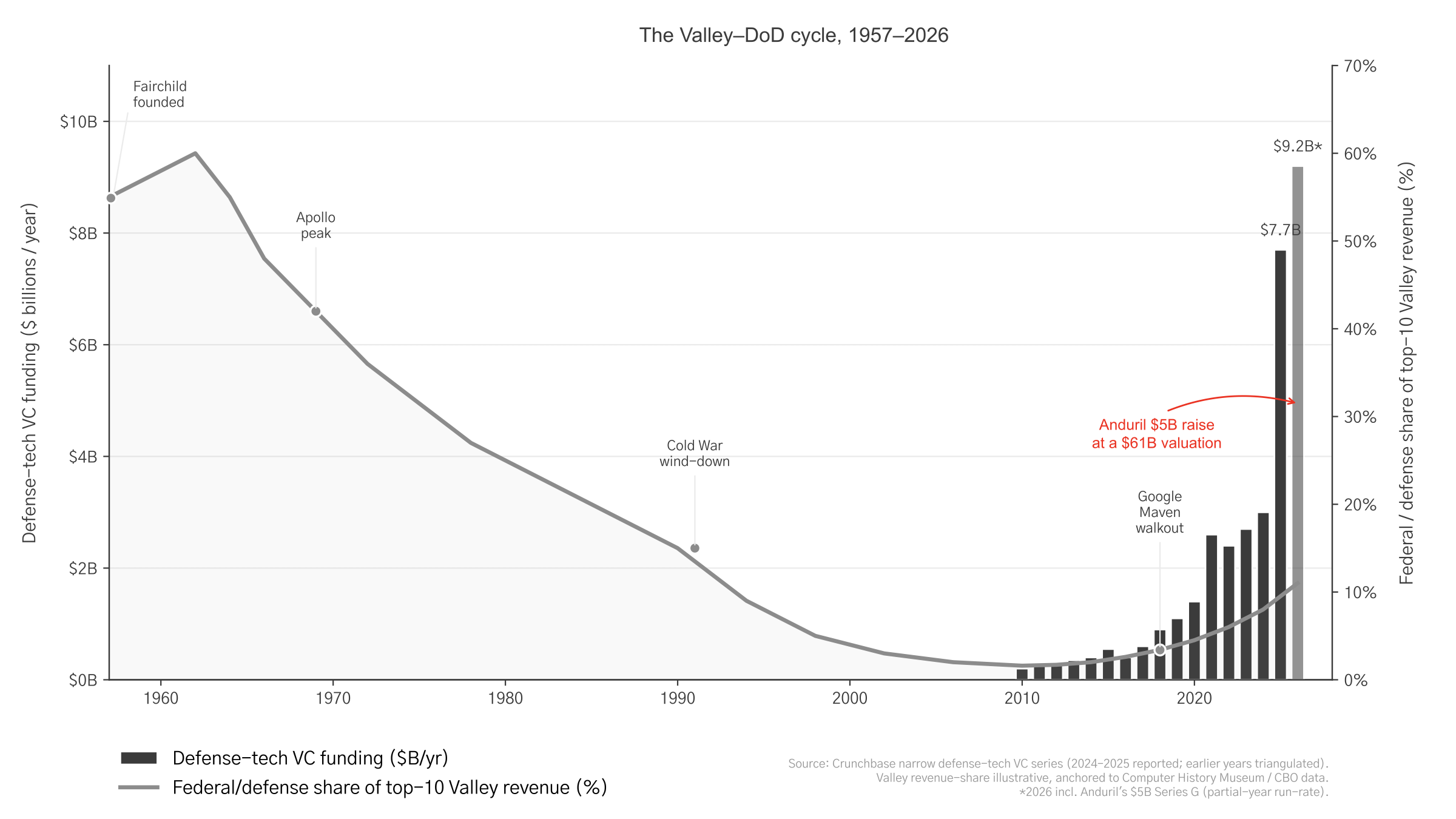
Silicon Valley Re-Enlists: How the Valley Rediscovered the Pentagon:

ROAR brings together the people shaping the future of robotics, autonomy, and public safety innovation in Canada

This year, we are honoured to feature General Wayne Eyre, former Chief of the Defence Staff for the Canadian Armed Forces, as a keynote speaker. With more than 40 years of military leadership experience, General Eyre has led through some of Canada’s most complex domestic and international security challenges, offering a rare perspective on leadership, readiness, and the rapidly evolving role of advanced technology in modern operations.
Join us at ROAR for an inside look at how robotics, drones, autonomous systems, and emerging defence technologies are transforming public safety, industrial operations, and national security. This is where operators, innovators, agencies, and industry leaders come together to see what is next and what is already possible.
Get your tickets: https://www.roarconference.ca/conferences/east
⚔️ Combat Readiness
2029 warning:
Canadian-backed firm CanBalt plans 500m euro defence park in central Lithuania
Germany’s Defence Minister Boris Pistorius, speaking to CBC in Ottawa: “The majority of German society is now convinced that there is once again a threat.” Russia could challenge NATO by 2029 — a view shared among Western allies based on coordinated intelligence. Russia has $1T allocated for defence through 2036, investing 7.5–10% of GDP. It is outpacing NATO in artillery shells, missiles, and drones. The Pentagon is cutting 50% of strategic bombers, one-third of fighters, and restricting submarines designated for NATO. Germany is building the strongest conventional military in Europe — and explicitly preparing to defend without US support.
Why Does It Take Years to Get a Patriot Missile From Factory to Front Line?
Ukraine struck Russia’s Baltic Fleet at Kronstadt dry dock — a Steregushchiy-class corvette (one of the fleet’s most capable air defence platforms) was hit. Result: Russia’s Baltic Fleet has lost ~one-third of its medium-range air defence capability. Estonia’s military intel: “this will certainly hamper air defence capability in the Kronstadt area for the future.”

First-ever sea drone rescue operation: a Corsair unmanned surface vessel from Task Force 59 (US Fifth Fleet, Bahrain) rescued two US Army soldiers from a downed AH-64 Apache near Oman — shot down by an Iranian Shahed drone. Corsair specs: 24 ft, 1,000 lb payload, 35+ knots. The crew was recovered at 3:30 AM local, then hoisted into a helicopter. The Navy holds ~50 Corsairs and awarded a $392M contract for autonomous vessels last year.
Related:
Drone wars: Shooting down drones one at a time [VIDEO]… A $200 Drone Can Sink a US Coast Guard Boat. Nobody Is Fixing It… As technology levels the field between stronger and weaker nations, old-fashioned wars of conquest might no longer be possible
Senators want a new Robotic and Autonomous Systems Combatant Command — four-star general to lead it; special acquisition and T&E authorities; modeled partly on Ukraine’s drone-focused military service. SASC passed the NDAA version 18-9. Hegseth already announced a sub-unified command for autonomous warfare.
CCA race at Berlin Air Show: Boeing’s MQ-28 Ghost Bat flew in from Australia, teamed with Rheinmetall. Helsing’s CA-1KA (kinetic attack) targeting maiden flight early 2027. Airbus showing U760 Ravenstorm full-scale model. General Atomics says its Gambit is already in the US Air Force’s CCA program and “ready today.” Germany on the clock: Pistorius says if they want it by 2029, contract must close “by next year.”
Foundation Robotics’ Phantom humanoid robot — San Francisco-based, $24M in US military research contracts, two units in Ukrainian military trials. Capabilities: 80kg carry, autonomous navigation, potential frontline weaponization. Battlefield deployment still “some way off.”
War on the Rocks: wargaming as acquisition reform — the most consequential insight from recent Marine Corps logistics wargames: sensors are attrited earlier than previously assumed, and war reserve materiel is misaligned to actual conflict requirements. “A single monolithic joint wargame is too limited.” Recommendation: distributed service-level games first, then merge into a DoD institutional series.
Canadian bacon:
Montréal-based defence technology firm Marconi Technologies has been awarded a contract exceeding $10 million to supply made-in-Canada ORION tactical radios to Polish Cyber Command.
Estonian Industry Minister seeks to strengthen ties in first visit to Canada:
“In 2025, [Estonia] committed to having innovation procurements account for at least 2 per cent of the volume of all public procurements and 5 per cent of all procurement costs. By 2035, the country aims to have those numbers increase to 5 and 10 per cent, respectively.”
If a foreign government can switch off the AI, the cloud, the chips, or the software your military and economy depend on, your physical security is on loan
GlobalEye NORAD integration faces a hard wall: the Multifunction Advanced Data Link (MADL) used by F-35s is not shared with foreign companies. Without MADL, Canadian surveillance aircraft using Link 16 would “light up like a tree” to enemy EW. Experts say the likelihood of the US licensing MADL to Sweden is “virtually nonexistent.” A “bridge capability” workaround would take years and cost billions. Canada would need Trump’s explicit sign-off. 🍁
Canada is falling behind on Arctic strategic power delivery — northern communities still rely on diesel delivered by air and sea. Canadian Strategic Missions Corporation (CSA-funded) is developing nuclear microreactors for Arctic bases; Alberta is funding a $10M prototype; CSMC has a Telesat partnership for remote oversight. Sax wants DND to designate a Canadian Forces base as a demonstration site. 🍁
North Vector Dynamics CEO Paul Ziadé on the ProtoPod: building hypersonic propulsion + counter-drone systems in Canada. Core message: speed of execution is the sovereign capability. Academia to defence tech in one generation. 🍁
MaRS on dual-use: the Pentagon has already been investing millions into Canadian health startups for decades. “Canada is playing catch-up right now.” Ottawa’s $241M dual-use fund is on the table. Trevor Grosse: procurement is “so complex and opaque” that only a small community can navigate it. 🍁
DIB Accelerator Conference: Philadelphia, August 25–26 — DoD senior officials, investors, defence industrial base. “Solutions Proving Ground” for manufacturing, readiness, and operations. International participation welcome.

Ukrainian front: Inside Ukraine’s AI-Enabled Drone Campaign Targeting Russian Logistics Deep Behind The Lines… Ukraine is currently codifying 150 new systems per month


Mapping Canada’s Defence Innovation Landscape
Canada’s defence ecosystem is moving quickly.
Over the past several months, Canada’s defence and security accelerator, Vimy Forge, has had the opportunity to engage with founders, operators, investors, government officials, and industry leaders from across the country. We recently concluded our second residency week with the Black Flight cohort. One observation continues to surface:
There is significant innovation happening in Canada’s defence and dual-use sectors, but there is no comprehensive picture of where that innovation exists.
As governments make decisions on policy and funding, financial institutions evaluate investment opportunities, and organizations like Vimy Forge design programs to support innovators, everyone is asking similar questions:
Who is building what?
Where are those companies located?
What capabilities are being developed?
How mature are those technologies? Where are the gaps?
Today, there is no single source of truth that provides those answers.
To help address this challenge, Vimy Forge is launching a national initiative to map Canada’s defence, security, and dual-use innovation landscape.
The objective is simple: build a living picture of Canadian capabilities, aligned to Canada’s Key Sovereign Capabilities and Technology Readiness Levels, creating better visibility across the ecosystem for innovators, industry, government, investors, and end users.
This is not an application to a Vimy Forge cohort or accelerator program. It is a collaborative effort to better understand the landscape and strengthen the connections needed to accelerate Canadian capability.
If your organization is developing technology relevant to defence, security, resilience, critical infrastructure, or sovereign capability, you are invited to participate.
Learn more about the initiative or complete the Expression of Interest to help map Canada’s defence innovation landscape.
🔫 Hot Shots
AI war: Three ex-DOGE staffers are raising $130M from a16z, Sequoia, and others for a startup that aims to use AI to secure government systems… Senate pushes DOD to create new combatant command for unmanned systems… ASML is the only company capable of manufacturing the machine that creates every advanced AI chip in the world
Grey war:
US + Five Eyes officially warned that Russia could launch a military challenge to NATO by 2029. Nordic intelligence has documented Moscow stationing up to 115,000 troops along NATO’s Baltic perimeter. Russia’s drone attack on June 2: 656 drones, 73 missiles, 33 Iskander ballistic missiles, Tsirkon cruise missiles. Ukraine shot down 11 of 33 Iskanders.
DoD released its updated 1260H List of 188 Chinese military companies operating in the United States. List updates ongoing. Additional government actions reserved.
Pan-domain warfare: joint → combined → multi-domain → all-domain → pan-domain. Canada is already using the terminology. The gap is integration: “Even in Ukraine, seamless integration has proven challenging.” Adversaries are advancing with “greater clarity and coherence.”
Small Wars Journal on autonomous sabotage: third-party drone warfare enables near-zero political cost intervention. Creates “stalemate without the hurt” — reducing the pain threshold that drives peace negotiations. Deniability is the feature, not the bug.
Gardar’s thesis on Ukrainian builders: “There are more innovative ideas being developed and used by technologists on the front lines than there are startups productising them.” Norway is building the investor-founder-user triangle. Canada should be doing the same.
Russia seems to be threatening a *commercial* satellite that provides imaging services to Ukraine
The most important thing SpaceX has built is a cost curve. Canada’s path to sovereign launch is no longer theoretical:

Odds & ends: Subcontractor Flow-Down Obligations in Defence Supply Chains… It’s hardware’s turn to eat the world… Germany Drops Jet Project With France in Setback for European Defence Sovereignty… Software, not drones, will define the next war… Have you heard about the US Army Open Solicitation?… Pentagon Needs Flexible, Agile Production Facilities

If you’ve got battlefield intel, classified tips, or just want to call in an airstrike on our typos, hit “reply” and sound off. Whether it’s a new tech sighting, a rumour from the mess hall, or feedback on our comms, we want your SITREP.
Thank you for a great recap of current events. The “Esprit de Corps” link was particularly appreciated.