

🎯 Three-Shot Burst
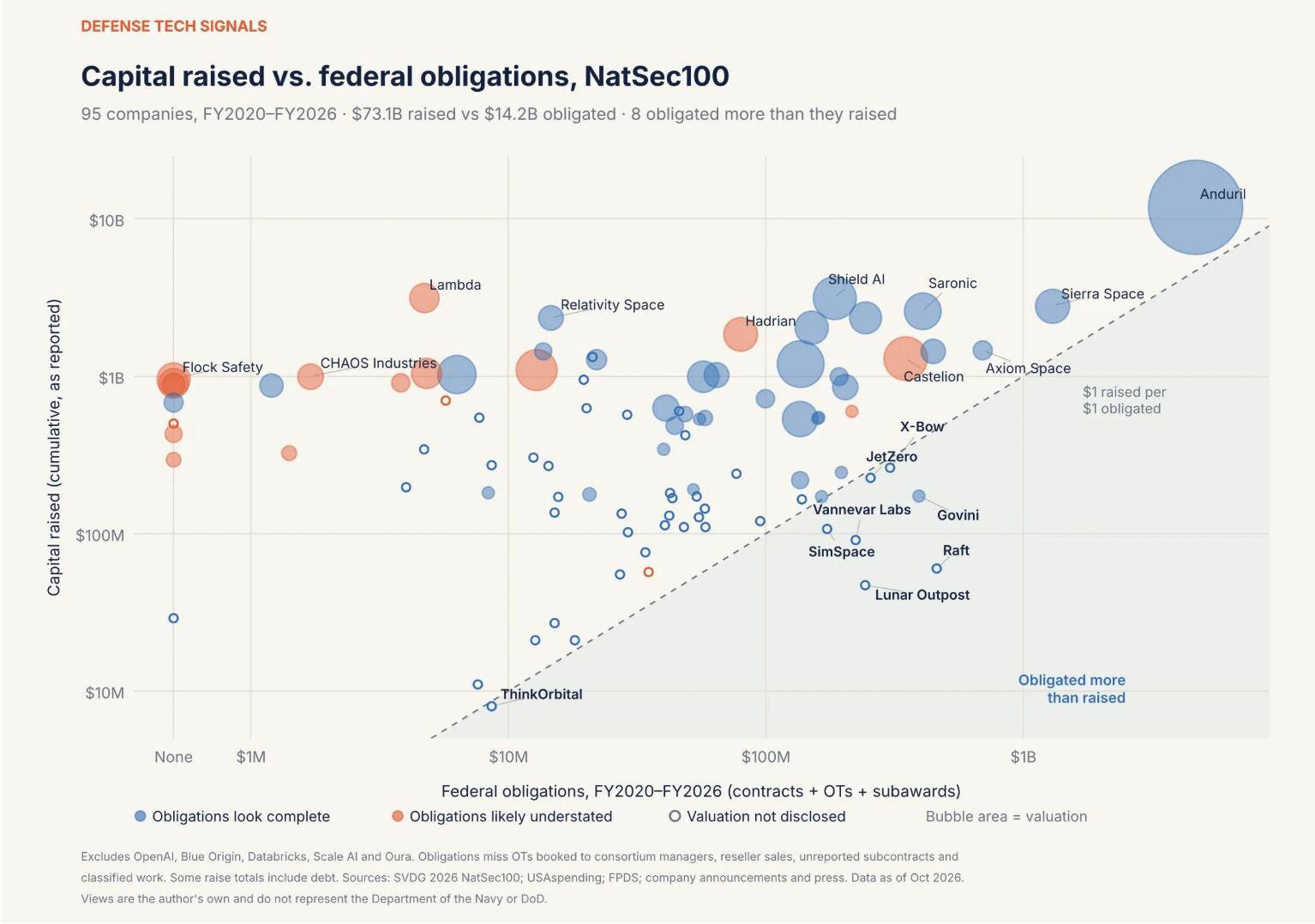
Procurement is the real test. That is the verdict from Hoover’s Dan Berkenstock, Maggie Gray of Shield Capital and Walter Manuel, who tracked federal awards to 882 venture-backed defence companies and found Pentagon R&D to the cohort, excluding SpaceX, Anduril and Palantir, rose from $33M in FY2015 to $1.8B. Procurement hit $859M in only part of FY2026, more than the previous decade combined through FY2024.
The clock is speeding up: the median time to a first $1M in R&D fell from seven years to four to two across three founding cohorts, and to a first $1M in procurement from 10 to six to three.
Of 146 companies founded before 2015, zero cleared $1M of procurement within four years. For the 2021 to 2026 cohort it is five of 178. No cohort clears that bar inside two years, so research money is still the only way in, and the top five firms hold more than half of every cohort’s dollars.
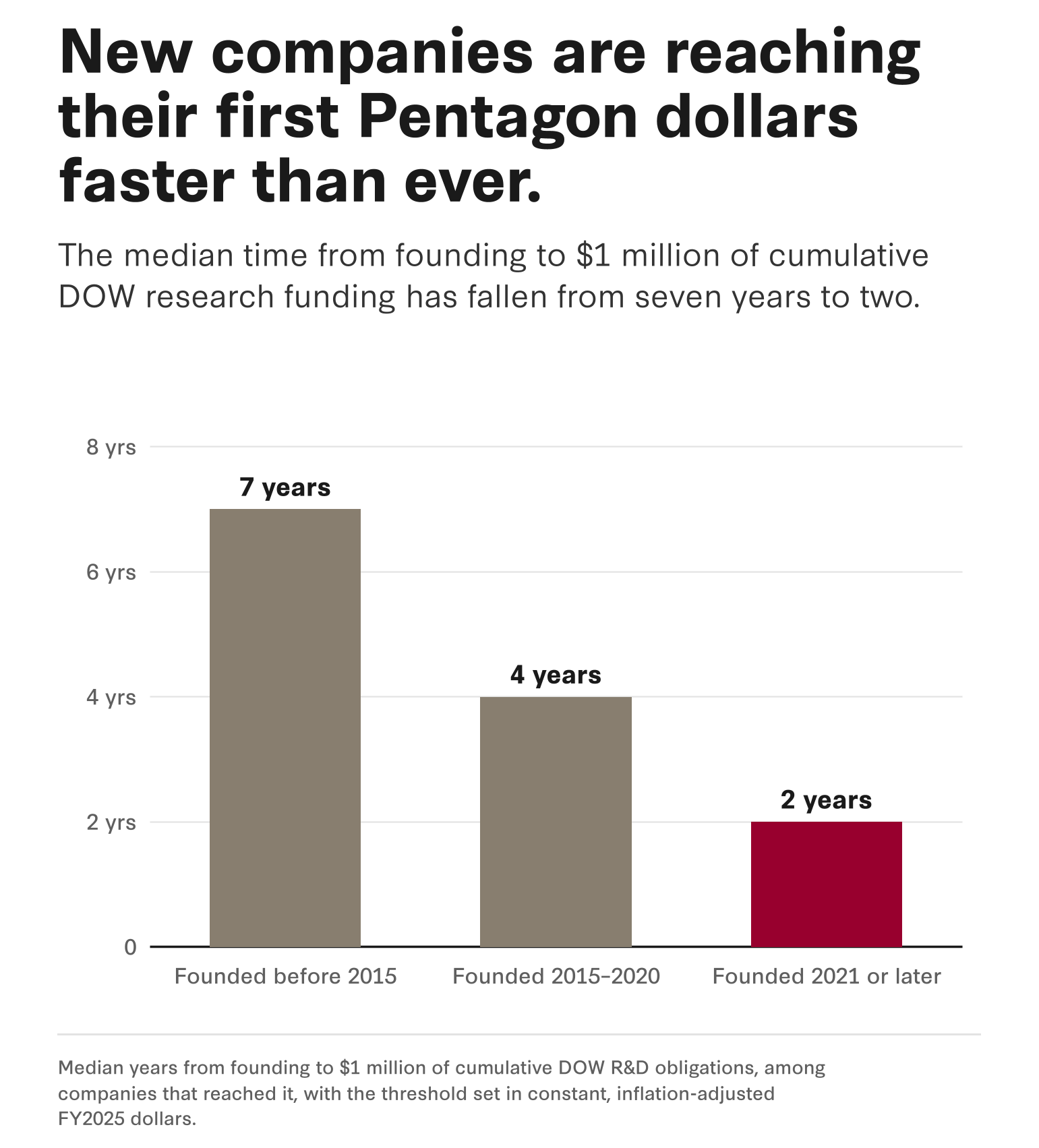
Hoover’s own summary of the paper:
VC into US aerospace and defence went from about $800M in the 2000s to about $80B in the 2020s, yet these firms still collect about 0.6% of Pentagon procurement.
Gray splits the money by technology: space takes 41% ($3.25B) of R&D but less than 10% of procurement, while robotics and autonomy grab 27% ($546M) of procurement, ahead of AI/ML at 12% and munitions at 10%.
Private capital isn’t waiting for the verdict. PitchBook’s Ali Javaheri counts a record $37.9B in Q3 defence tech VC, about one in five venture dollars worldwide, up from one in 14, in a quarter when global VC fell 24%. Strip out Blue Origin’s $10B round and it still rose 60%.
Counter-drone startups raised only $122M across 13 deals while the Army asks for nearly $1B in counter-small-drone procurement for FY2027. Europe is sprinting too: Dealroom forecasts a record $10.5B for European defence startups in 2026, up from $2.6B, calling it “Europe catching up rather than the U.S. slowing,” and Andrea Landabaso lists 27 European startups that raised $10M or more this year, led by Helsing at $1.8B and Quantum Systems at $1.2B.
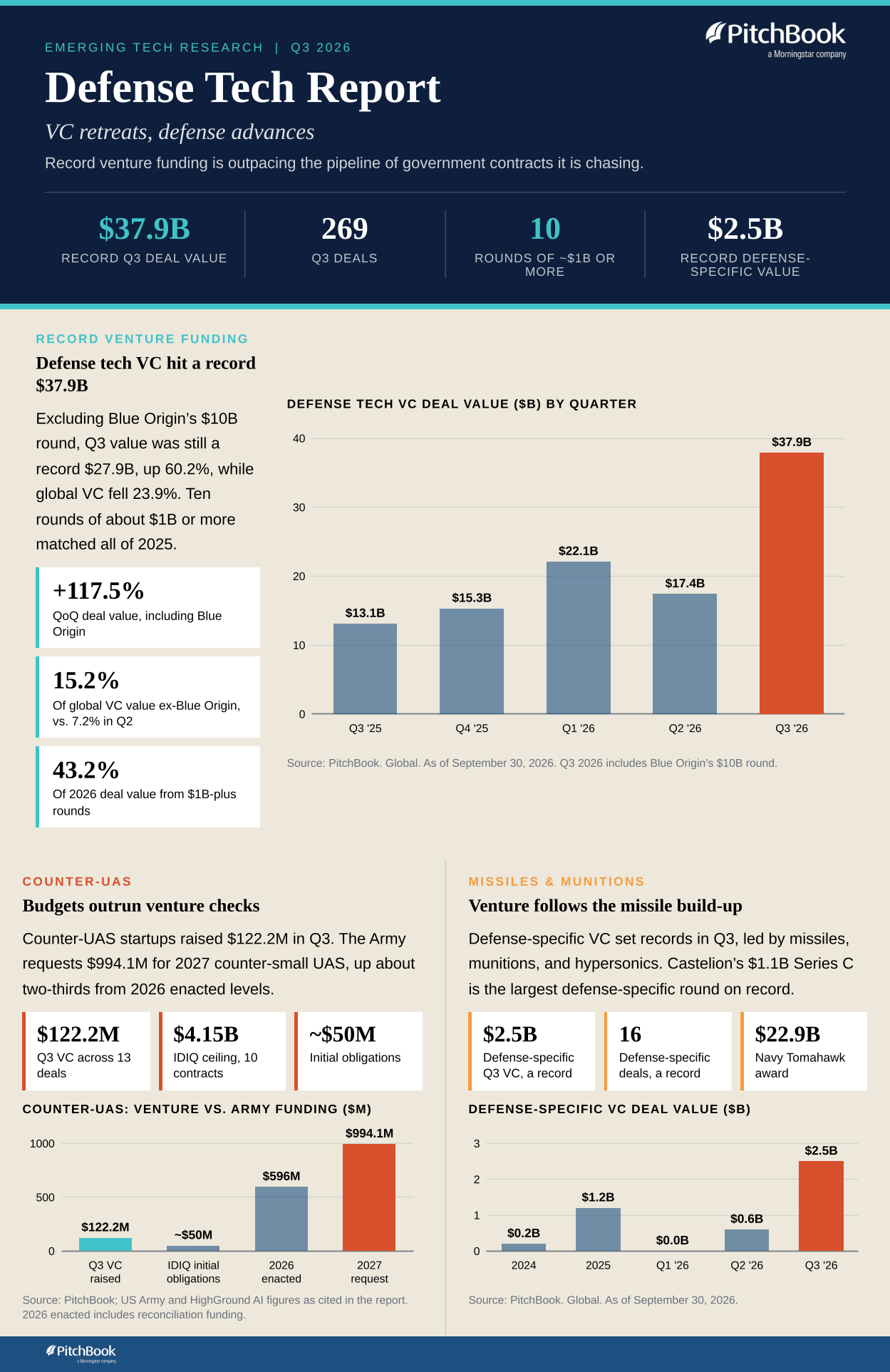
Reality check: Fortune’s Allie Garfinkle hears 2021 all over again, with that $37.9B spread over 269 deals and early-stage rounds priced at 17 to 50 times revenue. Washington Harbour’s Mina Faltas: “I see activity in the capital markets that reminds me of 2021.” Eclipse’s Aidan Madigan-Curtis sees “a pretty big YOLO sentiment” and “a lot of tourist investors,” and Trae Stephens calls mid-stage multiples “completely disconnected from reality.” Scout Ventures’ Brad Harrison, who closed a $125M Fund V in March, is already moving down the stack: “We think the next gains are in minerals, materials, power, and data.”

🍁 Two thousand drones, 243,000 km of coastline. CBC’s Ashley Burke finds the navy watching the world’s longest coastline with about 20 underwater drones, all American-made and used for mine hunting, not surveillance.
Kraken in Newfoundland and Labrador and B.C.’s Cellula Robotics sell to allies, and Cellula’s Guardian, which runs 5,000 km over 45 days, has been bought by five NATO navies. Not ours. The underwater surveillance system is pegged at $250M to $499M, arriving in the early 2030s and fully capable by 2043. VAdm Dan Charlebois: “The products that the navy needs exist here in Canada. We just have to enable ourselves to actually procure them and procure them at pace.”
Rob Huebert calls the old reliance on the Americans a “policy of hope.” The air gap is just as wide. CTV obtained RCAF reports showing a counter-drone system at CFB Trenton was offline for a planned power outage during one September 2025 incursion and “did not detect the drone” five days later. Seven cases at Trenton and Cold Lake in 2024 and 2025, zero interception attempts, zero operators identified, and Cold Lake “does not currently have a means of tracking small UAS aircraft.” Retired LGen Christopher Coates on the grid, the railways and resupply: “they’re all soft, none of them are protected.” AirMatrix’s Bashir Khan counts 601 drone sightings near US airports between April and June.
The Financial Post’s Fortress Canada series walks the floor at Volatus’ new 50,000-square-foot Mirabel plant: a $315M market cap, $34M in 2025 revenue, and a deal for up to 5,000 tactical drones for $25M once its first 100 pass muster, with those first 100 outsourced to a UK company. FPDynamics and Draganfly hold near-identical 5,000-drone awards.
Canadian Defence Review’s William Luxton profiles the same pivot, from ISR contract to sovereign end-to-end uncrewed systems, and Lynch himself argues in the Hill Times that Ottawa now needs a plan for industrial execution, because “the gap between innovation and industrial readiness deserves as much attention as the innovation itself.”
Francois Byrne found his first defence customer in France after years of work and a US intermediary, and wants “a clear route to a defence buyer” at home. Medicine Hat is pitching itself as Drone City next to CFB Suffield’s 2,700 km² range, where former base commander LCol Mike Onieu says “we need to unlock the base for third-party uses.”
Who you answer to. At the DealBook Summit, Palmer Luckey told Andrew Ross Sorkin the West has a warfighting problem: “Nobody in the West actually wants Ukraine to win. They just want them to not lose for as long as possible, which is a bizarre and absurd warfighting position.”
The Guardian breaks down the strike that dropped a span of the Kerch road bridge, the 19 km, $3.6B symbol of Putin’s Crimea, using Ukrainian Neptune and Flamingo FP-5 missiles, Palianytsia rocket drones and Destinus Ruta missiles in a “seventh stage” operation over several weeks.
Emils Paupe-Balodis argues it was flown without Starlink or Starshield, using loitering relay drones and MESH modems for terminal retargeting at around 800 km/h. Canada is building the same exit ramp. CBC’s Murray Brewster reports Dominion Dynamics and Telesat signed a $2.2M deal, backed by the NRC, for rugged Arctic terminals on Telesat’s Lightspeed constellation.

ADVERTISEMENT

Barrack Hill: Navigating Canada’s defence and procurement landscape with precision.
🤝 Deal Corner
🍁 Canada buys into the NATO Innovation Fund for €64.59M (about C$100M). Canada becomes the 25th Ally in the NIF, lifting the fund past €1.1B, with BDC managing the stake. Resilience Media notes the timing, with a fresh NIF-backed defence fund launching in Luxembourg on November 30.
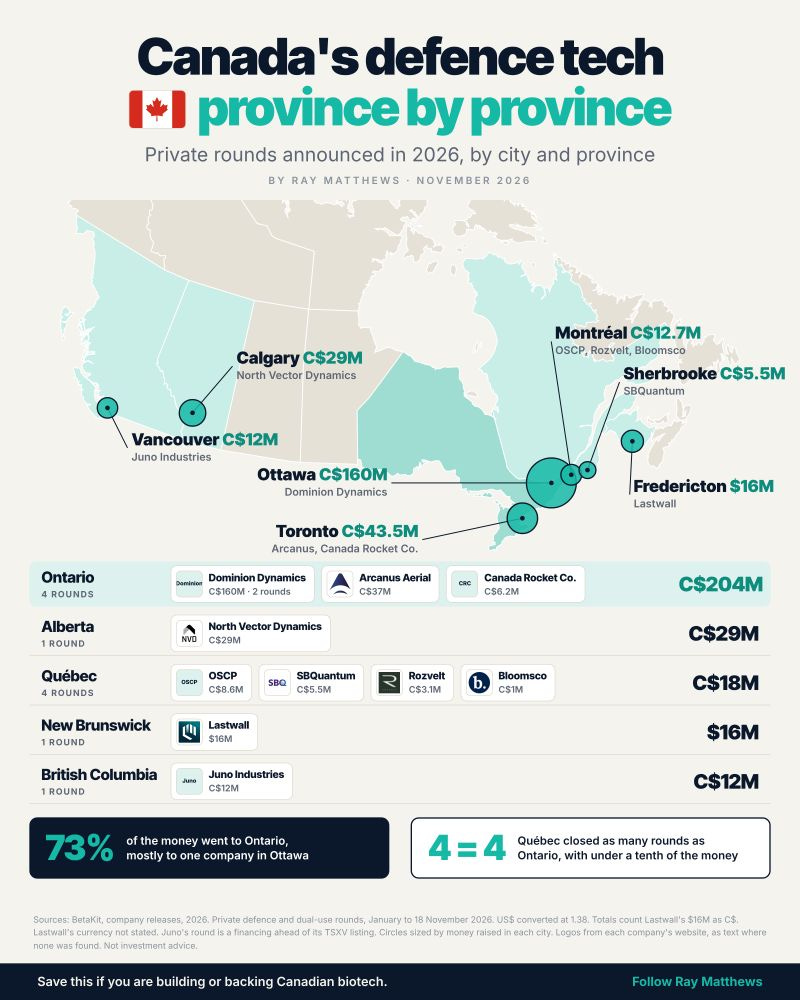
🍁 Dominion Dynamics stacks a $17M navy contract on a 12-company fighter consortium. The Logic has the exclusive on a $17M drone minehunter USV contract, Dominion’s first big federal award after earlier contracts under $43,000. The Globe’s Pippa Norman details the Scout consortium: design by March 2027, five demonstrators in late 2028, first flight in 2029.
Listening under the ice. Dominion says no one knows what Canada's Arctic sounds like underwater, so Project Deep Crown will freeze dozens of Echo buoys into the sea ice starting in late summer 2027.
🍁 North Vector Dynamics raises $29M and opens an Ottawa office. The Calgary counter-drone company closed a Series, and is building a one-metre, three-kilogram, 900 km/h interceptor. It holds a $4.2M four-year DRDC contract.
🍁 Isar Aerospace takes the keys to Canso on a US$112.5M launch deal. SpaceQ traces the deal back to a call from BGen Christopher Horner about 18 months ago: a 10-year contract with Maritime Launch worth US$112.5M (about C$159M) in base fees, a separate 10-year, $200M DND lease for its own pad, and first flight from Nova Scotia in the first half of 2028.
🍁 Hyperion targets $1.6B for Fund II, with Canada in the crosshairs. The Madrid private equity firm named Canadian financier Kevin Reed to its advisory board and plans eight to 12 control platforms at $79M to $314M of equity each. European buyout capital is now hunting Canadian mid-market primes.
🍁 Ukrainian drones, made in Canada. Euromaidan Press reports the Airlogix-Sentinel project to build Ukrainian drones in Canada for Ukraine’s forces, agreed between Ihor Klymenko and NSA David Morrison, plus $40M for a Ukrainian veterans fund and talks on joining the FREYJA anti-ballistic project, with a prototype due by Q2 2027.
🍁 Robotics Centre lands $4.5M for 80 Canadian-built drones. The Ottawa company will build 80 Shuriken drones and ground stations for the Canadian Army at its new Kanata plant under the General Purpose Uncrewed Aircraft System for Light Forces program, with training included and delivery due by March 2027. The frame and electronics are NDAA-compliant and sourced from non-adversary countries, and the order follows $9.5M in federal funding in September, including $5M in BDC debt.

Agon raises $70M to build Europe’s defence AI lab. Northzone led the Series A at a $450M valuation, taking the London and Berlin startup to $100M raised, with the UK Sovereign AI Fund and NSSIF making their first joint investment and Roelof Botha joining. Tectonic’s Erin O’Brien has the pivot from synthetic battle arena to foundation models, less than five months after a $30M seed.
Tiberius becomes a unicorn on an $85M Series A. Lakestar and Rochefort co-led the round at more than $1B post-money for the AI-designed munitions maker, which licenses production to local manufacturers.

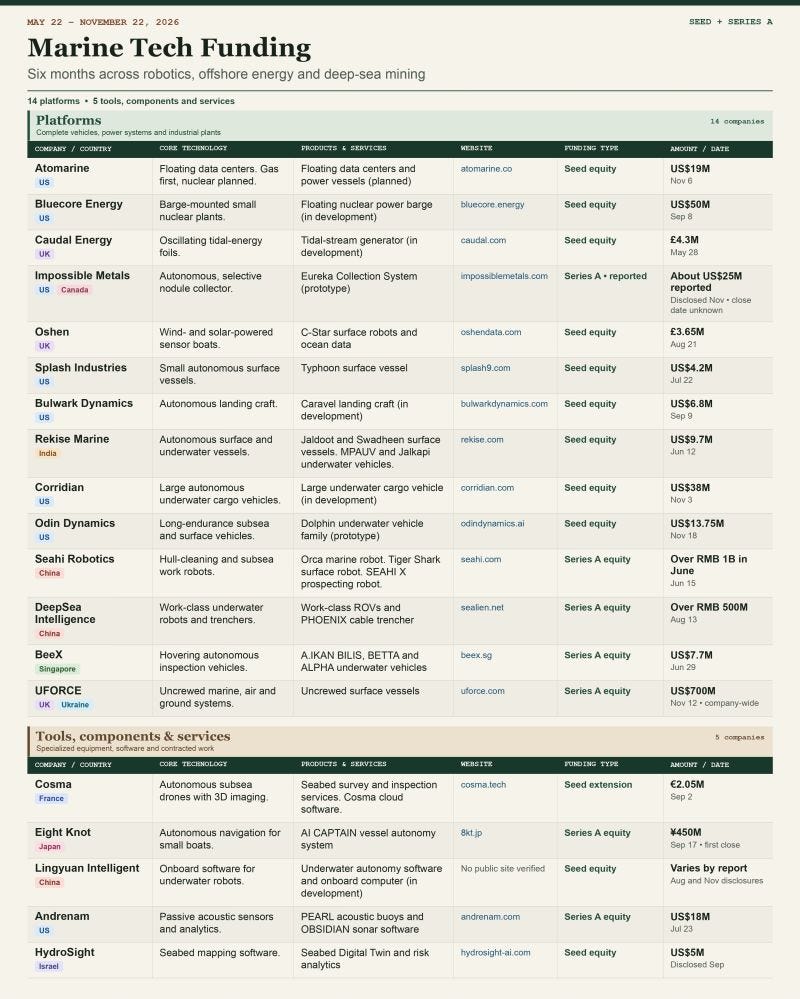
Odin Dynamics surfaces with $17M and a torpedo killer. Freestyle, BlueYard and Sierra led a $13.75M seed for the Dolphin UUV family, already over $20M in contracts in year one and pitched against a roughly $5M Mk 48 torpedo.
Valkryn raises $17M to grade the robots. Andreessen Horowitz led a $15M seed for a neutral auditor of autonomous systems, staffed with Applied Intuition, Palantir and SpaceX alumni.
Helsing loses a £90M navy contract and retreats from Plymouth. Bloomberg reports layoffs at the flagship UK underwater drone site after Helsing missed the Atlantic Net surveillance contract stretching from Greenland to the UK.
Related: Strider’s UK study finds British researchers co-authored more than 8,000 papers with Chinese military-linked institutions since 2020, and Morgan Stanley’s Adam Jonas notes China launched 70% of active warships since 2010, arguing “Agentic AI across proliferated swarms forever changes the capability and architecture of the arsenal” in his robot almanac.
US Army is officially allowing commercial tech firms to test prototypes on military ranges without holding a formal contract.
ADVERTISEMENT

Learn more.
⚔️ Combat Readiness
🍁 Kit for Canada. VAdm Angus Topshee told the defence committee “I am comfortable with the path we’re proceeding down” on six Saab GlobalEye jets built on the Bombardier 6500, despite no 360-degree radar and no air-to-air refuelling.
DND lists four things to know about DRDC, including Gray Jay Pathfinder microsatellites tracking ships and aircraft in the High Arctic.
🍁 Budget math. At the CDA Institute, Steve Saideman picks apart Ottawa’s $700B five-year figure, finding $48.7B reclassified and $7B for Latvia drawn from existing funds: “a large share of the ‘new’ money is not new.” His warning: “There will be less money to get and keep the CAF ready to fight.”

🍁 Arctic overload. The Logic finds the North swamped by DND: $32B for forward operating locations, six parts of the department calling Yellowknife, whose city hall has fewer than 300 staff and an airport with no water or sewer pipes. City manager Stephen Van Dine: “Do we have a coherent game plan? Not so much yet.” The Walrus reminds us how this went last time: Nanisivik has eaten $110.2M and needs another $200M, and the DEW Line cleanup cost $575M.
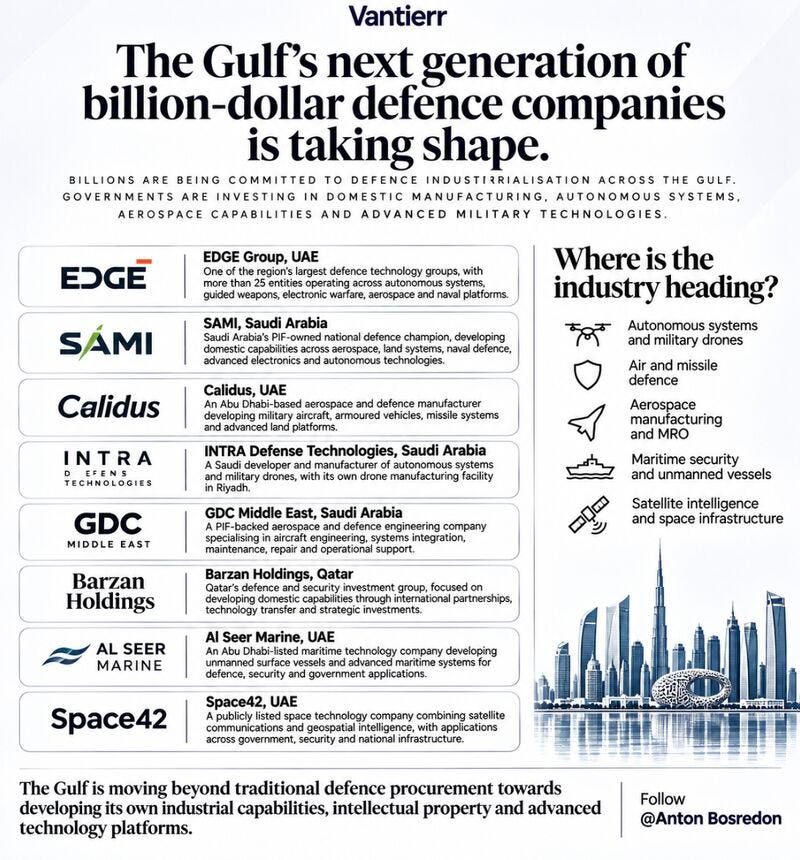
🍁 Heavy water, light supply. The Logic reports Canada no longer makes heavy water, the Candu reactor’s essential ingredient, and NRCan warns “new domestic heavy-water facilities are almost certainly required” if new reactors get built. Energy security is defence infrastructure.
🍁 Axis watch. The NYT details Strider’s finding of about $3.6B in Chinese government money flowing through companies tied to Alice Huang, including firms linked to DF missile and J-20 programs, while Nvidia sought licences for more than 40,000 H200 chips to one of them. Strider CEO Greg Levesque: “Follow the money and, too often, you find the PLA at the end of it.” The WSJ shows how Weichai took Ferretti with a 39.5% stake plus allies each holding under Italy’s 3% disclosure line, together 52% of the vote. Closer to home, the National Post notes Chinese EVs are already barred from European military bases and US land border crossings, and former NSIA Jody Thomas won’t buy one: “it is a computer on wheels.”

The ceiling in Kyiv. The WSJ’s Alistair MacDonald finds Ukraine’s arms boom hitting its limits: more than 1,300 companies, more than seven million drones this year, Neptune output below 1,000. Fire Point CEO Iryna Terekh: “Guys we have money but we have nothing to spend it on.”
Drones eat soldiers. RUSI’s Jack Watling and Robert Tollast estimate a 560-soldier battalion needs about 260 people to run its drones, burning 500 to 700 FPVs a week: “There is no discernible saving in personnel.”
Software Beirut. CNN reports the NSA’s classified NSANet went down after patching broke systems, with DNI Jay Clayton blaming updates that didn’t “come back up.” Nicole Perlroth strings together a week of outages, from Microsoft to the FAA to iCloud, and says mean time to exploit has hit “NEGATIVE SEVEN DAYS.” Google’s threat team saw AI frameworks find and exploit vulnerabilities without a human in the loop for the first time, with monthly zero-days reaching 22 in August, though the tools still “trade stealth for velocity.”

Europe rearms, slowly. Fiona Murray and Ardit Gashi show Germany spending a record €125B this year while the share of orders for novel capabilities fell from 22% to 9%, measured against “money spent,” not “capability delivered.” Britain will demand industrial offsets on foreign contracts above £50M, case by case, after sending £35.2B abroad over 10 years.

Pentagon reform watch. Palantir’s Shyam Sankar and Madeline Hart argue missiles need competition, because “The Pentagon broke the monopoly on space launches a decade ago. Missiles should be next.” Kyle Briggs audits the Office of Strategic Capital: more than $200B in authority, one funded deal (MP Materials at $150M) and 18 conditional commitments worth about $8.9B. His test for 2027 is simple: “If the public record still shows term sheets, the $200 billion headline will mostly measure what Congress authorized, not what OSC built.”

Counter-drone. NATO’s Nikos Loutas says Allies can now sign counter-drone contracts in 24 hours off a fixed-price marketplace, with NATO Engine drawing more than 1,000 manufacturers and 10 banks pledging more than $217B. BAE unveiled a passive radar that rides on TV and radio signals, fits in an SUV and costs up to ten times less than rivals. 🍁 Ottawa’s A.I.RShare ships about 50 non-explosive Overwatch interceptors a week that hit Mach 1.4 and stop drones with “aerodynamically engineered latex spaghetti.”
Interceptor math. Mark Machin, who commanded an engineering platoon on Op HERRICK, argues the interceptor is the cheap part. Of more than 300 Ukrainian interceptor crews reviewed in April, 66 had downed more than ten Shaheds each over the year and 170 had downed none, most of them new units short of training and the radars that cue them. A kill needs five links in order (detect, cue, find, close, destroy), and the same fix buys the most at the weakest one. When jet-powered Shaheds arrived, interception fell to about 60% from more than 90%, and sub-$2,000 interceptors couldn't keep up.
Maritime autonomy. Seasats launched Anduril’s Altius-600M from its Quickfish USV, a 19-foot boat with up to four weeks at sea. CEO Mike Flanigan: “There’s a deterrent value to not knowing what payload a USV is carrying.” Regent is sending a small fleet of Squire seagliders to the Middle East next year, flying below radar at up to 70 knots.
Big think. In The Economist, Kateryna Bondar says armies must break autonomous systems in the lab first: “It is not possible to write sensible rules for a system whose breaking points you have never observed.”
Hybrid war. Estonia says Russia’s GRU ordered an attempted arson at drone maker Threod Systems, with eight suspects detained and production untouched.
Quantum. IQT’s Megan Anderson argues the quantum race is now a deployment race, and the timeline to get ready “is only a couple of years.”

ADVERTISEMENT

Learn more here.
🔫 Hot Shots
🍁 ROAR hackathon. The Icebreaker was proud to be a partner for the ROAR counter-drone hackathon national finals in Ottawa, the culmination of a year-long challenge by Remote Robotic Systems’ Kevin Toderel. The winners: Ottawa’s Ctrl-Alt-Defend took $25k and Calgary’s Team CHuD $11k.

🍁 Born Compliant. Area X.O and TÜV SÜD Ottawa are running a free two-hour testing workshop on EMC, structural and environmental requirements on November 26, hybrid, with a tour of the lab for in-person attendees.
🍁 Dominion is hiring veterans. Dominion Dynamics says field experience becomes a force multiplier in the factory and is recruiting current and former service members to build its products.
🍁 Paint with feelings. Newfoundland’s Copsys built a digital skin that pings a phone when a hull starts to rust, and co-founder Mike Maguire says ordinary cathodic protection leaves a detectable electric signature.
🍁 Training in days, not years. On the Vanguard podcast, Bloomsco’s Hugh McGuire explains how AI turns military manuals into training packages, with a case study from the Canadian Joint Warfare Centre.
🍁 Space on our own terms. On BetaKit’s podcast, Nordspace’s Rahul Goel and Canada Rocket Company’s Hugh Kolias spar over how Canada builds sovereign launch as SpaceX scales back rideshare.
Ranges for rent. AtomsNotBits has the exclusive on REACH, Nico Roe’s plan for a national network of private test ranges, starting with 200 acres in Southern California, because startups wait up to 18 months for government ranges.
🍁 Georgian goes physical. Bloomberg’s Laura Dhillon Kane finds Georgian co-founder Simon Chong betting on a 95-year-old Campbell’s Soup factory in Toronto, where Georgian-backed Xanadu will build quantum hardware. Chong expects the next wave from physical AI embedded in machines, satellites, aircraft and defence systems, the kind of company that is hard to move to San Francisco.
Slush and second thoughts. Sifted reports from Helsinki, where Anthropic’s blockbuster IPO was the talk of Slush, founders predicted imminent superintelligence and investors debated whether the hype had gone too far.
Trade war. The Washington Post reports a classified Hegseth directive restricting the US-Canada defence relationship. A new Pentagon fact sheet grades Canada’s readiness: 41.9% RCAF fleet serviceability, 48% Army readiness, 53.9% for the navy, no airborne early warning and one of four subs seaworthy at any time. It also says Ottawa is deferring its biggest spending increases until after the 2029 election.
Fed up founder. Caseway’s Al Vigier, a CAF veteran and TKMS subcontractor, pulled out of a federal Silicon Valley accelerator and stopped chasing US defence work, pivoting to Taiwan and Europe’s €150B SAFE.
The Icebreaker is written for the people building Canada’s defence technology base. Forward it to someone who needs it.